Understanding Wavebands in Time-Resolved Fluorescence (TRF) Systems
Time-Resolved Fluorescence (TRF) detection is a gold-standard technique widely utilized in high-throughput screening, bio-assays, clinical diagnostics, and molecular spectroscopy. By exploiting the prolonged fluorescence lifetimes of rare-earth lanthanide chelates (such as Europium, TRF introduces a controlled delay between excitation and emission measurement. This temporal gating strategy successfully eliminates short-lived autofluorescence and scattered background noise, delivering exceptionally high Signal-to-Noise Ratios (SNR) and sub-picomolar detection sensitivity.
The optical efficiency of a TRF system depends almost entirely on the spectral purity and out-of-band blocking capabilities of its optical components. Precision bandpass filters and dichroic optics are essential to maximize excitation energy, suppress ambient light, and isolate specific narrowband emissions without signal loss.
Complete TRF Optical Path Solutions: Excitation, Dichroic, and Emission
A high-performance TRF optical layout requires seamless collaboration across three critical wavebands: UV excitation source filtering, beam splitting, and specific emission signal capture.
1. UV Excitation Band (365 nm)
Lanthanide complexes require high-energy, short-wavelength excitation—typically centered around 365 nm. Standard excitation sources often exhibit unwanted broad-spectrum sidebands that leak into the detection channel. Dedicated UV bandpass filters deliver steep edges and high out-of-band rejection to guarantee purely monochromatic excitation.
2. Dichroic Separation Band (45° Incident Angle)
Integrated fluorometers and microplate readers utilize a dichroic beamsplitter positioned at a 45° angle of incidence (AOI) to fold the optical path. It reflects short-wavelength UV excitation light onto the sample while transmitting long-wavelength fluorescence emission to the detector with minimal wavefront distortion.
3. Specific Emission Band (610 nm / 615 nm)
Europium chelates produce sharp, characteristic emission peaks around 610–615 nm. Emission bandpass filters deployed in front of photomultiplier tubes (PMT) or CMOS detectors must feature tight central wavelength tolerances ($\pm2\text{ nm}$) and deep blocking (up to OD6) across the ultraviolet, visible, and near-infrared spectra to eliminate all residual excitation scatter.
Technical Specifications of Mainstream TRF Optical Filters
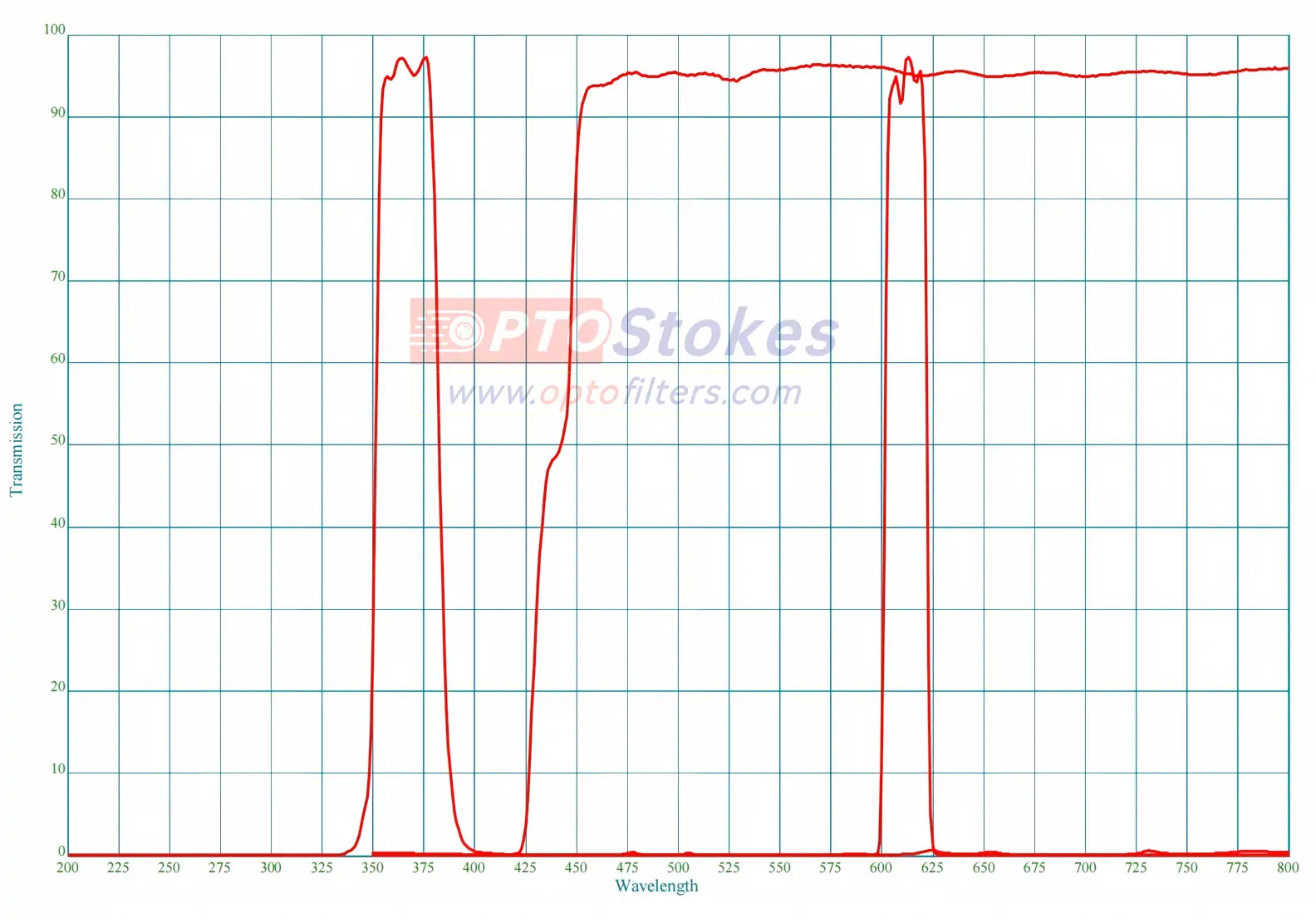
To support both prototype development and mass OEM production, OPTOStokes provides three optimized filter configurations designed for standard Europium TRF optical architectures:
| Filter Model | Filter Type | Center Wavelength / Bandwidth | Peak Transmission / Reflectance | Blocking / Rejection Range | Primary Application |
|---|---|---|---|---|---|
| BP365-30 | UV Excitation Bandpass | CWL: 365 ± 5 nm FWHM: 30 ± 3 nm | Tavg > 90% (355–375 nm) | OD > 3 (200–800 nm) | UV Light Source Purification / Excitation Path |
| Reflective365 Transmission615nm | 45° Dichroic Beamsplitter | AOI: 45° | Ravg > 95% (350–410 nm) Tavg > 95% (460–700 nm) | High Spectral Separation Efficiency | Coaxial Optical Path Separation / Integrated Optics |
| BP610-20 | Emission Narrowband Pass | CWL: 610 ± 2 nm FWHM: 20 ± 2 nm | Tavg > 90% (605–615 nm) | OD > 6 (350–590 nm) OD > 6 (635–800 nm) OD > 3 (800–1050 nm) | Europium Assay Emission Signal Capture |
Engineered for High Precision and System Stability
Compared to standard commercial filters, TRF optical filters produced by OPTOStokes are manufactured using plasma-assisted hard magnetron sputtering technology. This guarantees dense, pinhole-free dielectric thin-film coatings with zero spectral shift over temperature variations and environmental aging.
By pairing high-transmission spectral bands with ultra-deep optical density blocking (up to OD6), our filters effectively lower the detection baseline, preventing stray light leakage from compromising delicate biomedical assays. Whether you are building compact portable diagnostic instruments or high-throughput laboratory analyzers, our optical components ensure precise repeatability across batch production.
Custom Optical Coating and Fast Supply Options
Optical system designers often face trade-offs between lengthy custom coating lead times and off-the-shelf catalog filters that fail to match exact mechanical or spectral requirements. OPTOStokes bridges this gap by offering a dual-track supply model:
Extensive In-Stock Selection: Ready-to-ship inventory of standard TRF filters (including optical filters with standard dimensions like 12.5 mm, 25.4 mm, or custom-cut frames) for rapid prototyping.
OEM Customization Services: Tailored substrate dimensions, custom AOI configurations, specialized custom bandpass profiles, and custom optical coatings designed specifically for proprietary optical engines.
Our mature production lines, stringent spectrophotometric quality checks, and scalable manufacturing ensure predictable lead times and uncompromising quality control from initial engineering samples to volume deliveries.
Accelerate Your Optical System Development
Are high background noise or unoptimized spectral bandpass parameters limiting the sensitivity of your TRF instrument? Contact our optical engineering team today to review your optical path layout, request standard testing samples, or receive a tailored quotation for custom thin-film optical filters.
Email us directly at sales@optofilters.com or submit your specifications online to get dedicated technical support from our engineering staff within 24 hours.