When selecting interference filters, optical engineers often focus heavily on dielectric coating parameters: center wavelength (CWL), full width at half maximum (FWHM), and optical density (OD) blocking depth. However, the substrate material is frequently mischaracterized as a passive mechanical carrier. In high-sensitivity optical systems—such as weak signal fluorescence detection and precision polarimetry—the intrinsic optical, thermal, and mechanical properties of the substrate directly dictate the system’s overall signal-to-noise ratio (SNR) and spectral stability.
An interference filter is a composite optical component comprising a thin-film dielectric stack deposited onto an optical substrate. While dielectric coatings define spectral splitting and attenuation characteristics, the substrate governs transmitted wave-front distortion, autofluorescence background, beam displacement, and thermal endurance. Both elements are equally crucial to optomechanical system performance.
Engineering Evaluation of Key Optical Substrate Materials
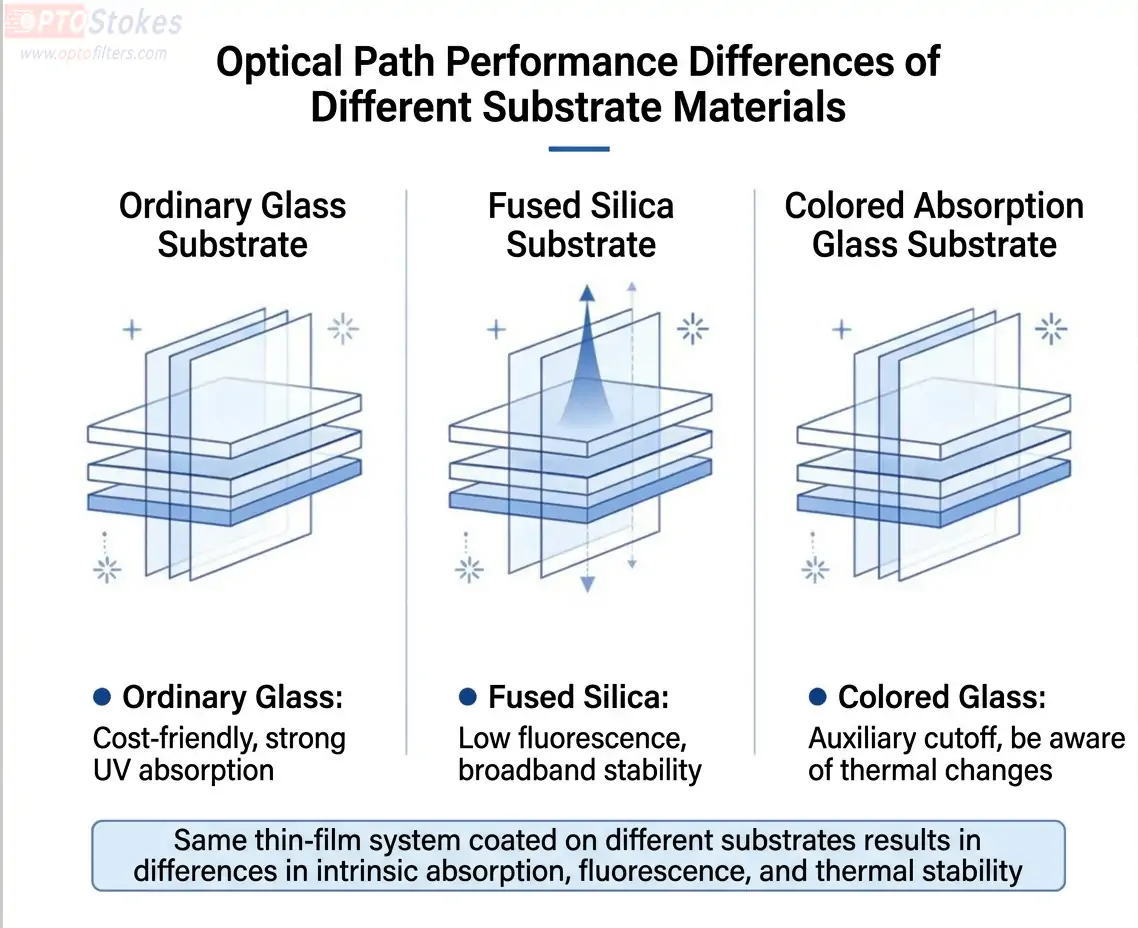
Selecting the optimal substrate material requires balancing spectral transmittance, thermal expansion coefficients, intrinsic fluorescence, and production costs. The three most common substrate categories display distinct engineering trade-offs:
| Substrate Category | Key Advantages | Engineering Limitations | Primary Applications |
|---|---|---|---|
| Optical Float Glass (Standard K9 / N-BK7) | Cost-effective, excellent surface quality, suitable for high-volume manufacturing. | High UV attenuation, higher thermal expansion coefficient, potential intrinsic autofluorescence. | Standard visible light inspection, industrial imaging, general optical setups. |
| Fused Silica (Synthetic Quartz) | Broadband transmittance (UV to NIR), ultra-low autofluorescence, exceptional thermal stability. | Higher material cost, specialized polishing requirements. | Fluorescence Filter Sets, UV spectroscopy, high-power laser optics. |
| Colored Absorption Glass | Built-in absorption edge, works synergistically with dielectric films for deep broadband rejection. | Temperature-dependent absorption edge shift; risk of thermal lensing under high irradiance. | Auxiliary deep blocking filters, order-sorting filters, ambient light suppression. |
1. Optical Float Glass (Standard K9 / N-BK7)
Optical float glass and crown glass variants like K9 serve as standard, cost-effective solutions for general optical instrumentation. They offer high mechanical durability and excellent surface polishability. However, standard optical glass exhibits noticeable absorption in the ultraviolet (UV) spectrum and possesses intrinsic fluorescence that can saturate sensitive optical detectors. Furthermore, its higher coefficient of thermal expansion makes it susceptible to thermal stress under temperature variations.
2. High-Purity Fused Silica
Fused silica provides high optical transmission spanning from the deep ultraviolet (DUV) through the near-infrared (NIR) spectrum. Characterized by negligible intrinsic autofluorescence and an extremely low thermal expansion coefficient, high-purity fused silica is the industry standard substrate for quantitative fluorescence analysis, qPCR optical systems, laser optics, and demanding outdoor sensor applications. High-precision Precision Optical Flats crafted from fused silica ensure minimal wavefront distortion across severe thermal gradients.
3. Colored Absorption Glass Substrates
Colored optical glass utilizes ion-doped glass matrices to absorb specific wavebands. When paired with thin-film interference coatings, colored glass substrates assist in achieving extreme out-of-band rejection (OD6 or higher). However, optical designers must account for thermal absorption drift: as operating temperatures increase, the spectral band-edge of colored glass shifts toward longer wavelengths, potentially altering system calibration in harsh operating environments.
Three Common Optical System Failures Caused by Substrates
1. Substrate Autofluorescence (Baseline Elevation)
Under excitation illumination, low-grade optical substrates absorb short-wavelength light and re-emit broad-spectrum fluorescence. This parasitic emission elevates the noise floor, directly degrading signal clarity. In quantitative fluorescence spectroscopy or low-concentration bio-detection systems, engineers frequently misdiagnose elevated baseline noise as a coating leak, when the true culprit is substrate autofluorescence.
2. Ghost Reflections and Stray Light Interference
Uncoated or inadequately anti-reflection coated substrate surfaces produce secondary parasitic reflections. These ghost reflections create optical crosstalk, beam displacement, and signal fluctuation at the sensor plane. The risk is magnified in thin substrate configurations. Utilizing optimized AR Coated Windows or wedge substrates effectively mitigates internal parasitic reflections and stabilizes system readouts.
3. Stress-Induced Birefringence
Mechanical stress introduced during substrate grinding, polishing, or aggressive optomechanical mounting generates residual internal stress. This stress induces optical anisotropy (birefringence), altering the polarization state of transmitted light. In polarization-sensitive instruments or oblique angle-of-incidence (AOI) setups, stress-induced birefringence causes polarization-dependent loss (PDL) and unpredictable transmission ripples.
Engineering Guidelines for Substrate Selection
To optimize optical performance and avoid costly redesigns, consider these practical selection rules during the initial design phase:
1. Prioritize Fused Silica for UV and Low-Signal Applications: Always specify high-purity fused silica substrates for ultraviolet, fluorescence, or single-photon detection systems to eliminate autofluorescence interference.
2. Control Mechanical Stress in Polarization-Sensitive Optical Paths: Choose low-stress annealed substrates for polarization-critical instruments. Ensure optomechanical housings contact only the clear aperture periphery using controlled torque or compliant mounting rings.
3. Factor Thermal Drift into Colored Glass Specifications: When using colored absorption glass for auxiliary blocking, evaluate environmental operating temperatures and avoid relying solely on ambient room-temperature transmission curves.
4. Define Substrate Specifications explicitly during RFQ: Never accept unverified "supplier default" glass. Explicitly specify substrate material grade, surface flatness (e.g., λ/10), parallelism, and scratch-dig standards at the drawing release stage.
Partnering with OPTOStokes for Reliable Optical Components
At OPTOStokes, we recognize that superior optical filter performance relies equally on substrate integrity and coating precision. Whether you require standard off-the-shelf components for prototyping or fully customized thin-film optical filters engineered for demanding OEM integration, OPTOStokes delivers world-class manufacturing, predictable lead times, and rigorous quality control.
Our extensive inventory of in-stock optical components supports rapid prototyping, while our custom coating and substrate fabrication lines cater to custom dimensions, tight wave-front tolerances, and specialized spectral specifications. Contact our engineering team at sales@optofilters.com to receive expert technical support, request detailed spectral data, or obtain a competitive quotation for your next project.