
Optimizing Dual-Channel Fluorescence Detection in Compact PCR Systems
As point-of-care testing (POCT) and micro-molecular diagnostic platforms evolve toward miniaturization, single-channel fluorescence optics are increasingly hitting throughput bottlenecks. Incorporating an internal control—such as pairing FAM (excitation/emission standard around 520 nm) with ROX (standard around 630 nm)—is vital for accurate signal baseline normalization and false-negative prevention. However, scaling up to multi-channel optical engines traditionally requires re-engineering mechanical mounts or expanding device dimensions.
To upgrade existing single-channel architectures to dual-channel capacity without mechanical structural redesign, OPTOSTOKES provides two distinct high-performance optical designs for micro-PCR and portable optical modules.
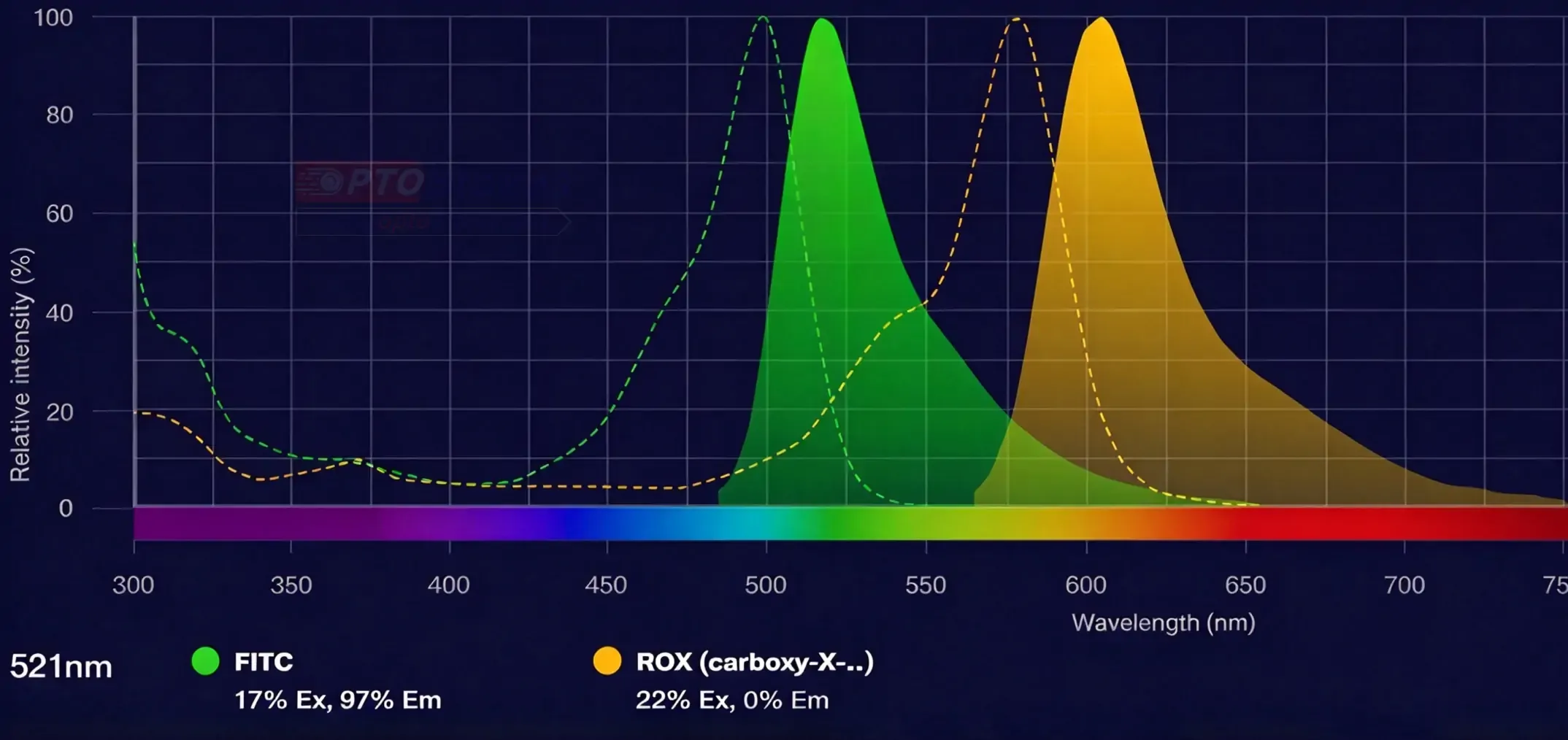
Approach 1: Single-Substrate Dual-Bandpass Filters
The single-substrate dual-bandpass filter features thin-film interference coatings deposited on a single optical substrate, designed with precise transmission windows tailored for dual fluorescence peaks (e.g., 520 nm and 630 nm).
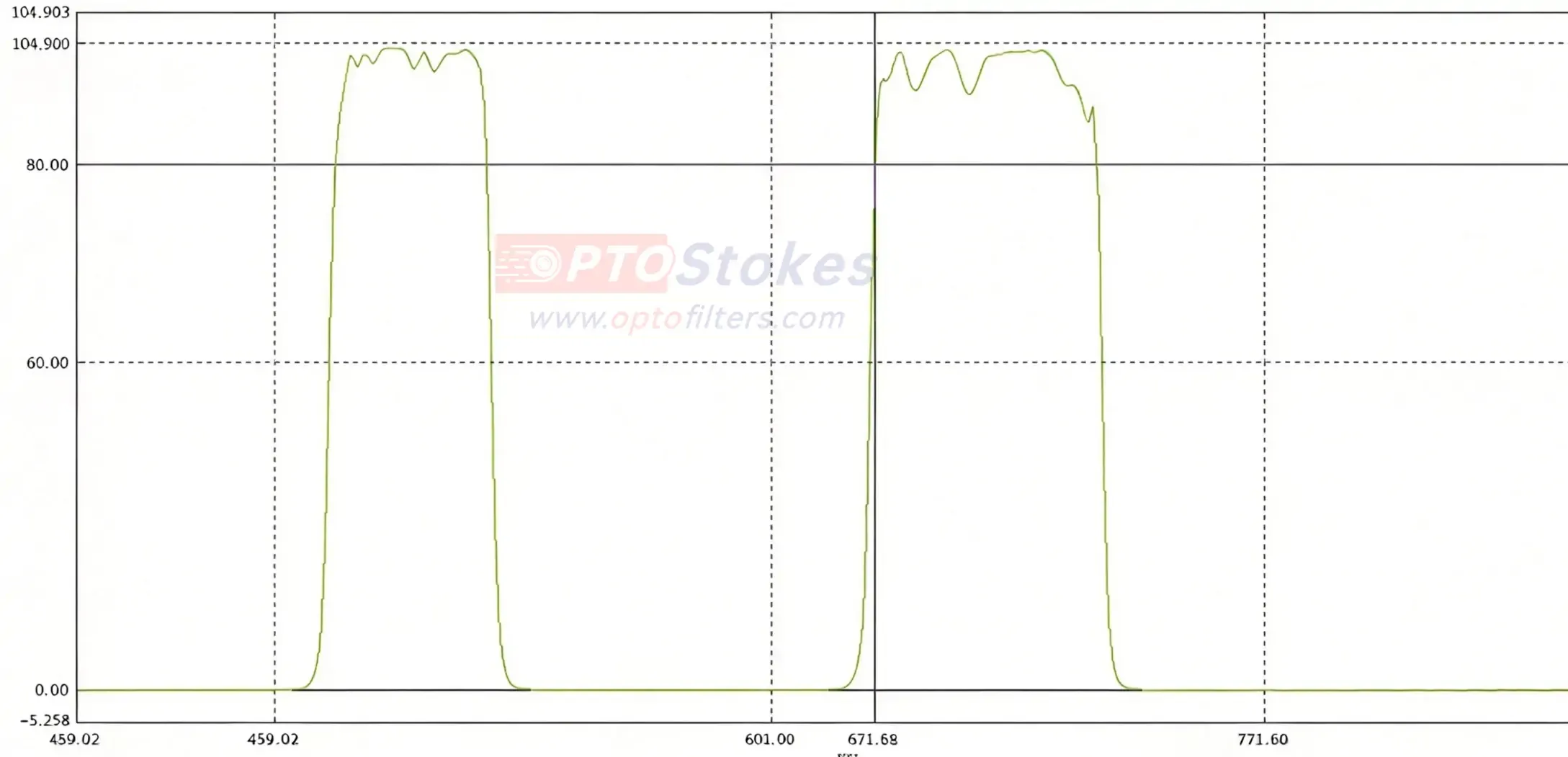
Technical Advantages
By eliminating physical seams, this design ensures high spectral isolation, zero mechanical vignetting, and uniform light throughput across both emission bands. It simplifies the optical alignment process and is ideal for space-constrained POCT cartridges where mechanical stability and optical integrity are critical.
Design Considerations
Achieving deep out-of-band blocking (OD6 or higher) alongside steep transition edges on a single substrate involves complex dielectric layer stacks, making accurate fabrication essential for cross-talk suppression.
Approach 2: Precision Spliced Dual-Filter Arrays
To address non-standard wavelength combinations or budget constraints associated with complex dual-band depositions, OPTOSTOKES offers high-precision spliced dual-filter arrays (Bifilter Assemblies). This approach joins two optimized single-bandpass filters side-by-side within a unified mechanical footprint.
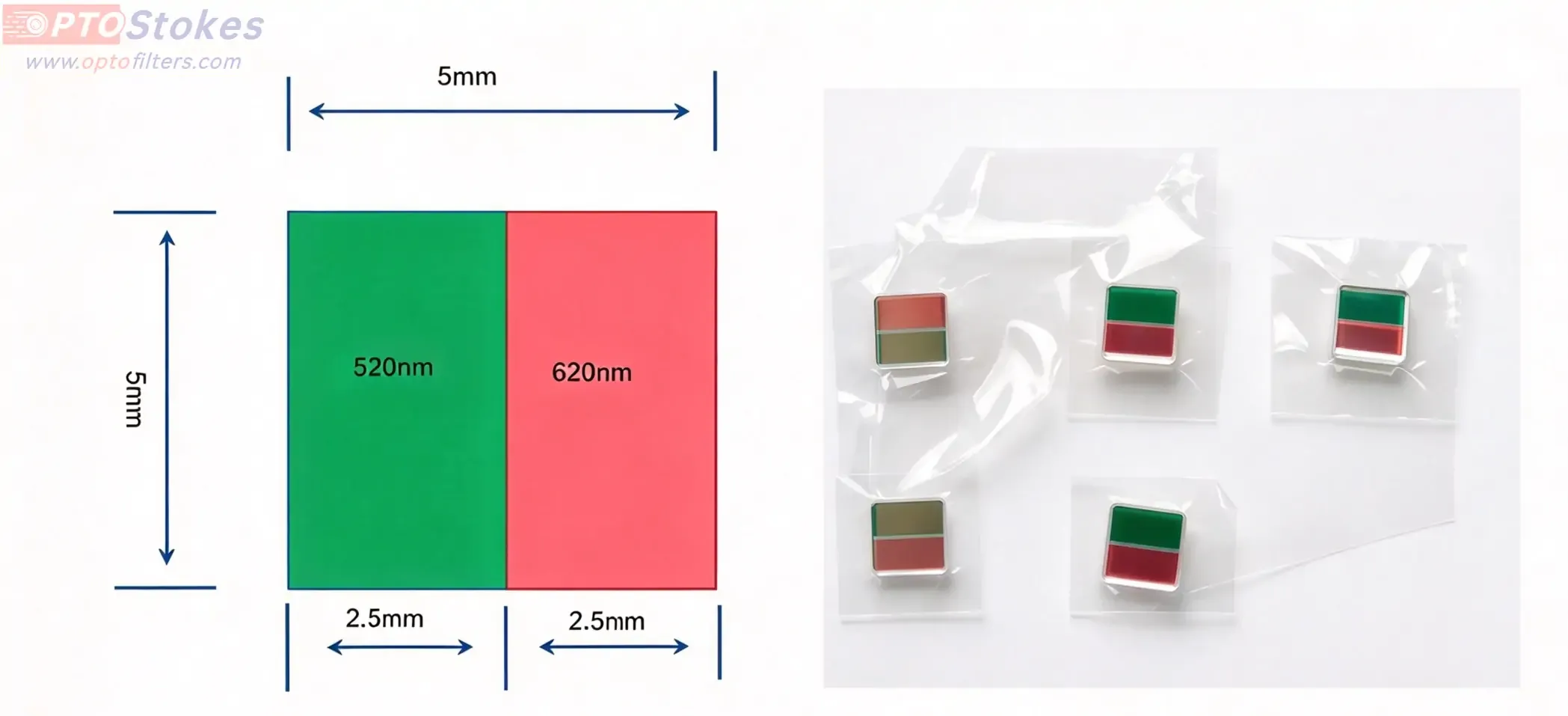
Technical Advantages
Spliced arrays offer maximum flexibility for rapid prototyping and custom optical channel pairing. Utilizing established high-volume single-band substrates helps lower initial tooling costs while allowing engineers to fine-tune transmission bands independently.
Design Considerations
Splicing reduces the effective aperture area per channel by half and introduces a physical boundary seam. To prevent unwanted light scattering at the boundary, precise edge polishing and optical masking techniques are applied. The small signal loss caused by the halved aperture can be compensated by adjusting photo-detector gain or optimizing signal-processing algorithms.
Engineering Comparison Matrix
| Optical Architecture | Spectral Flexibility | Optical Aperture Area | Manufacturing Complexity | Ideal Application |
|---|---|---|---|---|
| Single-Substrate Dual-Bandpass | Pre-defined fixed wavelengths | 100% full clear aperture | High (Complex thin-film stack) | High-precision, high-volume mini PCR systems |
| Precision Spliced Array | Fully customizable wavelengths | 50% per channel (Divided) | Moderate (Precision alignment & assembly) | Rapid prototyping, flexible assay conversion |
Partner with OPTOSTOKES for Custom Fluorescence Optics
Whether you require standard optical bandpass filters or tailored multi-band interference coatings, OPTOSTOKES supports every stage of product development—from rapid turn-around prototyping to high-volume commercial production with guaranteed lead times and tight quality tolerances.
Contact our engineering team at sales@optofilters.com to discuss custom OEM optical specs, request testing samples, or receive a tailored quotation for your diagnostic platform.