Understanding Optical Flat Substrates: The Unsung Hero of High-SNR Systems
In optical system design, selection often hyper-focuses on thin-film coating parameters—such as Center Wavelength (CWL), Full Width at Half Maximum (FWHM), and Out-of-Band Blocking depth. Substrates are frequently dismissed as mere physical carriers. However, in low-light fluorescence detection, Raman spectroscopy, and precision metrology, the underlying optical flat substrate directly dictates system performance. Substrate-induced reflections, autofluorescence, and stress birefringence can severely degrade the Signal-to-Noise Ratio (SNR).
An interference filter comprises an optical substrate and multi-layer dielectric coatings. While the coating specifies spectral performance, the substrate determines mechanical, thermal, and intrinsic optical behaviors. Both are equally critical to final optical instrument performance.
Engineering Performance: Substrate Material Comparison
Selecting the correct substrate material requires balancing spectral range, thermal environment, and cost targets. Below is an engineering overview of common optical flat materials:
| Substrate Material | Key Advantages | Engineering Limitations | Primary Applications |
|---|---|---|---|
| N-BK7 / Optical Float Glass | Cost-effective, excellent visible transmission, widely available . | High UV absorption, intrinsic autofluorescence, higher thermal expansion coefficient. | General visible light imaging, standard industrial inspection, non-fluorescent optical systems. |
| UV Fused Silica | Broadband UV-to-NIR transmission, extremely low autofluorescence, superior thermal stability. | Higher raw material cost, increased fabrication and polishing complexity. | Fluorescence quantification, UV laser optics, high-precision interferometry, Raman systems. |
| Color Absorptive Glass | Inherent absorption capability, complements dielectric coatings for deep blocking. | Temperature-dependent absorption edge drift under thermal variation. | Acousto-optic devices, order sorting filters, ambient noise suppression setup. |
Three Easily Misdiagnosed Substrate-Induced Failures
1. Substrate Autofluorescence
When high-energy excitation light passes through improper substrate glass, intrinsic impurities emit background fluorescence. This raises the baseline signal and masks weak fluorescence emission. Engineers often spend significant effort troubleshooting dielectric coatings, only to discover the noise originates entirely within the substrate matrix.
2. Parasitic Internal Reflections
Uncoated or poorly matched parallel substrate surfaces introduce parasitic secondary reflections. These ghost images and stray light cause signal instability and phase distortion. Applying anti-reflective (AR) coatings or utilizing precision wedge optical flats resolves stray light issues.
3. Stress Birefringence
Mechanical stress introduced during glass annealing, cutting, or rigid mounting induces stress birefringence. Under oblique angles of incidence (AOI) or within polarization-sensitive optical paths, birefringence shifts the polarization state and causes throughput fluctuations.
Engineering Best Practices for Substrate Selection
To ensure optimal system performance during early-stage prototyping, follow these guidelines:
• UV & Low-Light Systems: Always specify UV Fused Silica substrates to eliminate baseline autofluorescence.
• Polarization-Sensitive Paths: Select low-stress optical flats and avoid rigid mechanical clamping; use stress-free edge mounting techniques.
• Thermal Drift Management: Account for thermal absorption shift when pairing color glass substrates in fluctuating ambient environments.
• Define Specifications Early: Avoid reliance on generic default glass; explicitly define substrate polished flat tolerances ($\lambda/10$ or better) during design.
OPTOStokes 532nm Ultra-Narrow Bandpass Filter Series
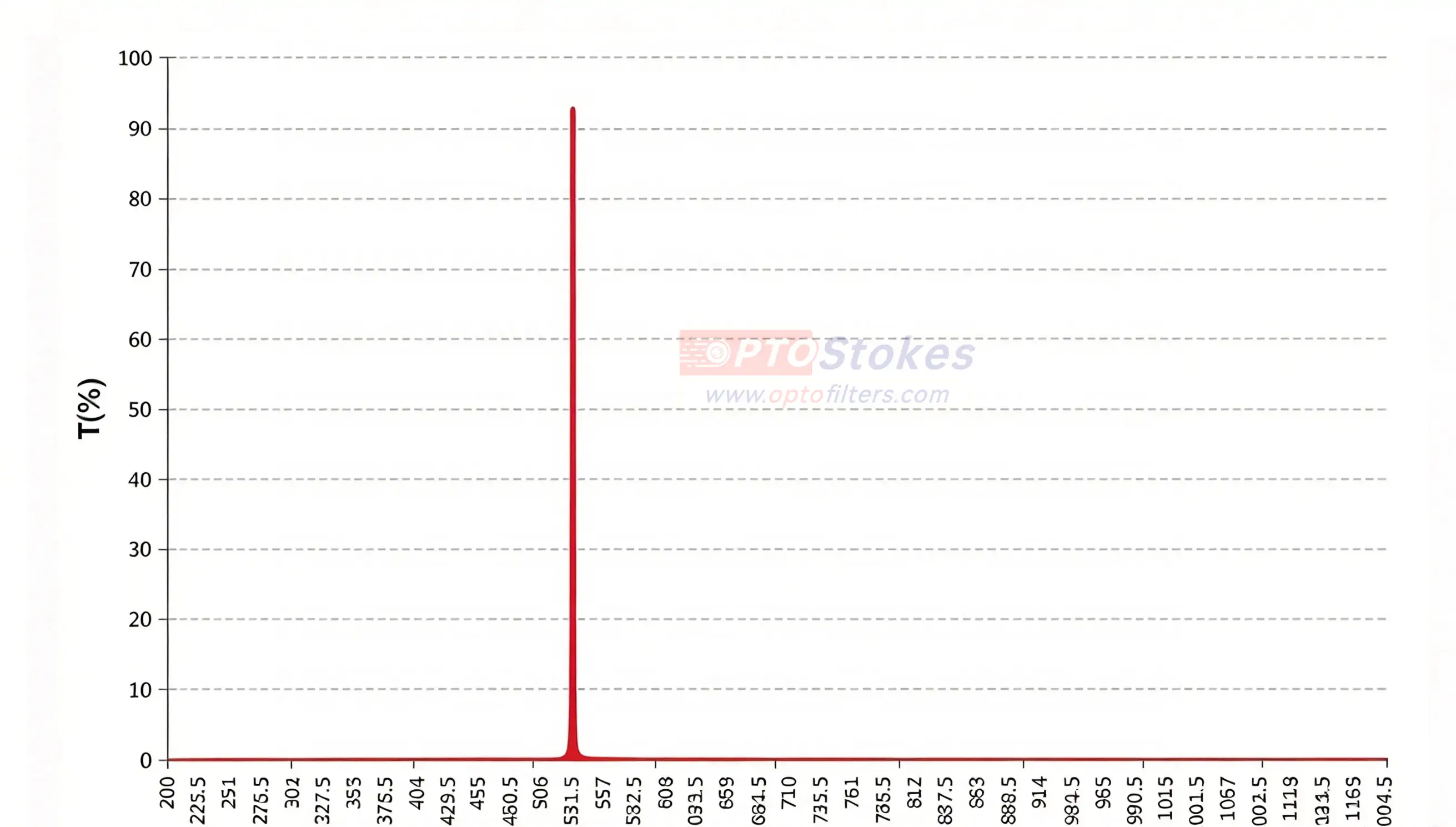
To meet demanding requirements in low-light spectroscopy and precise 532nm laser-line extraction, OPTOStokes has developed a high-performance 1nm ultra-narrow bandpass filter. Manufactured via dense hard-coating Electron-Beam Evaporation with Ion-Assisted Deposition (IAD), this filter guarantees zero spectral drift and ultra-high environmental durability.
Featuring a peak transmittance exceeding 92% and an out-of-band blocking depth of OD5 (200–1200 nm), this series delivers exceptional SNR for high-sensitivity detection instruments.
Technical Specifications (0° Angle of Incidence)
| Parameter | Specification / Standard Tolerance |
|---|---|
| Center Wavelength (CWL) | 532.18 ± 0.5 nm |
| Full Width at Half Maximum (FWHM) | 1.13 ± 0.5 nm |
| Peak Transmittance (T) | > 92.05% |
| Out-of-Band Blocking | OD5 (Optical Density 5.0) @ 200–1200 nm |
| Coating Technology | Hard Dielectric Film via IAD E-Beam Evaporation |
| Standard Dimensions | Dia25.4 x 1.1 mm / Dia25.4 x 2.0 mm (Custom sizes available) |
Seamless Prototyping to Volume Production with OPTOStokes
Whether your optical assembly requires immediate off-the-shelf optical components for rapid testing or custom-designed substrates with specific thermal expansion, thickness, and clear aperture requirements, OPTOStokes offers complete design-to-production flexibility.
Our robust manufacturing facility maintains extensive off-the-shelf inventory with guaranteed, predictable lead times for custom OEM batches. Our optical engineering team is available to review your optomechanical drawings, analyze substrate interference risks, and deliver optimized component recommendations.
Need specialized filter dimensions, custom substrates, or volume pricing?
Contact our technical sales team directly at sales@optofilters.com or submit your inquiry through our web form to receive an engineering response within 24 hours.