Overcoming Thin-Film Degradation in Precision Optical Systems
In optical instrument manufacturing, prototype testing often yields excellent baseline performance and high signal-to-noise ratios. However, after 6 to 12 months of continuous field operation, system performance may decline. Engineers frequently observe reduced sensitivity, baseline drift, and elevated background noise. When electronic circuits, light sources, and processing algorithms are eliminated as root causes, the failure mechanism typically traces back to a single component: thin-film degradation in the optical filter under prolonged radiation and thermal stress.
The Physics of Thin-Film Aging in Interference Filters
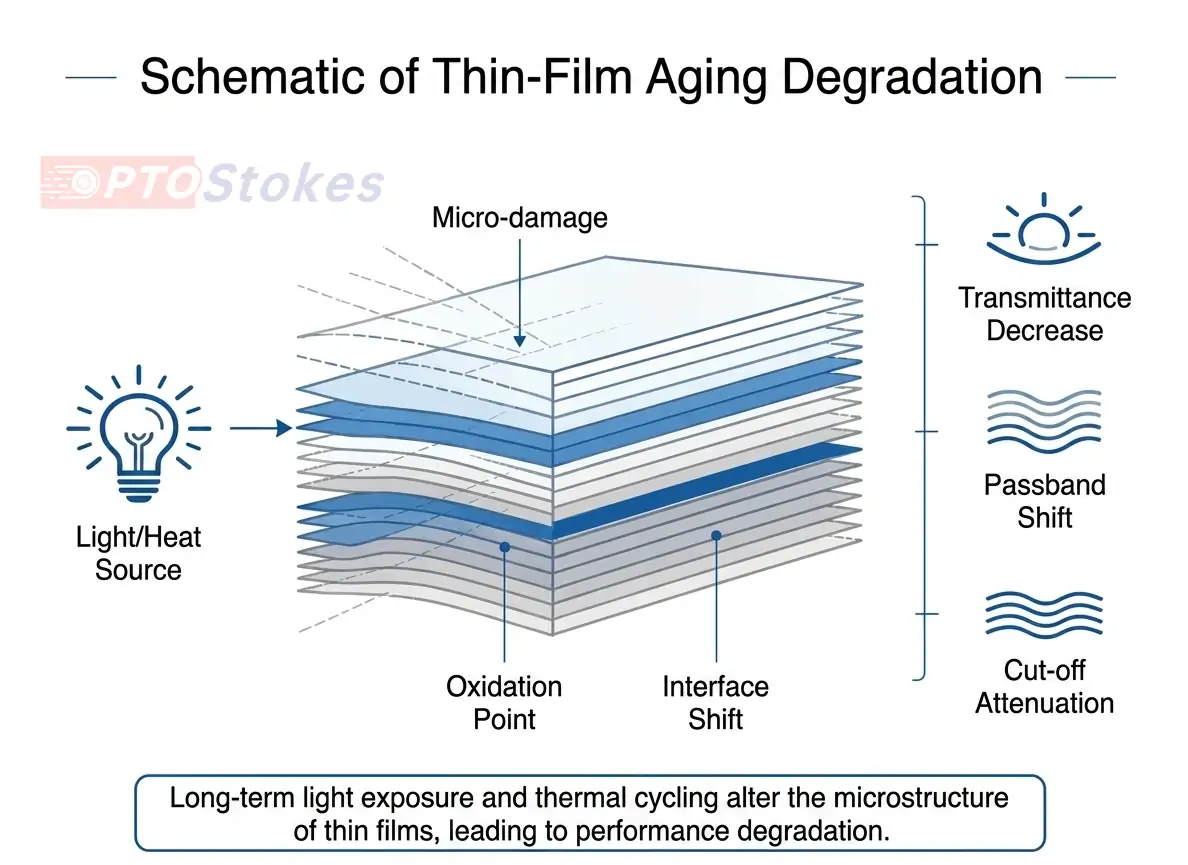
Precision interference filters consist of dozens to hundreds of alternating nanometer-scale dielectric layers. Continuous exposure to high-energy light (UV or high-power lasers), thermal cycling, and ambient humidity induces subtle physical and chemical alterations in these nanostructures. The primary microstructural changes include reduced packing density, refractive index modification, and interfacial micro-oxidation.
These structural shifts manifest as three critical optical degradation modes:
Peak Transmittance Decay: Micro-void absorption and interface scatter gradually attenuate peak light throughput.
Central Wavelength (CWL) & Passband Drift: Moisture absorption into porous layers alters the effective refractive index, causing spectral shifts away from target emission lines.
Out-of-Band Blocking Failure: Degradation of blocking layers allows stray light leakage, severely degrading signal integrity and baseline stability.
Engineered Solutions for Long-Term Coating Reliability
Conventional low-cost optical filters produced via high-rate, unassisted evaporation yield porous, low-density microstructures. While economically attractive initially, these coatings exhibit high susceptibility to environmental aging. Achieving multi-year stability requires advanced thin-film engineering at the deposition level.
| Performance Metric | Standard Evaporated Coatings | OPTOStokes High-Density Coatings |
|---|---|---|
| Packing Density | Low (< 0.90), porous structure | High (> 0.99), stoichiometric density |
| Moisture Sensitivity | High (spectral drift upon humidity exposure) | Zero shift (hermetically stable) |
| UV/Laser Resistance | Rapid micro-damage and solarization | Optimized radiation-hardened oxides |
| Thermal Drift Rate | > 0.01 nm/°C | < 0.002 nm/°C |
1. Densification via Energetic Deposition Processes
Utilizing Plasma-Assisted Chemical Vapor Deposition (PACVD) or Ion-Assisted Deposition (IAD) ensures precise control over adatom kinetic energy. This yields ultra-dense nanostructures with minimal void fractions, mitigating thermal expansion and structural relaxation.
2. Surface Environmental Passivation
Applying thin hydrophobic and anti-oxidation barrier layers seals surface grain boundaries against ambient moisture intrusion, preserving the spectral integrity of bandpass filters across wide operating temperatures.
3. Radiation-Hardened Material Stacks
For UV and high-fluence laser applications, material stacks are selected based on high bandgap energies and threshold damage limits (LIDT), slowing down photo-induced defect formation.
Sustaining Instrument Longevity with OPTOStokes
The true competitive value of precision optical equipment lies not merely in initial calibration accuracy, but in long-term field stability. Unplanned spectral drift leads to costly field service calls, frequent recalibrations, and compromised brand reputation.
At OPTOStokes, we address long-term reliability through robust manufacturing processes, stringent environmental testing, and flexible delivery options. Whether you need an off-the-shelf component from our extensive in-stock selection or a fully custom optical filter engineered for harsh radiation environments, our engineering team ensures predictable lead times and uncompromising quality.
For technical consultations, custom coating design inquiries, or sample requests, contact our engineering specialists at sales@optofilters.com.