Narrowband interference bandpass filters serve as core spectral separation components in precision optical systems, including fluorescence detection, high-precision spectrometry, and laser detection. Their high transmission, deep blocking, and narrow bandwidth make them the preferred choice for demanding optical path designs.
However, many R&D teams encounter a consistent debugging challenge: filters that meet performance specifications under standard normal-incidence test conditions often show degraded performance once installed in full systems with even minor tilt angles. Common issues include reduced signal strength, elevated baseline noise, and unstable detection performance.
This widespread issue stems from the inherent angle-dependent blue shift property of interference thin-film filters — a critical engineering detail often overlooked during optical path design and component selection.
What Is Filter Blue Shift? Core Causes Explained
Physics of Interference Filter Wavelength Shift
Narrowband interference filters achieve spectral selection through the optical interference effect of multi-layer dielectric thin films. All coating designs are calibrated for the ideal condition of 0° normal light incidence.
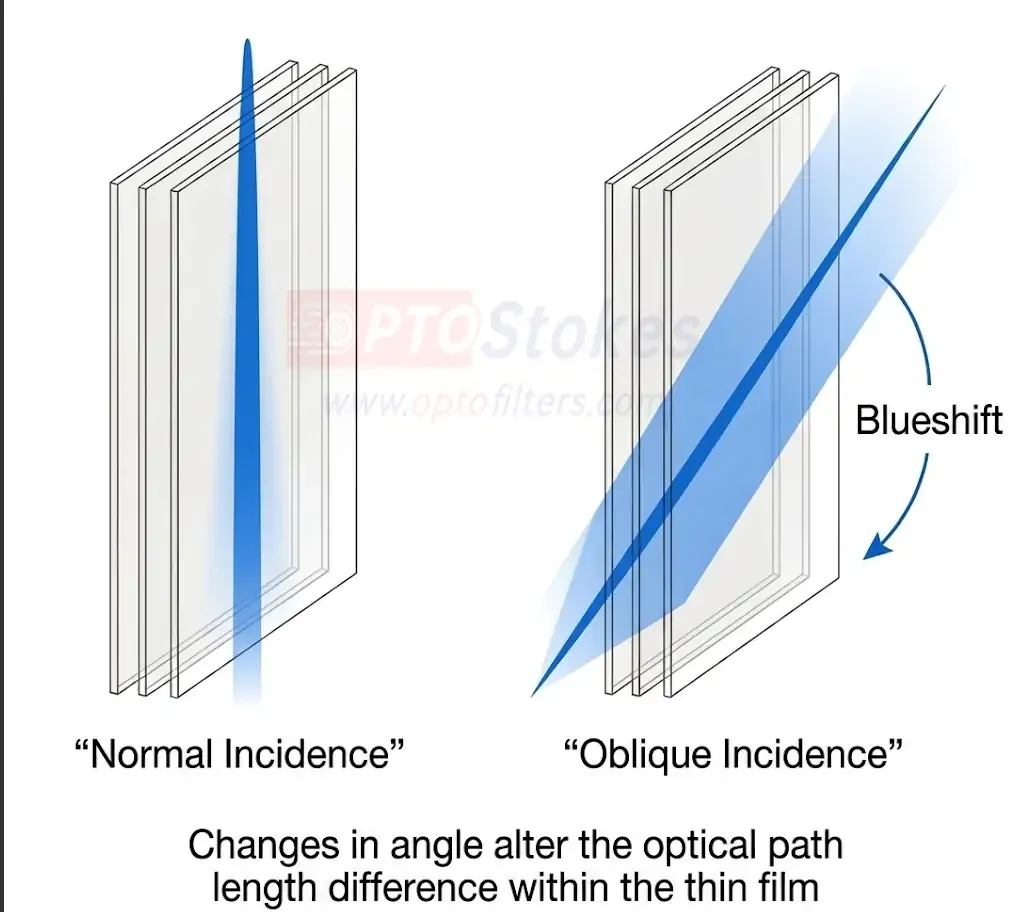
When light enters the filter at an oblique angle, the optical path length within the multi-layer film stack changes, altering the wavelength condition for constructive interference. The visible result is a shift of the filter’s transmission passband toward shorter wavelengths — a phenomenon widely known as blue shift in the optics industry.
It is critical to distinguish between filter types: standard colored glass filters operate on an absorption principle and do not exhibit angle-related wavelength shift. Interference filters, by contrast, rely entirely on thin-film interference and are inherently affected by incident angle. This is the most fundamental operational difference between the two component categories.
Key Factors Determining Blue Shift Magnitude
The magnitude of wavelength shift is not a fixed value. It is primarily determined by three factors: the cavity structure of the film stack, the refractive index of the thin-film materials, and the actual incident angle of the light.
For standard general-purpose filters, an incident angle of only 5° to 10° can produce measurable passband shift. This issue is particularly pronounced in compact portable devices and folded optical path designs where space constraints create inherent angle deviations.
Two Critical System Impacts of Unaddressed Blue Shift
Most selection processes only reference manufacturers’ standard 0° test parameters without accounting for real system operating conditions. This oversight leads to frequent issues during prototype debugging, primarily in two areas:
| Impact Category | System Symptom | Performance Consequence |
|---|---|---|
| Effective Signal Attenuation | Core source wavelength falls outside the filter’s peak transmission range | Reduced detection sensitivity, inability to accurately capture weak sample signals |
| Stray Light Leakage | Filter blocking edge shifts in parallel with the passband | Elevated detector baseline noise, significantly reduced test repeatability and SNR |
Practical Engineering Solutions for Angle Blue Shift
Based on equipment structure and cost requirements, two highly practical optimization approaches are widely adopted across the optics industry:
Option 1: Optimize Mechanical Optical Path Layout
This approach minimizes incident angle deviation by adjusting optical path layout, adding apertures, and implementing limit mounting structures to bring the filter as close as possible to ideal normal incidence conditions.
This solution requires no component replacement, making it suitable for iterations of mature equipment. Its main limitation is that miniaturized and micro devices have restricted space, leaving limited room for optimization.
Option 2: Custom Low-Angle-Sensitivity Coating Designs
During the filter design phase, spectral response across all operating angles is simulated in advance. By optimizing the arrangement of high and low refractive index layers and adjusting cavity structure, the magnitude of angle-induced shift can be greatly reduced.
While blue shift cannot be completely eliminated with advanced thin film coatings, the shift can be controlled within acceptable error tolerances for the system, making this approach suitable for all types of non-ideal optical paths.
Common Selection Pitfall: Don’t Rely Only on Standard Specs
All published filter specifications are measured under standard laboratory conditions with normal incidence. Real industrial equipment and analytical instruments operate in complex, variable conditions where angle deviation, temperature changes, and divergent beam profiles all alter actual component performance.
For precision optical path selection, teams should not rely solely on three basic parameters: center wavelength, full width at half maximum, and optical density. Selection must be matched comprehensively to the system’s actual incident angle, operating temperature, and optical path structure to avoid debugging issues at the source.
Optical system design is a systematic engineering discipline. Even minor deviations in component characteristics can be amplified into full-system performance defects. Precise matching to real operating conditions is the core of ensuring long-term system stability.
Get Custom Filter Solutions for Your Precision Systems
Whether you are troubleshooting angle shift issues in an existing design, selecting filters for a new precision system, or requiring custom angle-insensitive specifications, OPTOStokes delivers world-class optical filter solutions backed by robust production capabilities and predictable lead times.
We maintain an extensive in-stock selection of standard filters and support full custom coating design to meet your unique application requirements. Our engineering team provides technical support from initial selection through prototype validation.
Contact us at sales@optofilters.com to request technical consultation, sample evaluation, or a formal quotation tailored to your project needs.