Optical Filter Selection Guide for ITS Applications
As intelligent transportation systems (ITS) become the backbone of modern traffic management, high-accuracy license plate recognition (LPR) plays a central role in highway monitoring, urban traffic control, and parking management. Reliable LPR performance depends entirely on high-resolution, low-noise raw image capture, which makes optical filtering a critical design consideration for outdoor imaging systems.
Narrow bandpass filters serve as the primary optical component for isolating target illumination wavelengths and suppressing ambient light interference. Their performance directly impacts character extraction accuracy and overall system recognition rates, especially in challenging outdoor environments.
Imaging Challenges in Outdoor LPR Systems
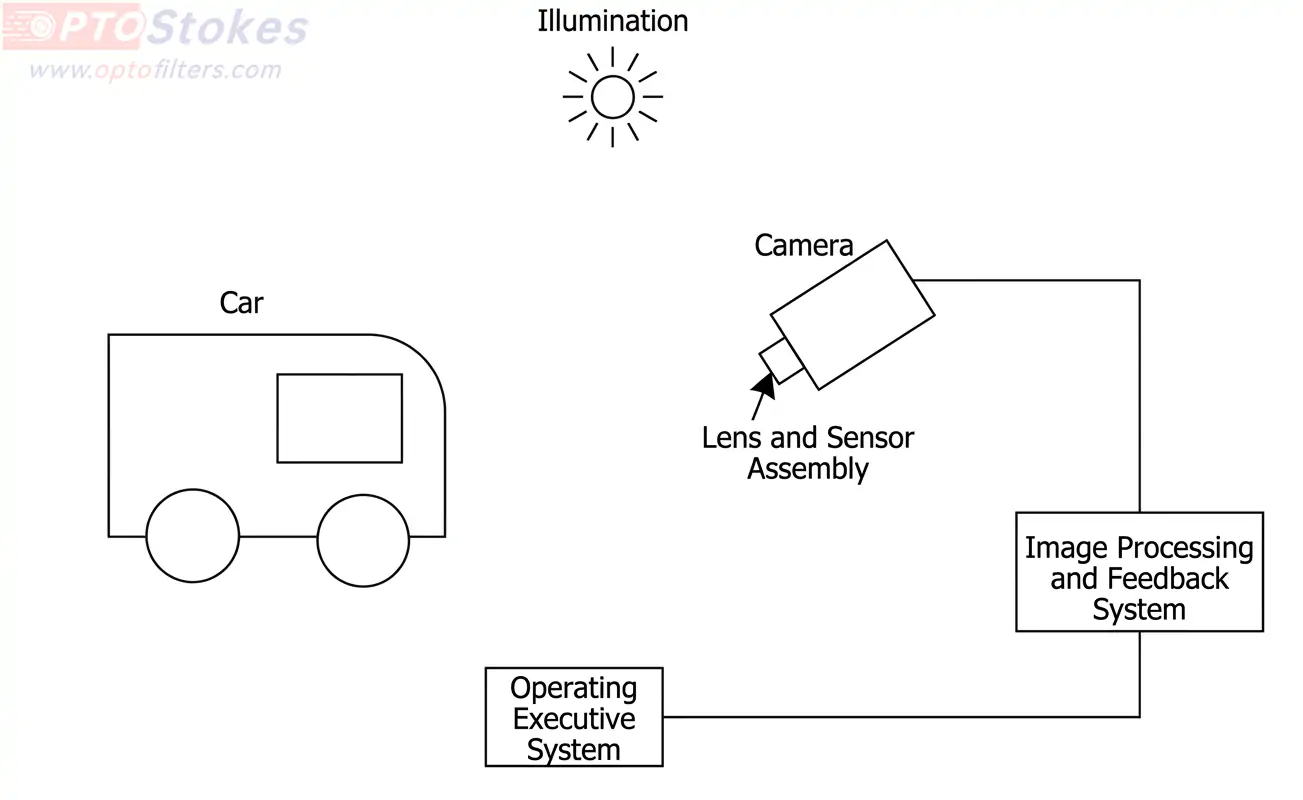
License plate imaging faces multiple inherent challenges: plates vary in condition, background color, and wear state; they are captured while in motion; and systems operate around the clock under open-sky conditions. Complex and dynamic ambient lighting is the single largest factor degrading image contrast and recognition reliability.
LPR Capture System Configuration
In a typical LPR setup, the optical filter is mounted either in front of the camera lens or directly ahead of the CCD/CMOS image sensor inside the camera housing. The camera is typically positioned at an angle of less than 20° relative to the license plate plane. Illumination systems are usually deployed as separate units to cover the required detection range.
Interfering Light Sources in Outdoor Environments
Outdoor LPR systems must contend with a broad spectrum of interfering light sources: direct and scattered sunlight, vehicle headlights (halogen, xenon, and LED), and street lighting (high-pressure sodium, incandescent, and LED). These sources span wavelengths well beyond the 400–1100 nm response range of silicon CCD sensors, and their intensity often exceeds that of the target illumination signal, making effective light rejection a non-trivial engineering challenge.
Core Selection Criteria for Narrow Bandpass Filters
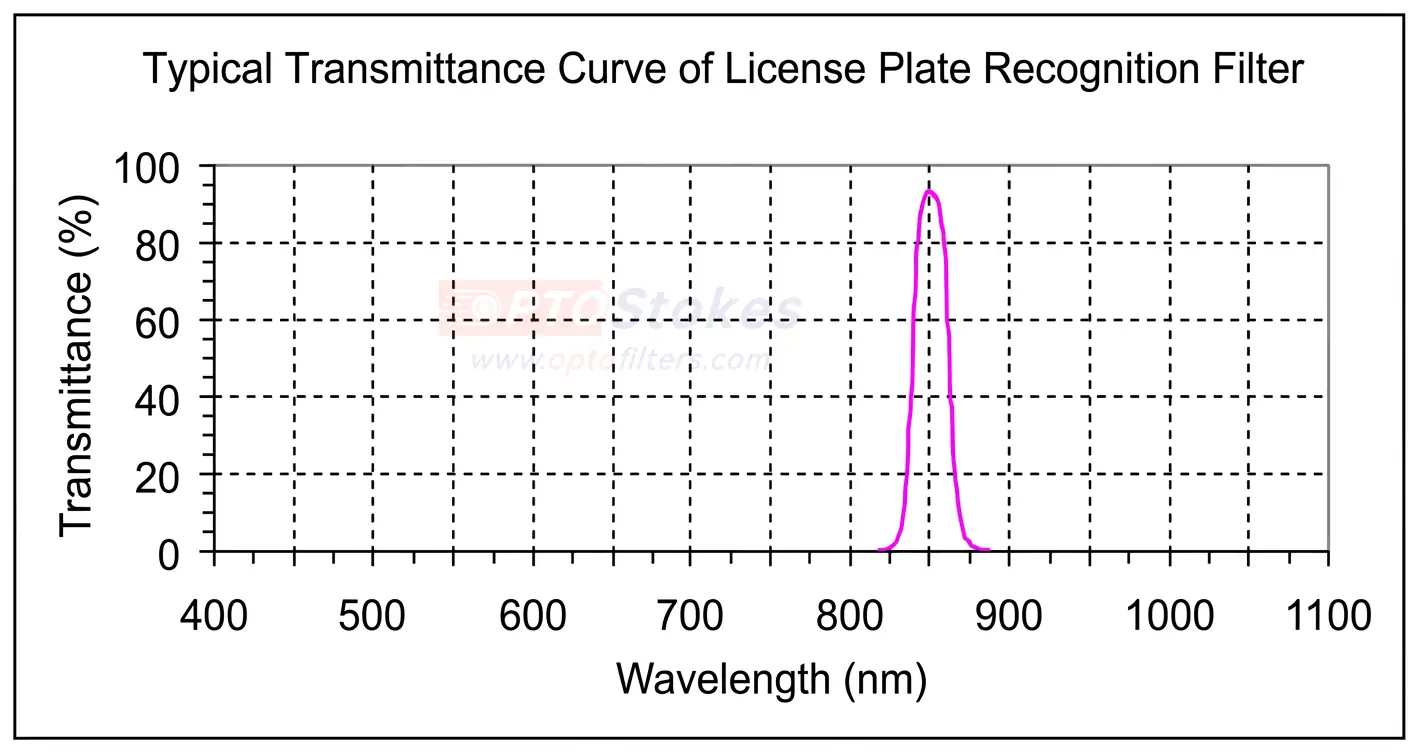
Most modern LPR systems operate in the near-infrared spectrum to avoid glare for drivers and improve night performance. 850 nm and 940 nm NIR filters are the most widely adopted options. The table below summarizes key performance specifications for LPR filter selection:
| Performance Parameter | Recommended Specification |
|---|---|
| Center Wavelength (CWL) | Matched to system illumination source (850 nm / 940 nm standard) |
| Blocking Range | Full coverage of silicon CCD spectral response: 400–1100 nm |
| Out-of-Band Blocking Depth | T < 0.1% (OD ≥ 3) across blocking range |
| Full Width at Half Maximum (FWHM) | 20–30 nm |
| Peak Transmission | ≥ 80% at center wavelength |
Additional Engineering & Application Considerations
Beyond base optical specifications, several practical factors determine long-term system performance and reliability:
Contrast optimization. Poor contrast between plate characters and background occurs when both reflect target wavelengths at similar rates. This issue can be resolved by selecting an alternative center wavelength or applying a targeted wavelength offset to a standard filter. The optimal solution depends on specific plate color schemes and field conditions.
Environmental stability. Outdoor LPR systems are exposed to rain, fog, snow, and high humidity. Filter substrates and coating materials must exhibit excellent moisture resistance. When colored glass substrates are used, a protective hard coating is recommended to prevent surface fogging and degradation over time.
Angle of incidence correction. Since cameras are typically mounted at up to 20° relative to the plate, the center wavelength of the filter will shift at non-normal incidence. CWL must be specified and calibrated for the actual operating angle to maximize signal throughput and filter efficiency.
Filter placement options. For wide field-of-view applications, filters should be mounted as close to the CCD/CMOS sensor as possible (internal camera placement). External lens-front mounting is suitable for angles within 20°. Internal placement is also recommended for improved stray light rejection, even for narrower field-of-view designs.
Vehicle-mounted systems. For LPR cameras installed on moving vehicles, external lens-front mounting is not recommended due to vibration and alignment constraints. Internal sensor-side mounting is required for mechanical stability and consistent performance.
All-Dielectric Coatings vs. IR Absorption Glass
Conventional IR absorption glass is not suitable as a standalone solution for LPR systems. It cannot block infrared components from halogen, xenon, or incandescent ambient light sources, and its surface is prone to moisture damage and hazing in outdoor environments, resulting in short service life.
All-dielectric coated narrow bandpass filters address both limitations. They deliver precise spectral control and deep out-of-band blocking to meet strict LPR performance requirements. Their durable construction delivers superior environmental stability, and their thin form factor supports both external lens mounting and internal integration directly in front of CCD sensors. These advantages make them the preferred choice for ITS and outdoor machine vision applications.
Your Trusted Optical Filter Partner for ITS
Selecting the right filter for LPR systems requires balancing spectral performance, environmental durability, and mechanical integration requirements — all while meeting delivery timelines and cost targets. Many engineering and procurement teams face challenges sourcing filters that match exact application specs with predictable lead times.
OPTOStokes offers an extensive in-stock selection of standard narrow bandpass filters, plus full custom coating capabilities to meet your unique LPR or ITS requirements. Our robust production lines deliver world-class optical performance with consistent quality and reliable lead times.
For technical consultation, sample requests, or a customized quotation, contact our optical engineering team at sales@optofilters.com.