How to Choose Optical Filter FWHM for Stable System Performance
In fluorescence detection, biochemical analysis, spectroscopy, and other precision optical instruments, the center wavelength (CWL) determines whether a filter is positioned around the required spectral feature. However, the full width at half maximum (FWHM) determines how much of the surrounding spectrum is admitted. For system designers, choosing the right FWHM is therefore a trade-off between signal throughput, spectral selectivity, and tolerance to optical and environmental variation.
FWHM is the wavelength interval between the two points where the filter transmission reaches 50% of its peak transmission. For interference bandpass filters, it is one of the key specifications used to define the transmitted spectral window.
There is no universally “best” FWHM. A wider bandwidth can improve optical throughput and tolerance to wavelength variation, while a narrower bandwidth can provide stronger spectral discrimination. The correct specification depends on the source spectrum, target signal, detector response, background radiation, optical geometry, and required measurement stability.
How FWHM Changes Optical Filter Performance
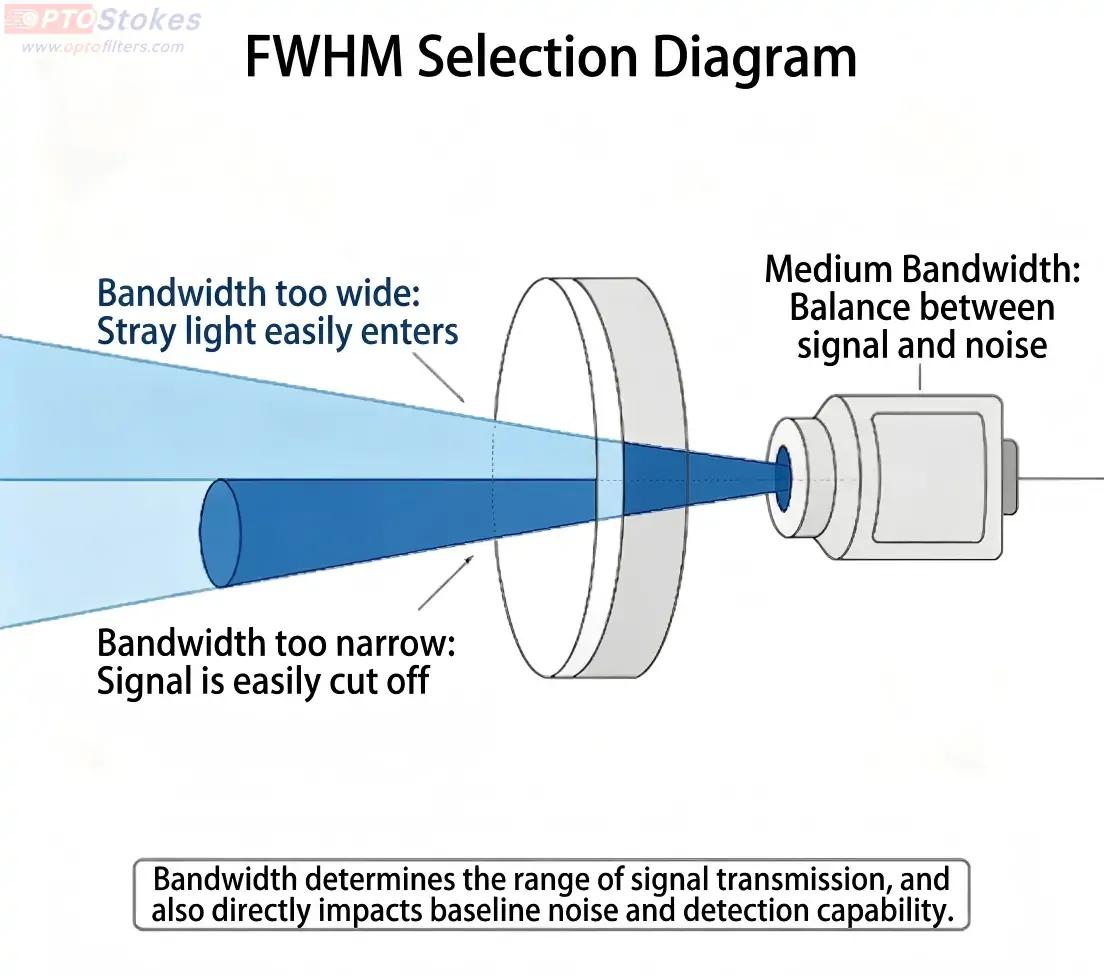
The basic relationship is straightforward: a wider FWHM allows a broader wavelength range to reach the detector, while a narrower FWHM rejects more of the adjacent spectrum. In a real instrument, however, the effect on system performance is more complicated because the filter interacts with the source, sample, detector, and other optical components.
| FWHM Selection | Primary Advantage | Typical Trade-Off | Engineering Consideration |
|---|---|---|---|
| Wide | Higher optical throughput and greater wavelength tolerance | More background and adjacent-spectrum transmission | Useful when signal power is the main constraint |
| Medium | Balanced throughput and spectral discrimination | Neither maximum throughput nor maximum selectivity | Often a practical starting point for precision instruments |
| Narrow | Higher spectral selectivity and stronger rejection of nearby wavelengths | Lower tolerance to wavelength shifts and optical misalignment | Requires careful control of angle, temperature, and system geometry |
For standard bandpass filters, FWHM should never be evaluated in isolation. Transmission, blocking range, optical density (OD), CWL tolerance, and operating angle are equally important when estimating the actual signal-to-background ratio.
What Happens When the FWHM Is Too Wide?
A filter with excessive bandwidth can admit wavelengths that are not useful to the measurement. In fluorescence systems, for example, the detector may receive more excitation leakage, sample autofluorescence, ambient light, or emissions from adjacent channels.
This increases the optical background reaching the detector. If the useful fluorescence signal remains unchanged while the background increases, the effective signal-to-noise performance can deteriorate. In low-concentration measurements, this may increase the practical detection limit even when the detector itself has sufficient sensitivity.
The problem is particularly important in multiplex fluorescence and analytical instruments, where neighboring spectral channels may overlap. In such systems, FWHM must be selected together with the emission spectrum and the required inter-channel rejection.
What Happens When the FWHM Is Too Narrow?
An excessively narrow filter can create a different engineering problem. The filter may provide excellent spectral discrimination under nominal laboratory conditions but become more sensitive to variations in the optical system.
Interference filters can experience a spectral shift when the angle of incidence changes. Temperature can also affect the spectral position of a thin-film filter. In systems with a converging or diverging beam, the filter may therefore experience a range of incidence angles rather than a single design angle.
These effects become increasingly important when the usable passband is very narrow. A relatively small spectral shift can reduce transmission at the target wavelength or move the filter response away from the intended emission line.
For this reason, narrow FWHM should not be specified simply because it appears to provide “better filtering.” The optical architecture must have sufficient angular, mechanical, and thermal control to take advantage of the narrower passband.
Practical FWHM Selection by Application
Wide Bandwidth: Approximately 30–50 nm
A 30–50 nm FWHM can be a reasonable starting range when high optical throughput and tolerance to wavelength variation are more important than maximum spectral discrimination. It can suit general-purpose detection, illumination monitoring, and systems where the target signal has a relatively broad spectrum.
Wide filters are also less demanding when the source wavelength, assembly angle, or operating conditions have moderate variation. However, their wider spectral acceptance can increase background transmission, so blocking performance still needs to be checked.
Medium Bandwidth: Approximately 15–25 nm
A 15–25 nm FWHM is often a practical engineering range for systems that require a balance between signal throughput and spectral selectivity. Applications may include fluorescence detection, biochemical analysis, industrial optical monitoring, and other instrument architectures where the useful signal is concentrated within a defined spectral region.
This range should be treated as a design starting point rather than an industry-wide specification. The actual optimum depends on the spectral width of the source or emission signal and the separation between the target signal and unwanted background.
Narrow Bandwidth: Approximately 5–10 nm
A 5–10 nm FWHM is appropriate when strong spectral discrimination is required and sufficient signal remains available after filtering. Typical applications include selected fluorescence channels, analytical spectroscopy, laser cleanup, and other measurements where adjacent wavelengths represent a significant source of interference.
For narrowband systems, engineers should verify not only FWHM but also CWL tolerance, peak transmission, out-of-band blocking, angle-of-incidence sensitivity, temperature stability, and polarization dependence where applicable.
For applications requiring more aggressive spectral isolation, narrow bandpass filters can provide substantially tighter wavelength selection than general-purpose bandpass filters.
FWHM Should Be Specified With the Complete Optical Filter Specification
One of the most common selection errors is treating FWHM as an independent target. In production optical systems, a filter specification should be evaluated as a complete spectral performance envelope.
| Parameter | Why It Matters |
|---|---|
| CWL | Defines the nominal center of the transmitted spectral band. |
| FWHM | Defines the width of the passband at 50% of peak transmission. |
| Peak Transmission | Determines how much useful optical signal reaches the detector. |
| Optical Density / Blocking | Determines how effectively unwanted wavelengths are suppressed. |
| CWL Tolerance | Defines acceptable part-to-part spectral variation. |
| Angle of Incidence | Can affect the spectral position of interference filters. |
| Temperature Stability | Determines how the spectral response changes with operating temperature. |
| Substrate and Coating | Influence spectral range, transmission, environmental durability, and mechanical integration. |
For fluorescence and PCR systems, for example, the filter should be evaluated as part of the complete excitation and emission path rather than as an isolated component. OPTOStokes supplies PCR optical filters and fluorescence filter solutions with spectral specifications matched to application requirements.
A Practical FWHM Selection Workflow
Define the target spectral feature. Identify the excitation wavelength, emission peak, laser line, Raman feature, or analytical absorption band that must be transmitted.
Determine the required spectral rejection. Identify nearby wavelengths, excitation leakage, ambient background, adjacent fluorescence channels, or other interference sources that must be suppressed.
Estimate the acceptable FWHM. Start with the widest bandwidth that provides sufficient spectral discrimination. Avoid specifying an unnecessarily narrow passband.
Check transmission and blocking together. A narrow FWHM with poor peak transmission may provide less useful signal than a wider filter with higher transmission.
Evaluate optical geometry. Confirm the intended angle of incidence, beam convergence or divergence, and whether the filter will operate in a collimated or non-collimated beam.
Check environmental and manufacturing tolerances. Consider temperature variation, CWL tolerance, coating uniformity, substrate tolerances, and assembly alignment.
Validate at system level. The final selection should be confirmed using the actual source spectrum, detector response, and optical layout rather than relying only on the nominal FWHM value.
Key Takeaway: Choose the FWHM for the System, Not for the Specification Sheet
A narrower FWHM is not automatically a better optical filter. It improves spectral selectivity, but it can also reduce usable signal and increase sensitivity to wavelength shifts caused by angle, temperature, polarization, and optical alignment.
A wider FWHM generally provides greater throughput and tolerance, but excessive bandwidth can admit unwanted background and reduce spectral discrimination.
The correct engineering approach is to optimize FWHM together with CWL, transmission, blocking, optical geometry, environmental conditions, and detector characteristics. The objective is not the narrowest possible bandwidth, but the bandwidth that delivers the required measurement performance with adequate production tolerance.
Custom FWHM Requirements for Optical Instruments
For OEM and instrument-development projects, the required FWHM may not match a standard catalog specification. OPTOStokes supports both in-stock optical filters and custom spectral designs, allowing engineers to define parameters such as CWL, FWHM, transmission, blocking range, substrate, dimensions, and coating requirements according to the optical system.
For a specific filter requirement, contact sales@optofilters.com with the target wavelength, required FWHM, transmission or OD requirements, substrate, dimensions, and operating conditions. Technical evaluation, sample development, and quotation can then be based on the actual system requirements rather than on FWHM alone.
```