Is Higher Peak Transmission Always Better? The Optical Trade-offs Behind High Transmittance
In optical filter selection, peak transmission is often viewed as the primary indicator of performance. A common assumption among engineering teams is that higher transmittance automatically delivers better filter performance. However, according to interference thin-film design physics, this view is incomplete.
Multilayer dielectric coatings operate under fundamental parameter trade-offs. Over-optimizing coating designs for peak transmission in the target band inherently compromises out-of-band rejection, angular stability, and polarization balance—ultimately capping the system's signal-to-noise ratio (SNR).
1. The Physics of Thin-Film Coating Trade-offs
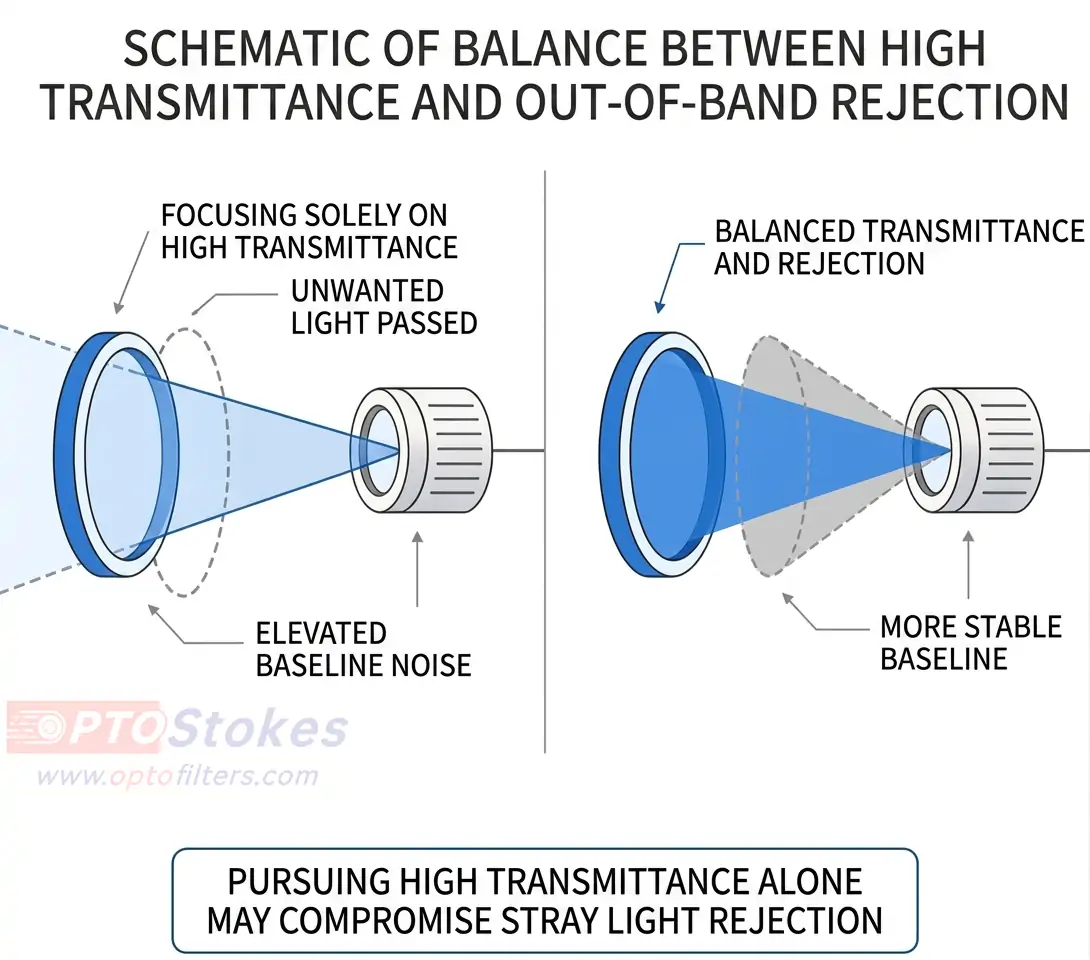
Interference bandpass filters rely on alternating nanoscale layers of high- and low-refractive-index materials to achieve spectral selection through optical interference. Because coating optimization budget is finite, allocating maximum design weight to peak transmission widens the transition band and degrades the blocking depth (Optical Density/OD). This reduces overall noise immunity in precision optical systems.
Engineering optical design requires managing trade-offs rather than maximizing a single parameter at the expense of system stability.
2. Engineering Drawbacks of Over-Optimizing Peak Transmission
Decreased Stray Light Rejection
Coating designs focused solely on maximum transmittance weaken out-of-band blocking capabilities. Residual excitation light and ambient stray light pass through the filter to the photodetector, elevating baseline noise and compromising weak-signal detection in fluorescence and Raman instruments.
Increased Angle Sensitivity
Steep spectral curves engineered for high transmission are highly sensitive to the angle of incidence (AOI). Small mechanical assembly tolerances or beam divergence angles in high-volume manufacturing cause spectral shifts, leading to measurement instability.
Expanded Polarization Splitting
Extreme high-transmission coatings struggle to balance s-polarization and p-polarization spectral responses. Under oblique incidence, this polarization split increases measurement dispersion and reduces quantitative repeatability.
3. Scenario-Based Optical Filter Selection Strategy
To assist system architects and procurement teams, the table below outlines recommended selection criteria based on application requirements:
| Application Type | Primary Requirement | Key Coating Optimization Focus | Recommended Trade-off |
|---|---|---|---|
| Qualitative Detection / Low-Power Sources | Signal Intensity | Maximize Peak Transmittance (>93-95%) | Moderate out-of-band rejection acceptable |
| Precision Quantitative Systems (Fluorescence / Spectrophotometry) | High SNR & Baseline Stability | Balanced Transmittance + High Blocking Depth (OD5–OD6) | Slightly reduced peak transmission for steep edges and low baseline noise |
4. System-Level Optical Design Conclusion
Selecting precision optical filters is a system engineering task. Mature optical design focuses on spectral stability, environmental reliability, and optimized signal-to-noise ratio rather than isolated peak specs. Proper parameter trade-offs ensure consistent, repeatable system performance in volume production.
Optimize Your Optical System Performance
Are you balancing high transmittance with strict out-of-band rejection requirements for your next production run? OPTOStokes provides an extensive inventory of in-stock standards alongside fully customized coating designs with guaranteed lead times and world-class quality control.
Contact our application engineers at sales@optofilters.com for technical consultation, custom coating simulations, or competitive quote requests.