What Are Infrared Filters?
In precision infrared sensing systems, even a 3nm deviation in filter center wavelength can trigger a 15% zero-point drift in sensor modules, rendering entire production line test data invalid. This seemingly compact optical component acts as the spectral gatekeeper of the IR sensing chain, directly defining which wavelengths your system can and cannot detect.
IR filters operate across the infrared spectrum, spanning from 0.75μm near-infrared to far-infrared bands of tens of micrometers. Most applications only require a narrow, targeted spectral segment, and filters function by blocking unwanted wavelengths while transmitting only the desired band.
Working Principles of Infrared Filters
There are two primary technical approaches to IR spectral filtering, each with distinct performance characteristics and application fit.
Absorptive IR Filters
These filters rely on the intrinsic absorption properties of substrate materials to block out-of-band wavelengths. For example, silicon substrates transmit light in the 1.1–7μm range and absorb wavelengths outside this window, a behavior defined by the material’s inherent physical properties. Absorptive filters offer limited wavelength tunability, as performance is bounded by the substrate’s natural spectral characteristics.
Interference IR Filters
The dominant technology for industrial applications, interference filters are fabricated by depositing tens to hundreds of dielectric thin film layers on a substrate. By precisely controlling the thickness of each layer, designers engineer constructive interference for target wavelengths (enhancing transmission) and destructive interference for all other bands (blocking transmission). This approach enables center wavelength tolerances within ±1nm and bandwidths as narrow as a few nanometers, making it the standard for high-precision Bandpass Filters and narrowband products.
Common Types of Infrared Filters
IR filters are categorized by function into four primary types, each optimized for specific use cases.
Bandpass Filters
Bandpass filters transmit only a defined spectral band, blocking both shorter and longer wavelengths. They are the most widely used filter type in gas detection systems, where they isolate the characteristic vibrational absorption peaks of target gas molecules.
For example, CO₂ detection requires a filter centered at 4.26μm, while CH₄ detection targets 3.3μm. OPTOStokes 4260nm narrow bandpass filters deliver high-precision spectral control for multi-gas sensing systems:
| Parameter | Specification |
|---|---|
| Center Wavelength (CWL) | 4260 ± 42 nm |
| FWHM (Standard Option) | 180 ± 20 nm |
| FWHM (High-Resolution Option) | 90 ± 20 nm |
| Peak Transmission | ≥ 80% |
| Out-of-Band Transmission (UV to 11μm) | < 0.1% (average) |
This deep out-of-band rejection minimizes channel crosstalk in multi-component gas detection systems, where insufficient blocking between CO₂ and CH₄ channels would directly degrade measurement accuracy.
Longpass Filters
Longpass filters transmit wavelengths longer than a specified cutoff edge while blocking shorter wavelengths. They are ubiquitous in thermal imaging systems, where they isolate the 8–14μm atmospheric window — the core operating band for infrared thermal detection.
OPTOStokes LP5500nm longpass filters feature a 5% cutoff wavelength of 5.5 ± 0.4μm, with ≥70% average transmission across 7.5–13.5μm and ≤0.5% blocking from 0.4–5μm, effectively rejecting visible and near-infrared background radiation.
Shortpass Filters
Shortpass filters operate in the reverse configuration: they transmit shorter wavelengths and block longer bands. While less common than bandpass or longpass designs, they are essential for specific near-infrared applications where long-wavelength background noise must be suppressed.
Narrowband IR Filters
Narrowband filters represent the high-precision end of the bandpass category, with FWHM values typically ranging from 20–50nm or even narrower. They are designed to extract an extremely precise spectral segment for high-resolution applications.
OPTOStokes offers an extensive NIR Filters portfolio covering 850nm to 16000nm, with standard center wavelengths including 850nm, 1653nm, 1940nm, 3400nm, 4260nm, 6300nm, 7300nm and 10600nm. Our 850nm narrowband filter delivers industry-leading spectral cleanliness for face recognition and structured light sensing:
| Parameter | Specification |
|---|---|
| Transmission Band | 837 – 862 nm |
| Average Transmission | ≥ 95% |
| Minimum Transmission | ≥ 92% |
| Out-of-Band Transmission (400–820nm / 878–1100nm) | < 0.2% (average) |
5 Key Parameters for IR Filter Selection
Each core filter parameter corresponds to real-world performance risks in system integration. Understanding these tradeoffs is critical for reliable IR sensing design.
Center Wavelength (CWL)
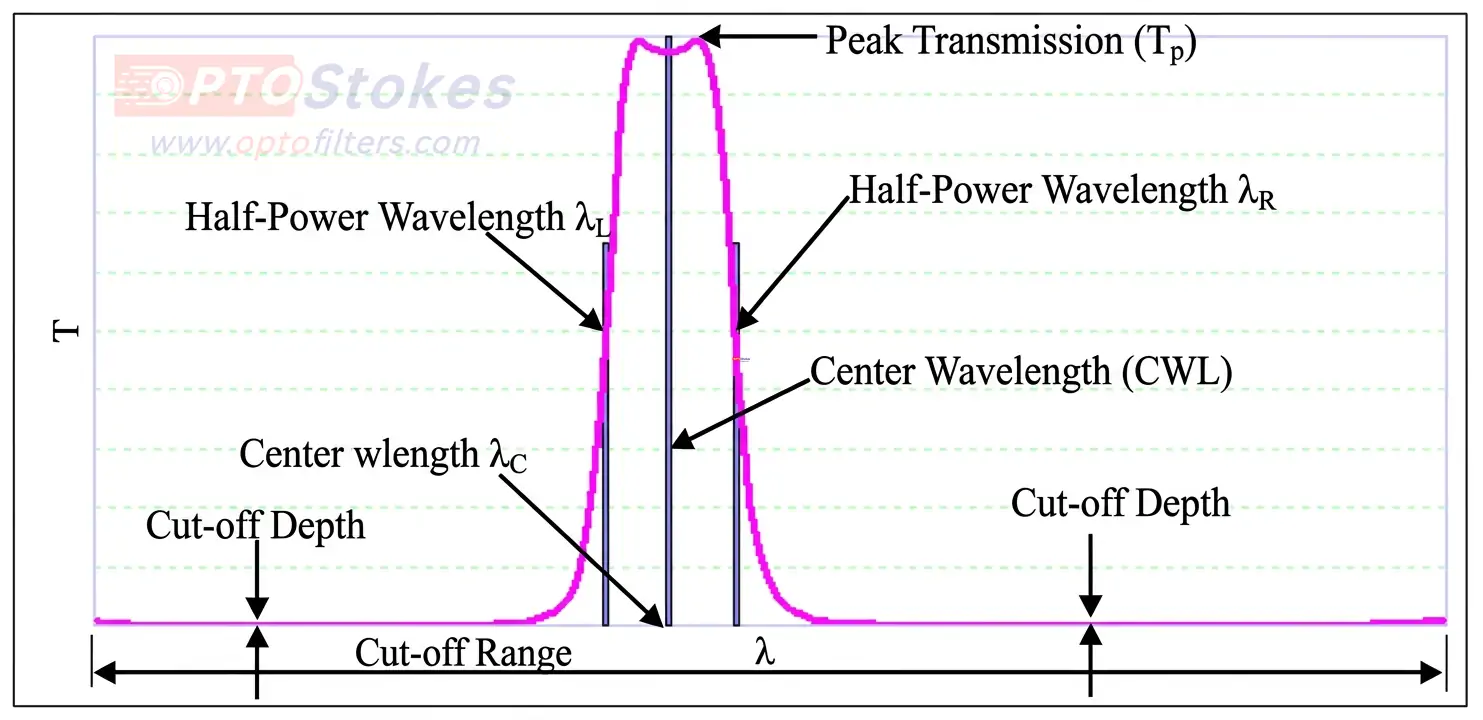
CWL defines the central wavelength of the transmission band, and is the most fundamental selection criterion. A misaligned CWL directly reduces signal strength: for example, substituting a 4.20μm filter in a CO₂ detection system designed for 4.26μm can cut signal intensity by 40%, as molecular absorption peaks are extremely narrow and wavelength-specific.
Full Width at Half Maximum (FWHM)
FWHM defines the width of the transmission band at 50% of peak transmittance. Narrower bandwidths deliver stronger anti-interference performance but require more complex coating processes and typically reduce peak transmission. For standard CO₂ detection, 180nm FWHM provides sufficient coverage; for isotopic analysis or high-resolution spectroscopy, 90nm or narrower bandwidths are required. The optimal FWHM depends on your application’s spectral resolution requirements, not simply the narrowest available option.
Optical Density (Blocking Depth)
Optical Density (OD) quantifies a filter’s ability to block out-of-band wavelengths. OD4 corresponds to transmission below 0.01%, while OD6 represents transmission below 0.0001%. Many engineers prioritize CWL and FWHM while treating blocking depth as a secondary specification, but insufficient OD leads to high stray light and poor signal-to-noise ratio (SNR), especially in high-temperature industrial environments where background radiation is intense. OPTOStokes 4260nm filters achieve average out-of-band transmission below 0.1% — approximately OD3 blocking, with even deeper rejection in the peak blocking region — directly reducing channel crosstalk in multi-gas systems.
Peak Transmission
Peak transmission measures the percentage of target-wavelength light that passes through the filter. While 100% transmission is ideal, multilayer thin-film coatings introduce inherent reflection and absorption losses. Typical interference filters achieve 85–95% peak transmission. Higher transmission directly improves system SNR: in near-infrared face recognition and structured light applications, each 1% increase in transmission delivers measurable improvements in detection performance. These losses must be accounted for in system-level signal budgeting.
Angle of Incidence Effects
An often-overlooked specification, angle of incidence (AOI) effects cause center wavelength to shift toward shorter wavelengths as light enters the filter at oblique angles. The shift follows the approximate relationship: λ(θ) = λ₀ × √(1 - sin²θ/n²), where n is the equivalent refractive index of the film stack. For systems with wide fields of view, this causes uneven spectral response across the imaging area. Experienced optical designers pre-compensate for AOI shifts during the coating design phase, a practical engineering consideration built on decades of real-world application experience.
OPTOStokes IR Filter Solutions
OPTOStokes delivers world-class infrared filter technology for OEM, R&D and industrial integration applications. Our extensive in-stock product range covers standard wavelengths from UV through SWIR, while our robust in-house coating line supports full custom spectral designs matched to your exact system requirements.
With predictable lead times, guaranteed coating uniformity and strict quality control across every production batch, we provide reliable filter solutions for gas detection, thermal imaging, biomedical sensing, laser systems and industrial inspection applications.
For custom spectral designs, free technical consultation, sample requests or volume pricing, contact our optical engineering team at sales@optofilters.com. We will work directly with your team to deliver the optimal IR filter solution for your application.