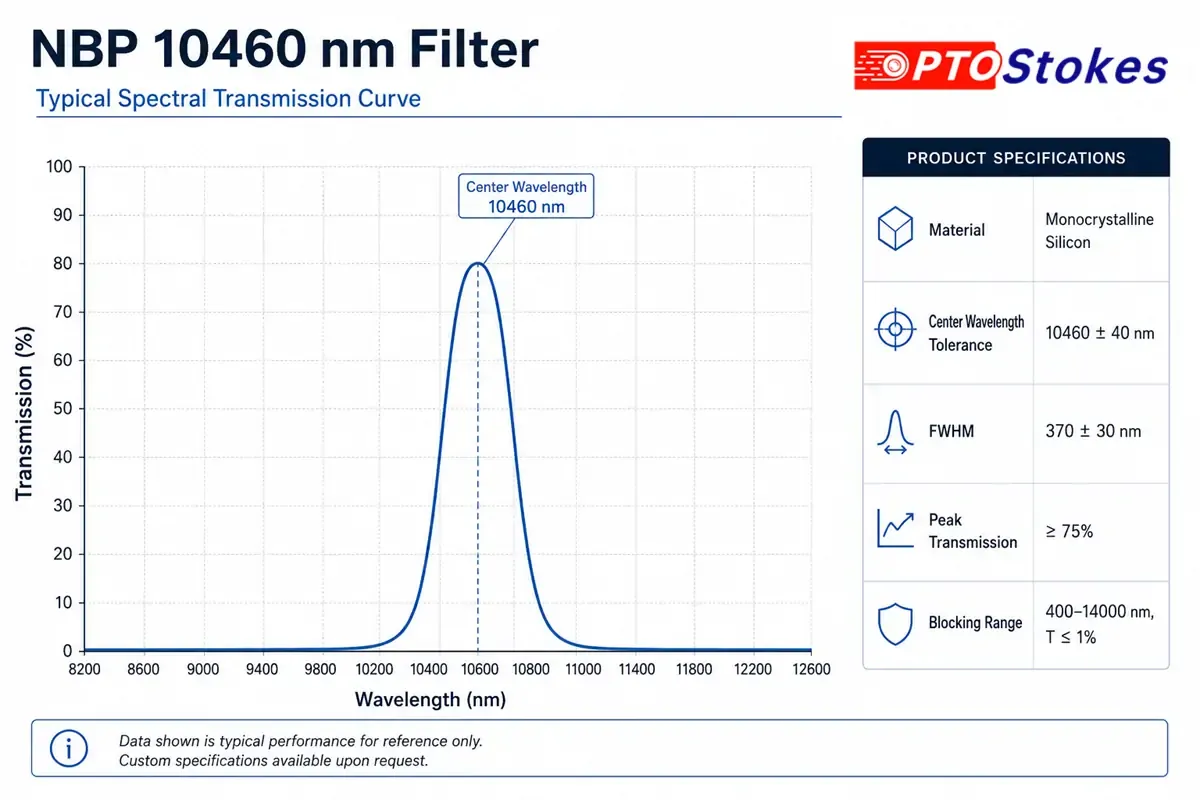
Key conclusion: For most LWIR ammonia detection systems, the best stock starting point from the current OPTOStokes product range is NBP 10460 370nm. It provides a center wavelength of 10460±40 nm, a bandwidth of 370±30 nm, peak transmission of ≥75%, and wide-range blocking from 400–14000 nm, T≤1%.
This filter is recommended because its center wavelength is closest to the practical NH3 absorption region around 10.3–10.6 µm. For engineers developing NDIR ammonia sensors, LWIR gas detection modules, or thermal imaging-based leak detection systems, it offers a balanced stock solution between spectral matching, optical throughput, and availability.
If the project requires maximum gas selectivity in a high-interference environment, a custom 10.45 µm filter with narrower FWHM can still be specified. But for stock-based prototype validation and early system integration, NBP 10460 370nm is the most practical first-choice filter.
Why NH3 Detection Usually Targets the 10.3–10.6 µm Region
Ammonia gas has strong infrared absorption features in the long-wave infrared region near 10 µm. In practical optical design, the target filter wavelength must not only match the molecular absorption band, but also fit the detector response, light source spectrum, optical path length, gas concentration range, humidity level, and background radiation.
The 10.3–10.6 µm region is especially useful because it lies within the 8–14 µm LWIR atmospheric window, where many uncooled infrared detectors, thermal imaging cores, and LWIR gas sensing systems operate. This makes it a practical wavelength range for compact industrial ammonia detection equipment.
| Candidate Band | Engineering Value | Main Limitation | Selection Advice |
|---|---|---|---|
| Around 9.0 µm | NH3 absorption may be present | Higher risk of interference from humidity and nearby gas absorption | Not recommended as the first design choice |
| 10.3–10.6 µm | Strong practical NH3 detection region in LWIR | Requires proper bandpass width and out-of-band blocking | Recommended target range for ammonia gas filters |
| Around 10.7 µm | Can still cover part of the NH3-related LWIR region | May shift farther from the preferred detection center depending on system design | Use only after spectral simulation or application testing |
Best Stock Product Recommendation: NBP 10460 370nm
Among the four available stock filters, NBP 10460 370nm is the most suitable standard product for ammonia detection because it is closest to the preferred 10.45 µm design point. Its 370 nm bandwidth provides more optical energy to the detector than a very narrow filter, which can be useful in compact NDIR sensors and LWIR modules where signal strength is limited.
| Model | Substrate | Size | CWL | FWHM | Peak Transmission | Blocking Range | Recommendation |
|---|---|---|---|---|---|---|---|
| NBP 10460 370nm | Monocrystalline Silicon | Φ100 × 0.5 mm | 10460±40 nm | 370±30 nm | ≥75% | 400–14000 nm, T≤1% | Best stock choice for NH3 detection |
| NBP 10500 600nm | Monocrystalline Silicon | Φ100 × 0.5 mm | 10500±50 nm | 600±40 nm | ≥75% | 400–13500 nm, T≤1% | Higher throughput, but lower selectivity |
| NBP 10560 370nm | Monocrystalline Silicon | Φ100 × 0.5 mm | 10560±40 nm | 370±30 nm | ≥75% | 400–18000 nm, T≤1% | Useful alternative when broader long-wavelength blocking is required |
| NBP 10700 370nm | Monocrystalline Silicon | Φ100 × 0.5 mm | 10700±40 nm | 370±30 nm | ≥75% | 400–14000 nm, T≤1% | Less preferred for standard NH3 detection |
Why NBP 10460 370nm Is the Preferred Stock Solution
1. Closest CWL to the Practical NH3 Detection Band
The CWL of 10460±40 nm places NBP 10460 370nm very close to the commonly used ammonia detection region around 10.45 µm. This makes it a better first-choice stock filter than 10560 nm or 10700 nm options when the goal is to detect NH3 rather than simply transmit a broad LWIR band.
2. Balanced Bandwidth for Signal Strength and Selectivity
A 370 nm FWHM is not an ultra-narrow laboratory filter. Its advantage is practical throughput. In compact NDIR sensors or LWIR detection modules, too narrow a bandwidth can reduce detector signal and increase the burden on electronics and signal processing.
For most prototype and engineering validation work, 370±30 nm gives a useful balance: narrow enough to focus on the NH3-related LWIR region, but wide enough to maintain optical energy at the detector.
3. Suitable Format for Further Cutting and Custom Assembly
The stock size of Φ100 × 0.5 mm is suitable for downstream cutting into smaller round, square, or rectangular filters. This is useful for OEM sensor manufacturers that need multiple small filters from one coated wafer format.
4. Verified Stock Specification for Faster Project Evaluation
For early-stage development, using an available stock filter reduces waiting time and helps engineers verify whether the NH3 optical path, detector, electronics, and algorithm are suitable before moving to a fully customized filter design.
When to Choose the Other Stock Options
Although NBP 10460 370nm is the preferred stock recommendation for ammonia detection, the other filters may still be useful in specific system designs.
| Model | When It May Be Used | Main Trade-Off |
|---|---|---|
| NBP 10500 600nm | When the system needs higher optical throughput and has enough algorithmic or reference-channel compensation | The 600 nm bandwidth reduces gas selectivity and may increase interference risk |
| NBP 10560 370nm | When the optical design or detector response favors a slightly longer CWL, or when broader blocking to 18000 nm is required | It is farther from the preferred 10.45 µm starting point than NBP 10460 |
| NBP 10700 370nm | When system testing shows better response at a longer LWIR wavelength | Not recommended as the default NH3 filter without spectral verification |
Recommended Filter Strategy by Application
1. NDIR Ammonia Gas Sensors
For NDIR ammonia sensors, the recommended stock starting point is NBP 10460 370nm. It gives useful signal strength while targeting the NH3-sensitive LWIR region.
The sensor should ideally use a reference channel outside the main NH3 absorption band. This helps compensate for source drift, detector drift, temperature change, window contamination, and background variation.
| NDIR Design Factor | Recommended Approach |
|---|---|
| Measurement filter | NBP 10460 370nm as the first stock option |
| Reference filter | Select a non-absorbing or weaker-absorbing nearby LWIR band after system-level testing |
| Optical path length | Match to the expected NH3 concentration range |
| Humidity compensation | Use reference channel, calibration algorithm, and environmental testing |
| Final validation | Test with real gas concentration, temperature range, humidity range, and interfering gases |
2. LWIR Thermal Imaging Ammonia Leak Detection
Thermal imaging-based gas detection systems face more background radiation than compact gas cells. The filter must isolate the target gas band while rejecting unwanted thermal and solar radiation.
For this application, NBP 10460 370nm can be used as a stock validation filter. If the imaging system requires stronger gas contrast or lower false response, OPTOStokes can develop a custom filter with adjusted CWL, narrower FWHM, and stricter blocking.
3. FTIR and Laboratory Pre-Filtering
In FTIR or laboratory systems, the filter is often used as a pre-filter to reduce unwanted radiation before spectral analysis. In this case, the bandwidth can be wider than an NDIR measurement channel because the final spectral separation is performed by the instrument.
For this use case, NBP 10500 600nm may be considered when higher throughput is more important than narrow gas selectivity. However, for NH3-targeted filtering, NBP 10460 370nm remains the safer first choice.
Important Engineering Notes for Silicon-Based LWIR Filters
The listed OPTOStokes stock filters use monocrystalline silicon substrates. For this reason, the filter should be evaluated based on its actual coated-filter specification, including CWL, FWHM, peak transmission, blocking range, and application test result.
In LWIR gas detection, substrate choice should not be judged by material name alone. The useful question is whether the finished filter meets the required transmission, blocking, thermal stability, size, and environmental performance in the customer’s optical system.
| Engineering Item | Why It Matters |
|---|---|
| Substrate | Monocrystalline silicon is used in the listed stock products and should be validated by finished-filter spectral performance |
| Transmission | Peak transmission of ≥75% supports practical signal levels in compact sensors |
| Blocking | T≤1% blocking is suitable for many prototype systems, but stricter OD blocking may be needed for high-sensitivity instruments |
| Angle of incidence | Narrow bandpass filters shift toward shorter wavelengths as incident angle increases |
| Environmental conditions | High humidity, corrosive gas, and thermal cycling should be considered before mass production |
Common Mistakes When Selecting NH3 Detection Filters
1. Choosing Only by Peak Wavelength
A filter with the right CWL can still fail if its bandwidth is too wide, blocking is too weak, or the detector receives too much background radiation. CWL is only the first parameter. FWHM, blocking, transmission, substrate, and system geometry must be reviewed together.
2. Using a Generic 8–14 µm Window
A standard LWIR window does not provide gas selectivity. It transmits a broad thermal band and cannot isolate the NH3 absorption region. For ammonia detection, a narrow bandpass filter is required.
3. Ignoring Reference Channel Design
In NDIR systems, a measurement filter alone is usually not enough. A reference channel is needed to reduce error caused by source drift, detector drift, contamination, temperature change, and non-gas optical losses.
4. Treating Wider Bandwidth as Always Better
A wider FWHM increases signal, but it can also increase interference. This is why NBP 10500 600nm should not automatically be selected just because it passes more light. For NH3 detection, NBP 10460 370nm offers a better default balance.
5. Ignoring Filter Angle Shift
Bandpass filters shift to shorter wavelengths when the incident angle increases. For better wavelength accuracy, the optical system should keep the filter close to normal incidence whenever possible.
OPTOStokes Solution for NH3 Gas Detection Filters
OPTOStokes supports both stock and custom optical filters for gas sensing, LWIR detection, thermal imaging, and industrial optical systems. For ammonia detection, the recommended stock solution is NBP 10460 370nm, while custom designs can be developed for stricter requirements.
| Customer Requirement | OPTOStokes Support |
|---|---|
| Fast prototype validation | Use stock NBP 10460 370nm for NH3 detection testing |
| Higher selectivity | Customize narrower FWHM, such as 150–300 nm depending on system needs |
| Higher throughput | Consider wider FWHM after checking interference risk |
| Custom size | Cutting from Φ100 mm coated wafers into round, square, or rectangular filters |
| Custom blocking | Adjust blocking range and depth according to detector and background radiation |
| OEM production | Support repeatable supply for sensor modules, gas analyzers, and imaging systems |
RFQ Checklist for NH3 Ammonia Detection Filters
To receive an accurate quotation and avoid the wrong filter design, provide the following information when contacting OPTOStokes:
| Information Needed | Example |
|---|---|
| Target gas | NH3 / ammonia |
| Detection method | NDIR sensor, LWIR gas imaging, FTIR, or custom infrared module |
| Preferred stock model | NBP 10460 370nm |
| Required CWL | 10460 nm stock option, or custom 10.45 µm design |
| Required FWHM | 370 nm stock option, or custom 150–300 nm design |
| Filter size | Φ100 × 0.5 mm wafer, or custom cut size |
| Blocking requirement | Standard T≤1% blocking, or custom OD3/OD4 blocking |
| Operating environment | Temperature, humidity, corrosive gas exposure, outdoor or indoor use |
| Quantity | Prototype quantity and expected production volume |
Final Recommendation
If you need a stock optical filter for ammonia gas detection, choose NBP 10460 370nm first. It is the closest available OPTOStokes stock option to the practical NH3 detection region, with 10460±40 nm CWL, 370±30 nm FWHM, ≥75% peak transmission, and 400–14000 nm blocking with T≤1%.
If your system requires higher selectivity, lower cross-interference, stricter blocking, or a smaller cut size, OPTOStokes can develop a custom NH3 filter based on your detector, optical path length, gas concentration range, and operating environment.
Send your target wavelength, FWHM, blocking range, filter size, application method, and expected quantity to sales@optofilters.com. OPTOStokes will help match the filter design to your ammonia detection system.