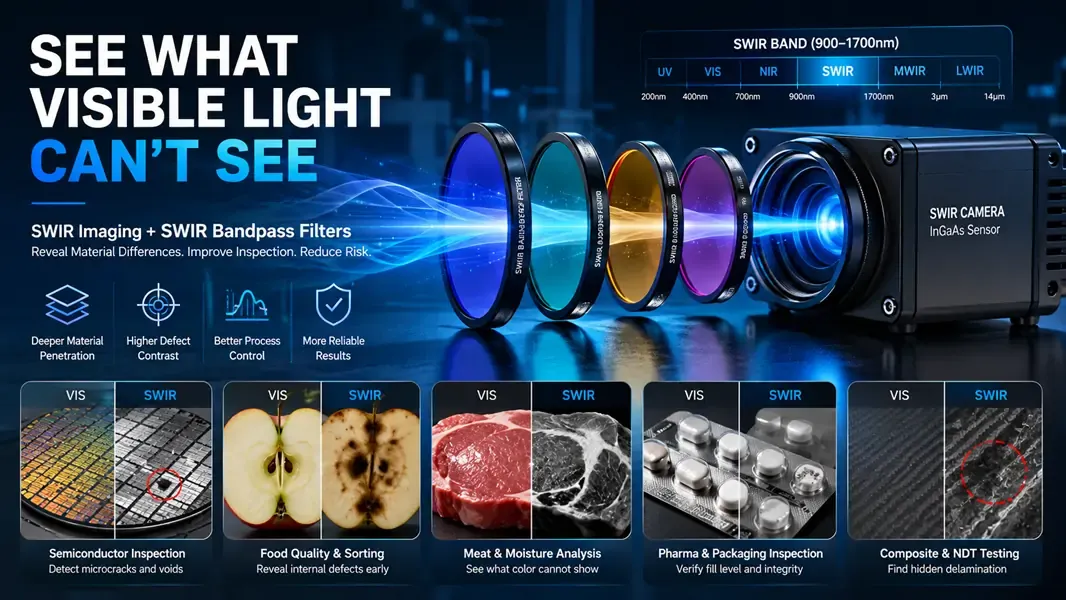
Key conclusion: The strongest industrial inspection systems do not only capture sharper images. They reveal material differences that visible cameras cannot separate. This is where SWIR imaging, combined with the right SWIR bandpass filters, becomes valuable.
Many inspection failures do not happen because the image is blurry. They happen because the defect has almost no visible contrast. A silicon wafer may look clean while hiding microcracks. A fruit may look fresh while carrying internal bruising. A meat sample may show normal color while moisture, fat, or protein distribution is unstable.
Visible cameras read color, texture, shape, and surface detail. SWIR imaging reads absorption, reflection, and transmission differences in materials. That is the practical difference:
Visible light shows appearance. SWIR helps reveal material behavior.
What Is SWIR Imaging?
SWIR stands for Short-Wave Infrared. In industrial imaging, many SWIR systems work around 900–1700 nm, while some hyperspectral or extended-range systems reach toward 2500 nm.
SWIR should not be treated as a “more advanced camera” in a general sense. It is better understood as a material identification window. Many materials that look similar under visible light show different absorption, reflection, or transmission behavior in the SWIR region.
| Visible Imaging | SWIR Imaging | Engineering Meaning |
|---|---|---|
| Color | Spectral absorption | Helps separate materials with similar appearance |
| Surface texture | Moisture and composition response | Useful for food, agriculture, plastics, and coatings |
| Shape and edge | Transmission through selected materials | Useful for silicon inspection and hidden structure detection |
| Surface defect contrast | Subsurface or material contrast | Helps detect defects that visible cameras may miss |
Why SWIR Matters in Semiconductor Inspection
In semiconductor inspection, one of the most important SWIR capabilities is through-silicon imaging. Silicon is largely opaque to visible light, so a normal camera can inspect surface scratches, particles, contamination, edge chips, and visible pattern issues, but it cannot reliably inspect hidden structures inside or behind the silicon.
At selected SWIR wavelengths, silicon becomes more transmissive. This allows engineers to inspect defects and structures that are not accessible with visible imaging.
| Semiconductor Target | What SWIR Can Help Reveal | Why It Matters |
|---|---|---|
| Silicon wafer | Internal microcracks and hidden defects | Helps stop latent defects before later process steps |
| Wafer bonding | Voids, misalignment, and interface problems | Improves bonding process control |
| MEMS devices | Packaged internal structures | Supports non-destructive inspection |
| TSV and wafer-level packaging | Alignment and hidden structure issues | Useful for advanced packaging inspection |
| Diced chips | Cracks, chipping, and backside defects | Reduces downstream reliability risk |
| Silicon ingots and rods | Inclusions and internal irregularities | Improves material screening before processing |
The economic value is straightforward: semiconductor manufacturing is not only damaged by obvious defects. It is damaged by defects that pass early inspection and fail later during packaging, testing, reliability validation, or customer use.
SWIR helps move hidden-defect detection earlier in the process. That can reduce wasted process time, material loss, and yield uncertainty.
Why SWIR Matters in Food Inspection
Food inspection faces a similar problem. The product may look acceptable, but the internal state may already be different. A fruit can show no external damage while carrying internal bruising. A nut may look normal while containing mold or insect damage. Meat may show similar color while moisture and fat distribution vary.
Visible cameras are useful for color, shape, size, and surface grading. But they become unstable when the target problem is moisture, composition, internal damage, or foreign material with similar visible appearance.
SWIR is useful because water, fat, protein, starch, sugar, and many organic materials show different spectral responses in the short-wave infrared region.
| Food Type | SWIR Inspection Target | Application Value |
|---|---|---|
| Fruit | Internal bruising, moisture variation, ripeness, decay | Grading, sorting, and bad-fruit rejection |
| Meat | Moisture, fat distribution, protein response, bone fragments | Quality control and foreign material detection |
| Nuts | Mold, insect damage, moisture, foreign material | Food safety screening |
| Grain | Impurities, mold, moisture, mixed particles | Storage and processing inspection |
| Bakery products | Moisture distribution and baking uniformity | Texture and consistency control |
| Powdered food | Adulteration, foreign matter, composition difference | Raw material quality control |
SWIR does not replace every food inspection method. Its value is to cover a weak point of ordinary vision:
Visible cameras judge appearance. SWIR provides material evidence.
SWIR and Hyperspectral Imaging: Building a Composition Map
SWIR is often combined with hyperspectral imaging in food, agriculture, recycling, pharmaceutical, and material inspection. A standard camera records a two-dimensional image. A hyperspectral camera records both image position and spectral response.
In simple terms, each pixel becomes more than a color point. It becomes a small material signature.
This allows engineers to build a composition map: where moisture is high, where fat is concentrated, where protein response changes, where mold may exist, or where a foreign material differs from the product background.
| Development Stage | Purpose | Result |
|---|---|---|
| Hyperspectral research | Collect full spectral data from real samples | Find wavelengths that separate good and bad samples |
| Key wavelength selection | Reduce hundreds of bands to several useful bands | Lower system cost and data load |
| Multispectral system design | Fix selected wavelengths into practical optical channels | Build a faster production-ready inspection system |
| Filter specification | Define CWL, FWHM, blocking range, and transmission | Select or customize SWIR bandpass filters |
| Production deployment | Run the model on a line-scan or area-scan system | Support sorting, rejection, alarm, or grading decisions |
This workflow is one of the most practical routes for industrial deployment:
Use hyperspectral imaging to discover the key wavelengths. Use multispectral imaging and filters to make the solution faster, simpler, and more affordable.
Why Not Use Only Visible, Thermal Infrared, or X-Ray?
Different inspection technologies answer different physical questions. A poor system design often starts with using the wrong imaging method for the wrong defect mechanism.
| Technology | Main Signal | Best For | Weak Point |
|---|---|---|---|
| Visible imaging | Color, shape, size, surface texture | Appearance inspection, positioning, dimension measurement | Weak for internal defects and composition differences |
| SWIR imaging | Material absorption, reflection, and transmission difference | Silicon inspection, food composition, moisture, plastics, foreign material sorting | Higher system cost and stricter optical design requirements |
| Thermal infrared | Temperature distribution | Heat leakage, overheating, thermal abnormality, insulation inspection | Not a direct material composition tool |
| X-ray | Density and structure difference | Metal foreign bodies, bones, internal structure | Higher cost, safety control, and system complexity |
SWIR is not a universal replacement for visible imaging, thermal imaging, or X-ray inspection. Its role is specific: detect material differences and selected hidden information when visible contrast is not enough.
SWIR System Design Is Not Just a Camera Choice
Many SWIR projects fail because the system is treated as a camera purchase. In reality, a stable SWIR inspection system requires matched optics, illumination, filters, mechanics, image acquisition, and algorithms.
| System Component | Engineering Role | Common Failure Mode |
|---|---|---|
| SWIR light source | Provides selected illumination wavelength and power | Uneven light creates false contrast |
| SWIR lens | Images the target with proper transmission and resolution | Visible lenses may lose transmission or focus performance in SWIR |
| SWIR camera | Captures reflected or transmitted SWIR signal | Wrong sensor range misses the useful wavelength |
| SWIR bandpass filter | Isolates the wavelength carrying useful material contrast | Wrong CWL or FWHM reduces contrast or increases noise |
| Motion platform or conveyor | Controls sample position and inspection speed | Motion blur or unstable sample spacing affects detection |
| Algorithm model | Converts spectral or image contrast into pass/fail decisions | Insufficient samples cause unstable classification |
| Reject or alarm mechanism | Turns detection into production action | Response delay causes wrong sorting or missed defects |
Key Questions Before Selecting a SWIR Filter
The filter should not be selected only from a catalog wavelength. It should be selected from the inspection target, material behavior, and system geometry.
| Question | Why It Matters |
|---|---|
| What material difference must be detected? | The useful wavelength depends on whether the target is moisture, silicon transmission, plastic type, coating, or foreign material |
| Is the system reflective or transmissive? | Reflection and transmission setups often require different illumination and filter strategy |
| Is the target moving? | Line-scan systems require enough light and stable exposure at production speed |
| How narrow should the passband be? | Narrow FWHM improves selectivity but reduces signal; wider FWHM improves throughput but may reduce contrast |
| What blocking range is required? | Poor out-of-band blocking can let unwanted visible or NIR light reach the detector |
| What is the angle of incidence? | Bandpass filters shift with angle, which can affect wavelength accuracy |
| What environment will the filter face? | Humidity, cleaning chemicals, dust, and temperature cycling can affect long-term stability |
Recommended SWIR Filter Strategy by Application
1. Semiconductor and Silicon Inspection
For silicon wafer, die, MEMS, and advanced packaging inspection, the filter should be selected around the wavelength range where silicon transmission and defect contrast are strong enough for the camera and illumination design.
Recommended approach: start with wavelength screening, compare contrast at several SWIR bands, then define the final CWL, FWHM, and blocking range.
2. Food Sorting and Quality Control
For fruit, meat, nuts, grain, bakery, and powdered food inspection, the filter should target the material feature that affects the decision: moisture, fat, protein, ripeness, mold, or foreign material.
Recommended approach: use hyperspectral testing to identify useful wavelengths first, then build a lower-cost multispectral system using selected SWIR bandpass filters.
3. Plastic, Glass, and Foreign Material Sorting
Many foreign materials are difficult to separate under visible light because their color is close to the product background. SWIR can create stronger contrast when the materials absorb or reflect differently in the selected band.
Recommended approach: compare product and contaminant spectra, then select a bandpass filter that maximizes contrast while keeping enough optical signal.
4. Coating, Moisture, and Surface Process Inspection
Some coatings, liquids, and surface treatments show weak visible contrast but clear SWIR response. This is useful for process monitoring, drying inspection, and coverage verification.
Recommended approach: define whether the inspection target is thickness, coverage, moisture, or residue, then select filters around the highest contrast wavelength.
OPTOStokes SWIR Filter Support
OPTOStokes supplies optical filters for industrial imaging, machine vision, semiconductor inspection, food sorting, spectroscopy, and OEM optical modules. For SWIR inspection projects, we support both stock-oriented selection and custom filter development.
| Requirement | OPTOStokes Support |
|---|---|
| SWIR bandpass filters | Custom CWL and FWHM according to selected inspection wavelength |
| High transmission | Filter design optimized for usable signal at the detector |
| Out-of-band blocking | Blocking design for visible, NIR, or unwanted SWIR leakage |
| Custom size and shape | Round, square, rectangular, small-format, and special-shaped filters |
| Prototype to production | Support from sample validation to repeatable OEM supply |
| Application matching | Filter selection for semiconductor, food, material sorting, and industrial vision systems |
RFQ Checklist for SWIR Industrial Inspection Filters
To receive a useful quotation and avoid an incorrect filter specification, provide the following information when contacting OPTOStokes:
| Information Needed | Example |
|---|---|
| Application | Silicon wafer inspection, fruit sorting, meat quality control, grain inspection, plastic sorting |
| Target material or defect | Microcrack, moisture, fat distribution, mold, foreign material, coating residue |
| Imaging mode | Reflection, transmission, line-scan, area-scan, hyperspectral, or multispectral |
| Target wavelength | Known CWL, or wavelength range from hyperspectral testing |
| FWHM requirement | Narrow band for selectivity, wider band for higher signal |
| Blocking requirement | Visible/NIR blocking, SWIR out-of-band blocking, or custom OD requirement |
| Filter size | Diameter, length × width, thickness, and tolerance |
| Operating environment | Temperature, humidity, cleaning process, dust, vibration, or outdoor exposure |
| Quantity and schedule | Prototype quantity, pilot production quantity, and expected delivery target |
Final Recommendation
Do not choose SWIR only because it sounds more advanced than visible imaging. Choose SWIR when the inspection target has a real spectral difference in the short-wave infrared region.
For semiconductor inspection, SWIR is valuable when the target is hidden silicon structure, backside features, microcracks, bonding defects, or packaging alignment. For food inspection, SWIR is valuable when the target is moisture, composition, ripeness, mold, bruising, or foreign material that visible cameras cannot separate reliably.
The practical path is simple: identify the material difference, test the useful wavelength, select the right SWIR filter, then build the optical system around stable contrast.
For custom SWIR bandpass filters, send your target wavelength, FWHM, blocking range, filter size, application details, and expected quantity to sales@optofilters.com. OPTOStokes can help match the filter design to your industrial inspection system.