
Why Near Infrared Analysis Became Practical
Near infrared spectroscopy was once limited by weak absorption signals and unstable instrumentation. That changed when more stable light sources, better signal amplification, and more sensitive detectors became available. These improvements made NIR measurements more repeatable and more useful in real production environments.
At the same time, chemometrics made NIR far more valuable. Because NIR spectra contain broad and overlapping bands, raw spectra alone are often difficult to interpret directly. Chemometric models help extract meaningful information from complex, multi-component samples and turn weak spectral differences into usable analytical results.
What NIR Does Well
NIR is especially effective for routine analysis of major components, where the target concentration is typically above about 0.1% by sample weight. It is not the first choice for trace-level analysis, but it performs well when the goal is rapid screening, quality control, and process monitoring.
NIR also offers practical value beyond chemistry. Because the spectrum is influenced by both chemical bonds and physical sample properties, it can be used to evaluate composition, particle size, and mixture uniformity in a single measurement workflow.
| NIR Capability | What It Measures | Why It Matters in Industry |
|---|---|---|
| Chemical analysis | Moisture, organics, protein, oil, active ingredients | Supports fast release testing and process control |
| Physical analysis | Particle size, density trends, mixing uniformity | Helps detect process drift before final failure |
| Minimal sample preparation | Direct measurement of many bulk samples | Reduces labor and improves throughput |
| Penetration ability | Can probe beneath the surface of some materials | Useful for non-destructive inspection and inline sensing |
Why Industry Uses NIR for Quality Control
NIR is widely used in agriculture, petroleum, chemicals, tobacco, food, pharmaceuticals, and biofuels because it balances speed, flexibility, and low sample preparation. In some materials, the optical penetration depth can reach up to about 5 cm, which allows measurement without destructive pretreatment.
The real advantage is operational efficiency. Instead of sending samples through slow chemical workflows, manufacturers can screen incoming materials, monitor processing conditions, and check final consistency with a faster optical method.
How NIR Light Interacts with a Sample
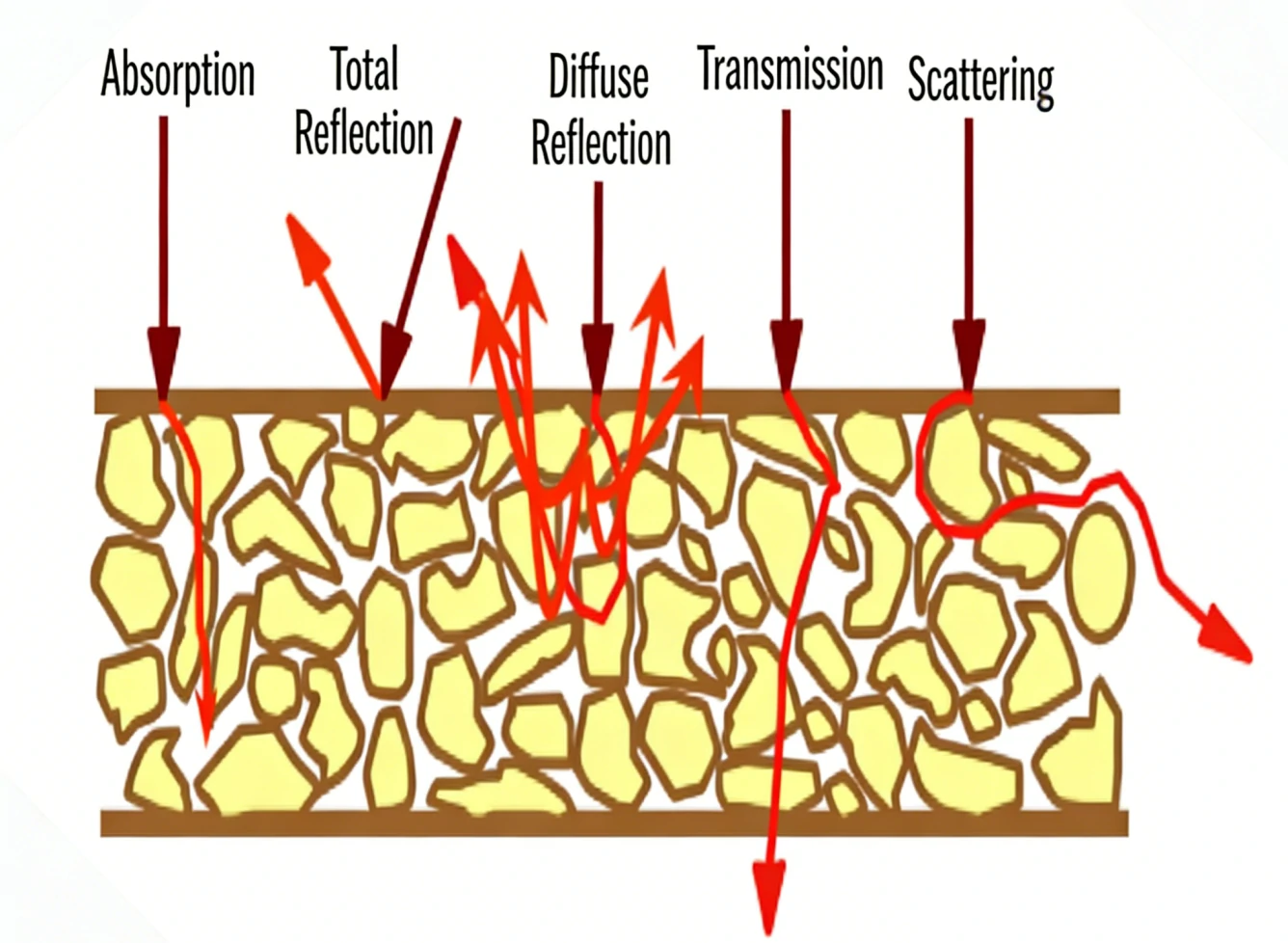
When NIR light reaches a sample, several optical interactions can occur at the same time: absorption, transmission, scattering, total reflection, and diffuse reflection. The sampling method determines which part of that interaction is collected by the detector and therefore which kind of sample can be analyzed effectively.
This is why NIR method design is not only about wavelength selection. It also depends on the sample state, path length, surface condition, particle structure, and measurement environment.
Main NIR Sampling Modes
In industrial NIR work, the three main collection modes are transmission, diffuse reflectance, and transflectance or diffuse transmittance. Transmission and diffuse reflectance are the most widely used. Some specialized systems also use trans-reflection configurations when sample thickness, scattering, or packaging constraints require it.
| Sampling Mode | Signal Path | Best for | Typical Sample Forms |
|---|---|---|---|
| Transmission | Light passes through the sample | Clear or semi-clear materials | Liquids, thin films, some transparent solids |
| Diffuse Reflectance | Light enters the sample, scatters, and returns to the detector | Opaque solids and rough surfaces | Powders, granules, tablets, sheets, pastes |
| Diffuse Transmittance / Transflectance | Light penetrates the sample and is collected after scattering | Semi-solid or scattering samples | Meat paste, pharmaceutical tablets, viscous mixtures |
(1) Transmission NIR
How It Works
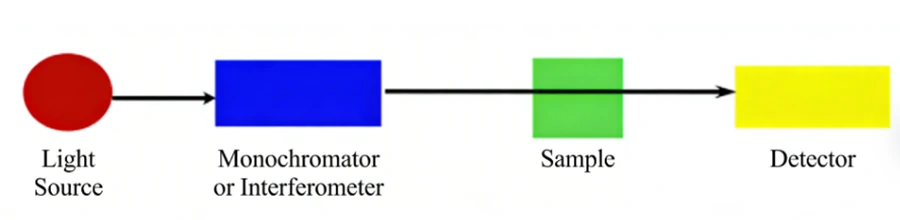
In transmission mode, NIR light travels through the sample and the detector measures the energy that emerges on the other side. This configuration is most suitable when the sample allows enough light to pass through without complete attenuation.
Where It Works Best
Transmission mode is commonly used for liquids, thin polymer films, and other materials with sufficient optical path control. It is useful when the goal is to measure bulk composition with a defined path length and relatively low scattering.
Main Limitation
If the sample is too thick, too opaque, or highly scattering, transmission becomes unstable or impractical. In those cases, reflectance-based modes usually perform better.
(2) Diffuse Reflectance NIR
How It Works
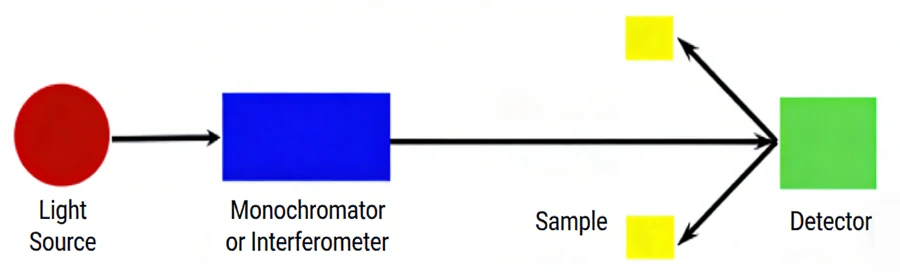
In diffuse reflectance mode, NIR light enters the sample, undergoes repeated reflection, refraction, absorption, and scattering inside the material, and then exits the surface carrying sample information. The detector collects this returning light instead of waiting for full penetration through the sample.
Where It Works Best
This is the preferred mode for most solid samples because NIR often cannot pass fully through dense or opaque solids. It is widely used for powders, granules, flakes, tablets, sheets, and pastes.
In practical instruments, diffuse reflectance is often implemented with an integrating sphere or a solid-state fiber optic probe. These setups help collect scattered light more efficiently and improve repeatability in industrial measurement.
| Diffuse Reflectance Advantage | Practical Value |
|---|---|
| No need for full sample penetration | Works well for opaque solids |
| Flexible probe-based measurement | Supports inline and at-line inspection |
| Good for heterogeneous materials | Useful for powders and non-uniform surfaces |
(3) Diffuse Transmittance / Transflectance NIR
How It Works
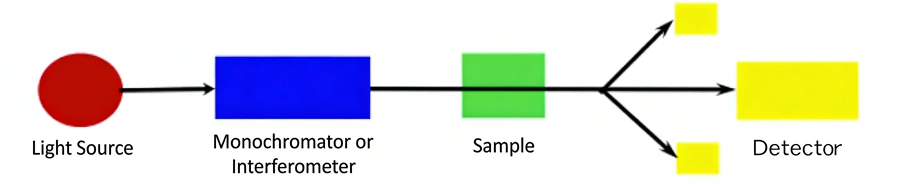
In this mode, NIR light passes into the sample, experiences both transmission and scattering, and is then collected by the detector. In practice, it is often used when the sample is neither fully transparent nor fully opaque.
Where It Works Best
This approach is commonly used for semi-solid or highly scattering products, such as meat paste, pharmaceutical tablets, and similar materials. These samples do not behave like clear liquids, but they still allow partial penetration of light with strong internal scattering.
Why It Matters
Diffuse transmittance can provide more representative bulk information than surface-only collection when the sample structure is thick, moist, or internally non-uniform.
How to Choose the Right NIR Sampling Mode
Problem
Many NIR projects fail early because the wrong sampling geometry is selected. The wavelength may be correct, but the optical path is not. That leads to unstable spectra, poor calibration robustness, and misleading process decisions.
Analysis
The correct mode depends on five variables: sample transparency, particle structure, thickness, surface condition, and process environment. These factors determine whether the detector should collect transmitted light, scattered surface return, or a mixed scattering-through-sample signal.
OPTOStokes Solution
OPTOStokes supports NIR optical filter solutions for spectroscopy, sensing, and industrial analyzers where the sampling mode directly affects performance. Instead of choosing a filter in isolation, the optical design should match the sampling geometry, detector response, source spectrum, and blocking requirement as one system.
That is especially important when moving from lab feasibility to production deployment. A filter that works in a benchtop setup may fail in a probe-based diffuse reflectance system or a compact transmittance assembly if angle shift, stray light, or out-of-band leakage is ignored.
| If Your Sample Is... | Recommended Mode | Why |
|---|---|---|
| Clear or lightly absorbing | Transmission | Gives direct bulk-path measurement |
| Opaque powder or solid | Diffuse Reflectance | Collects useful scattered information without full penetration |
| Semi-solid or internally scattering | Diffuse Transmittance / Transflectance | Balances penetration and scattering information |
Key Takeaway
NIR is valuable not because it gives the sharpest spectrum, but because it gives fast, non-destructive, and practical data in real production conditions. The right sampling mode is the first major decision in making that data reliable.
If your team is selecting filters for NIR transmission, diffuse reflectance, or transflectance systems, OPTOStokes can support both stock and custom optical filter requirements. For technical discussions or RFQ support, visit https://www.optofilters.com/ or contact sales@optofilters.com.