What Is Near Infrared (NIR)?
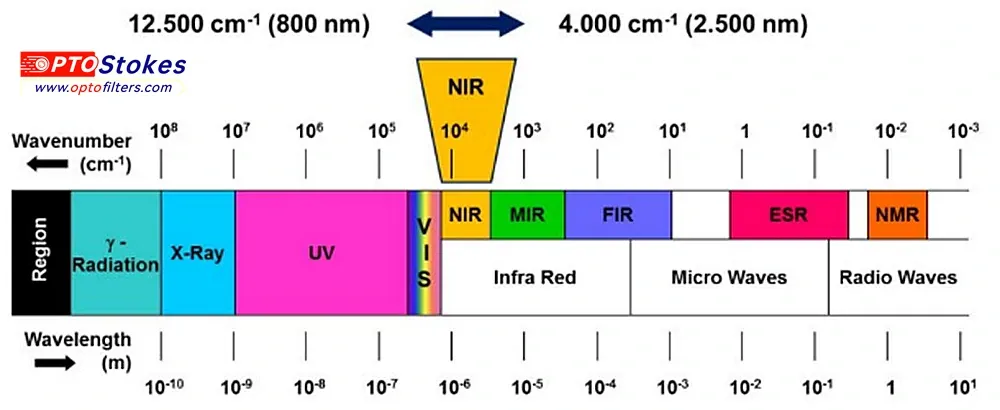
Near infrared (NIR) is the part of the electromagnetic spectrum from 780 to 2500 nm, or about 12,800 to 4,000 cm⁻¹ in wavenumber. It sits between visible red light and the mid-infrared region. In spectroscopy, NIR is widely used because it can probe molecular structure while supporting fast, non-destructive measurement.
Like all electromagnetic radiation, NIR can be described as both a wave and a stream of photons. Its photon energy follows E = hν = hc/λ, where h is Planck’s constant, ν is frequency, c is the speed of light, and λ is wavelength. This energy is high enough to interact with specific molecular bonds, but the interaction mechanism is different from the stronger fundamental absorption seen in mid-IR spectroscopy.
What Makes a Molecule NIR-Active?
When NIR light reaches a material, only bonds that produce a measurable change in dipole moment during vibration can generate meaningful absorption. These are called IR-active bonds. If a molecular bond does not interact with the incoming radiation in this way, the light mostly passes through the sample without forming a useful NIR absorption feature.
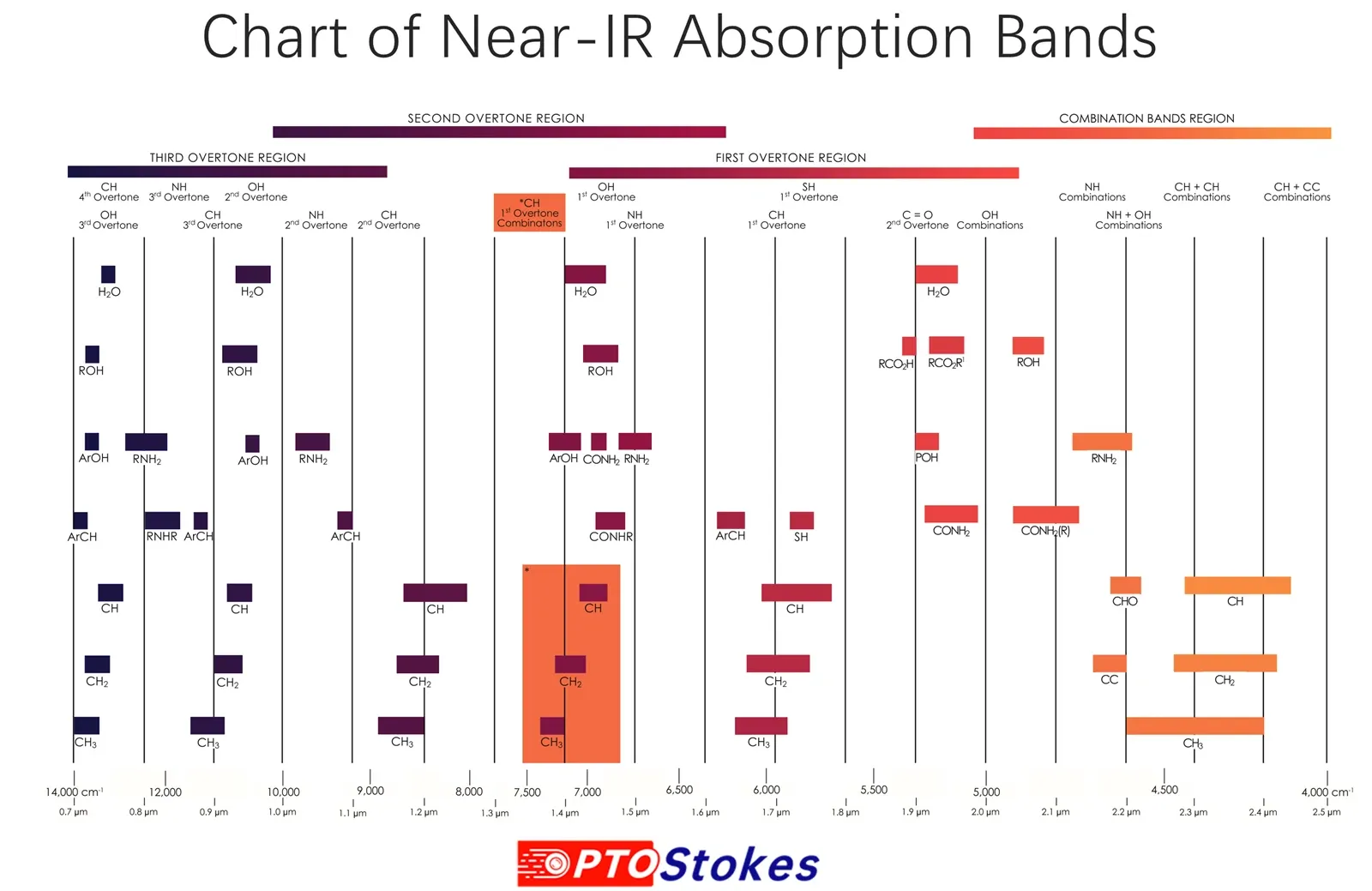
In practical NIR analysis, the most important contributors are hydrogen-containing bonds such as O-H, C-H, N-H, and S-H. These bonds dominate because their vibrational overtones and combination bands are strong enough to appear in the near infrared region, even though they are still much weaker than their mid-infrared fundamentals.
Why NIR Spectra Are Harder to Read Than Mid-IR Spectra
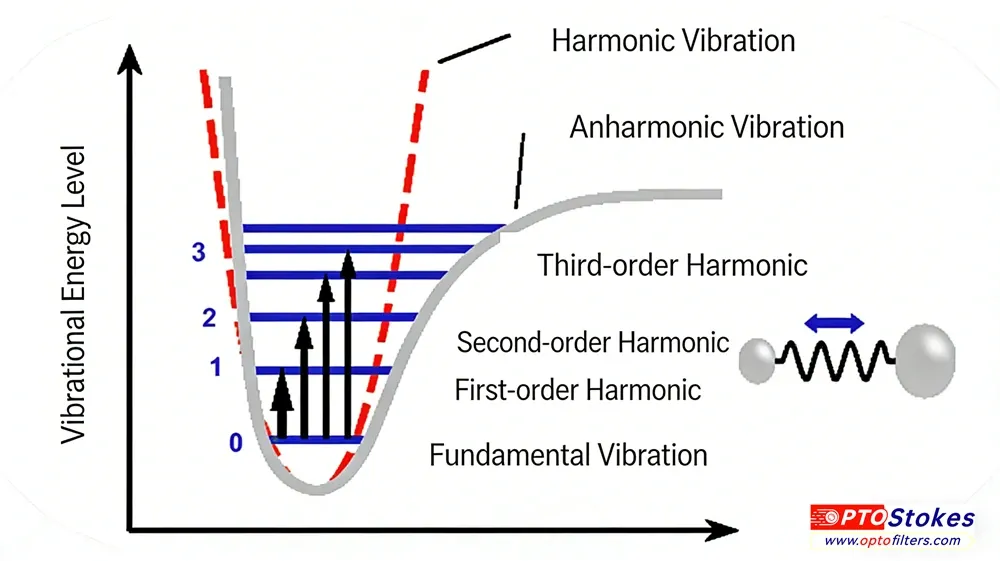
The key point is simple: NIR absorption bands are not fundamental vibrations. They are mainly overtones and combination bands derived from the stronger fundamental absorptions found in the mid-infrared region. That is why NIR peaks are broader, weaker, and more overlapped.
This is also why raw NIR spectra often look less intuitive than mid-IR spectra. Instead of clean, isolated fingerprint peaks, engineers usually see broad bands with significant overlap. As a result, NIR is powerful for rapid screening and quantitative models, but it is harder to interpret directly without strong optical design and data processing.
| Parameter | NIR Spectroscopy | Mid-IR Spectroscopy | Engineering Impact |
|---|---|---|---|
| Spectral range | 780–2500 nm | About 2500–25,000 nm | NIR is often easier to integrate into compact optical systems |
| Main transitions | Overtones and combination bands | Fundamental vibrational bands | Mid-IR gives clearer chemical identity; NIR is better for fast process sensing |
| Band intensity | Typically 1–5 orders weaker | Stronger absorption | NIR systems need better signal control and filter design |
| Band overlap | High | Lower | NIR often needs chemometrics and tighter spectral isolation |
| Direct interpretation | More difficult | More straightforward | NIR benefits more from application-specific optical filtering |
Which Bonds Dominate NIR Absorption?
The NIR region is especially sensitive to chemical groups that contain hydrogen. These groups generate the most useful overtone and combination absorptions. Other groups such as C=O or C=C can contribute, but their signals are usually weaker in the near infrared region.
| Bond Type | Typical Importance in NIR | What It Often Indicates |
|---|---|---|
| O-H | Very strong | Water, hydroxyl-rich compounds, moisture-sensitive materials |
| C-H | Very strong | Hydrocarbons, organics, polymers, oils, solvents |
| N-H | Strong | Amines, proteins, nitrogen-containing organics |
| S-H | Moderate | Thiols and sulfur-containing compounds |
| C=O / C=C | Weaker | Secondary structural information rather than dominant NIR response |
For many real systems, the useful signal does not come from a single isolated peak. It comes from a broad region where several overtone and combination bands overlap. That is exactly why filter selection matters. Poor spectral isolation can bury small but meaningful absorption differences under stray light and neighboring bands.
The Real Problem in NIR Systems
Problem
NIR signals are weaker than mid-IR fundamentals, and the bands often overlap severely. In a real instrument, that creates three common problems: low contrast between target and background, cross-talk between adjacent spectral regions, and unstable results when the source angle or detector response changes.
Analysis
If the optical filter is too broad, it collects unnecessary wavelengths and reduces selectivity. If out-of-band blocking is too weak, visible leakage or neighboring NIR bands can distort the result. If angle sensitivity is ignored, the center wavelength can shift enough to move the passband away from the intended absorption region.
| Filter Parameter | Why It Matters in NIR | Selection Priority |
|---|---|---|
| Center wavelength (CWL) | Determines which absorption region is sampled | Match the target bond or analyte window first |
| Bandwidth (FWHM) | Controls spectral selectivity versus throughput | Use narrower bands when overlap is severe |
| Out-of-band blocking | Reduces stray light and neighboring band interference | Critical for low-signal measurements |
| Angle sensitivity | Passband can shift under oblique incidence | Important in imaging and compact assemblies |
| Substrate and coating stability | Affects transmission, durability, and thermal performance | Must match the full system environment |
OPTOStokes Solution
OPTOStokes supports both ready-stock NIR filters and custom optical filter design for spectroscopy, sensing, and imaging platforms. Instead of choosing a generic wavelength and hoping it works, engineers can define the target band, bandwidth, blocking requirement, angle condition, and substrate constraint from the start.
This matters most when the spectrum is crowded and weak, which is common in NIR work. A better filter stack improves spectral separation, stabilizes the signal path, and reduces trial-and-error during system integration. For procurement teams, it also means a clearer path from specification to repeatable supply.
When NIR Is the Better Choice
NIR is not a replacement for mid-IR in every case. It becomes the better choice when the application values speed, deeper penetration, inline monitoring, or lower sample preparation burden more than direct fingerprint-style interpretation.
| Application Need | NIR Advantage | Decision Note |
|---|---|---|
| Fast inline process monitoring | Strong | NIR is widely preferred for continuous measurement systems |
| Minimal sample preparation | Strong | Useful for bulk materials, powders, films, and moving targets |
| Direct structural identification | Limited | Mid-IR usually provides clearer fingerprint information |
| Compact instrument integration | Strong | NIR optics are often easier to package into industrial platforms |
How to Select an NIR Filter More Efficiently
Step 1: Define the target chemical information first. Are you tracking moisture, organics, protein-related absorption, or a broad material classification signal? Without this step, filter selection becomes guesswork.
Step 2: Define the useful spectral window and the interference you must reject. In NIR, blocking performance is not a secondary specification. It directly affects measurement reliability.
Step 3: Match the filter to the full optical path, including source spectrum, detector sensitivity, incidence angle, temperature range, and package constraints. A good filter on paper can still fail inside the wrong optical architecture.
Step 4: Decide early whether a stock filter is sufficient or whether a custom design will save time at the system level. When the target band is narrow, weak, or close to interference, customization is usually the faster path.
Key Takeaway
NIR is powerful because it is fast and practical, but it is difficult because the useful signals are weak, broad, and heavily overlapped. That is why successful NIR systems depend not only on spectroscopy models, but also on disciplined optical filtering.
If you are defining an NIR spectroscopy or sensing platform, OPTOStokes can support wavelength-specific filter selection from prototype stage to controlled production. For stock and custom inquiries, visit https://www.optofilters.com/ or contact sales@optofilters.com.