Why NIR Quantitative Analysis Works
Near-infrared quantitative analysis is based on a simple principle: the detected spectrum carries information about the sample’s composition and structure. When a sample is placed between the light source and the detector, the transmitted or scattered light is modified by the material. That optical change can be correlated with concentration.
This is where NIR spectroscopy becomes useful for process control. It does not always deliver sharp fingerprint peaks like mid-IR, but it can provide fast, repeatable quantitative information when the optical path and sample condition are properly controlled.
Transmission NIR: The Stronger Basis for Quantitation
How Transmission Measurement Works
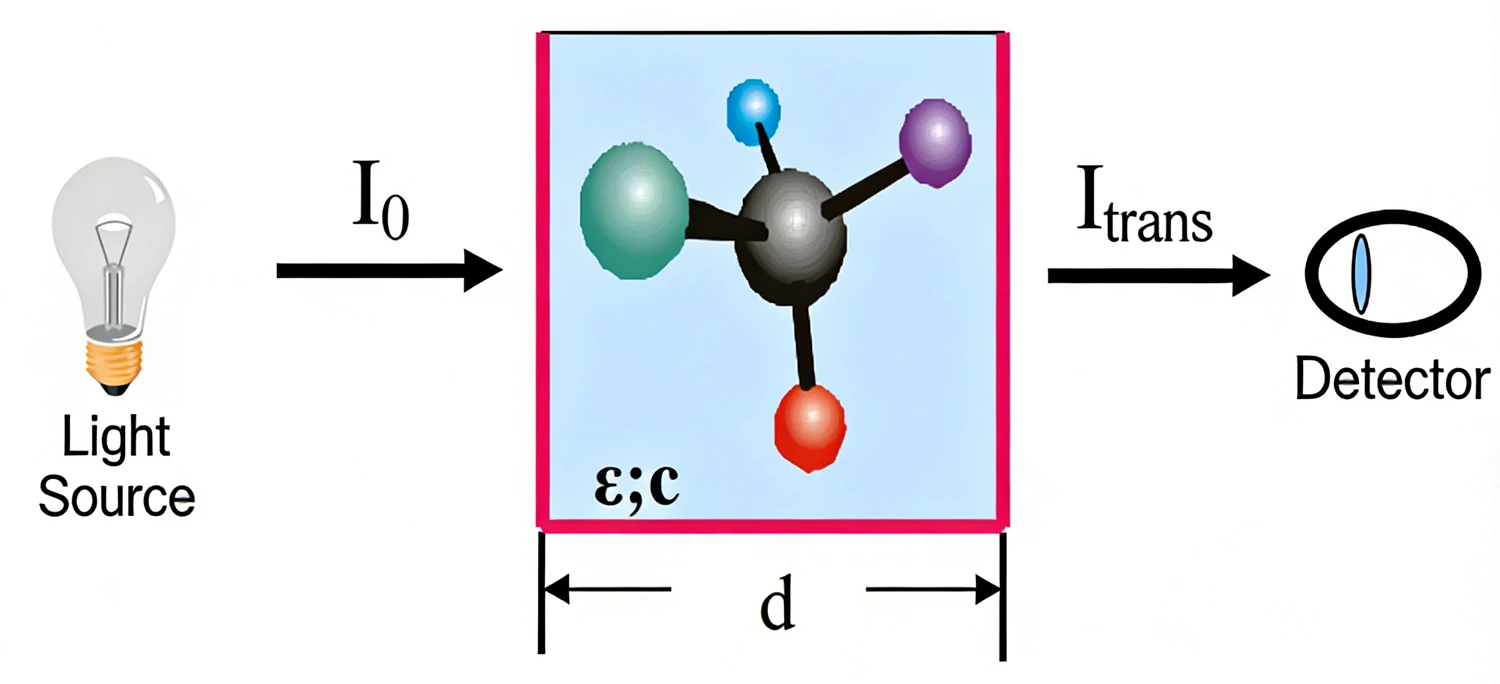
In transmission mode, the sample is placed directly between the incident beam and the detector. The measured spectrum is produced by the fraction of light that passes through the material. If the sample is a transparent liquid and the optical path length is fixed, the relationship between absorbance and concentration can be described by the Beer-Lambert law.
Beer-Lambert Law
A = -log(Itrans/I0) = εcd
Where:
| Symbol | Meaning |
|---|---|
| A | Absorbance |
| I0 | Incident light intensity |
| Itrans | Transmitted light intensity after passing through the sample |
| ε | Molar absorptivity of the target component |
| c | Concentration of the target component |
| d | Optical path length |
The engineering value of this equation is straightforward. If wavelength, path length, and optical stability are controlled, absorbance increases in proportion to concentration. That makes transmission NIR the cleaner and more defensible choice for quantitative analysis, especially in liquids and other optically consistent samples.
Why Diffuse Reflectance Is More Complicated
How Reflectance Measurement Works
In reflectance mode, the incident light enters the sample, undergoes multiple internal interactions, and then returns to the surface before reaching the detector. That returning light still carries useful chemical information, which is why diffuse reflectance is widely used for powders, granules, tablets, and rough solids.
However, the signal is no longer controlled only by concentration. It is also affected by particle size, particle distribution, surface texture, packing density, and sample shape. That is the key reason why reflectance-based quantitation is more conditional.
Apparent Absorbance in Diffuse Reflectance
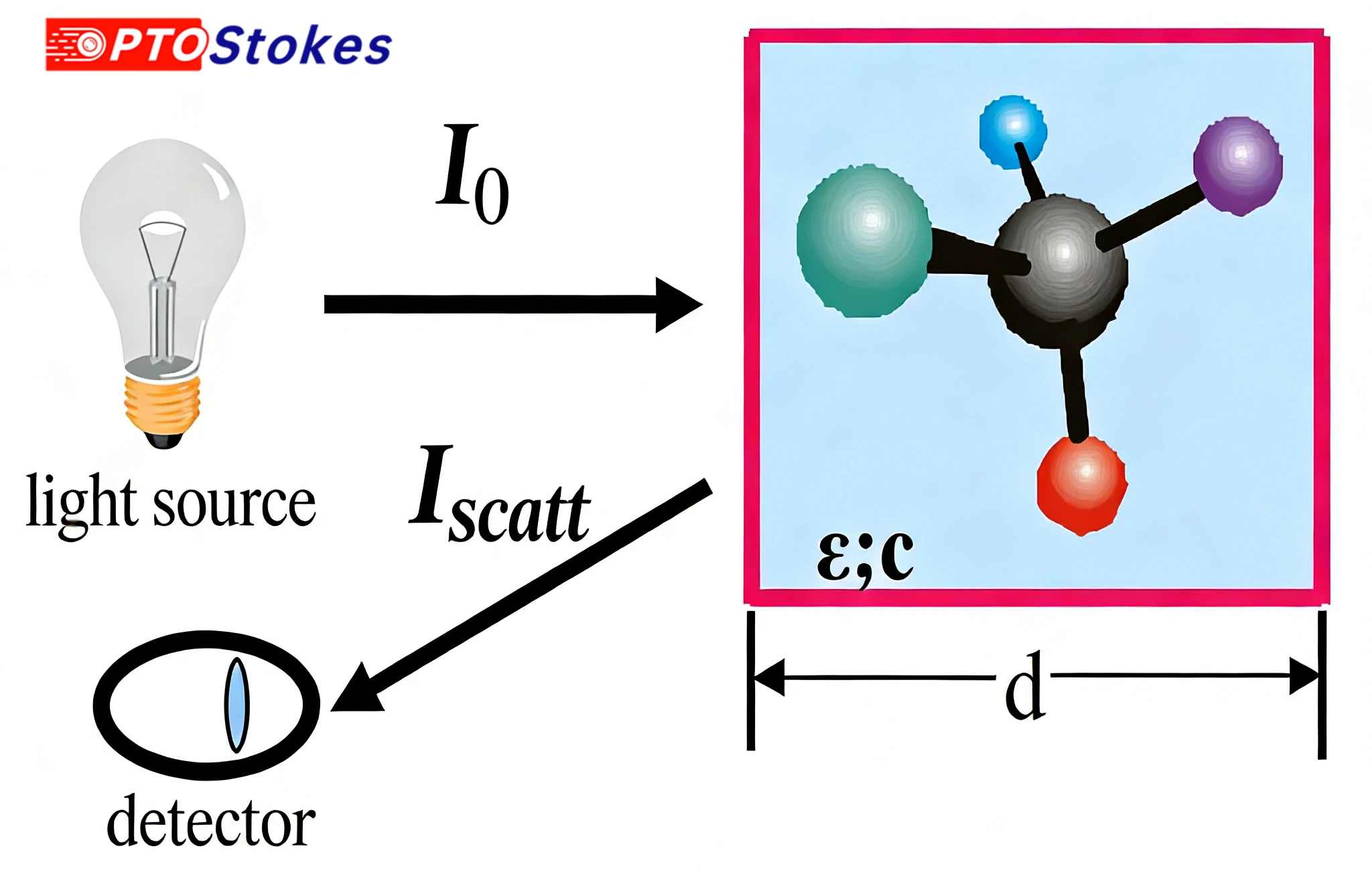
A = -log(Iscatt/I0) = -log(R)
Where:
| Symbol | Meaning |
|---|---|
| A | Apparent absorbance |
| I0 | Incident light intensity |
| Iscatt | Diffuse reflected light intensity from the sample |
| R | Measured reflectance |
In practice, this apparent absorbance can show an approximate linear relation to concentration, but only when the sample’s physical state is well controlled. That is why diffuse reflectance models often succeed in industrial quality control, yet still require stronger calibration discipline than transmission-based methods.
Transmission vs Reflectance for NIR Quantitative Analysis
| Factor | Transmission NIR | Diffuse Reflectance NIR |
|---|---|---|
| Theoretical basis | Direct Beer-Lambert relationship when path length is fixed | Approximate linearity only under controlled sample conditions |
| Best sample type | Transparent liquids, thin films, low-scatter samples | Powders, tablets, granules, rough solids, pastes |
| Main interference | Path length variation, stray light, source instability | Particle size, morphology, packing, scattering variation |
| Quantitative robustness | Usually stronger | Usually more model-dependent |
| Industrial usefulness | High for controlled liquid analysis | High for solid-state screening and routine QC |
What This Means for Real NIR System Design
Problem
Many NIR projects assume that once the target wavelength is chosen, the quantitative model will work automatically. That is wrong. If the collection geometry does not match the sample state, the spectrum may look stable but still carry the wrong analytical weight.
Analysis
For transmission systems, the priority is path-length consistency, detector stability, and suppression of stray light. For reflectance systems, the priority shifts to sample presentation, scattering control, and calibration robustness. In both cases, optical filtering directly affects signal purity.
OPTOStokes Solution
OPTOStokes supports NIR bandpass filters and custom optical filter solutions for quantitative instruments built around near infrared analysis. For transmission systems, filter design should protect spectral isolation and reduce out-of-band leakage. For reflectance systems, filter design should also account for lower signal intensity, stronger scatter, and higher sensitivity to background variation.
This is where filter specification stops being a catalog exercise. Center wavelength, bandwidth, blocking level, substrate choice, and angle behavior all influence whether the detected signal remains quantitative or becomes noisy and model-dependent.
How to Choose the Right Quantitative Strategy
Step 1: Start from the sample state. If the sample is optically clear and the path length can be fixed, transmission is usually the better quantitative route.
Step 2: If the sample is opaque, granular, or highly scattering, use reflectance, but accept that physical variability must be controlled alongside chemistry.
Step 3: Match the optical filter to the full measurement geometry rather than to wavelength alone. The same analyte window can behave very differently under different sampling modes.
Step 4: Build calibration around real production variation, not ideal lab samples. That is especially important in reflectance-based NIR quantitation.
Key Takeaway
Transmission NIR gives the cleaner theoretical path to quantitation because it can follow Beer-Lambert law more directly. Diffuse reflectance NIR remains highly useful, but its quantitative performance depends far more on sample physics.
If your system requires stable NIR quantitation, the right optical filter is not optional. It is part of the measurement model itself. For stock and custom inquiries, visit OPTOStokes at optofilters.com or contact sales@optofilters.com.