
Product Description
BP808nm Industrial Vision Bandpass Filter 30nm Bandwidth OD2 Cut off 350-1100nm
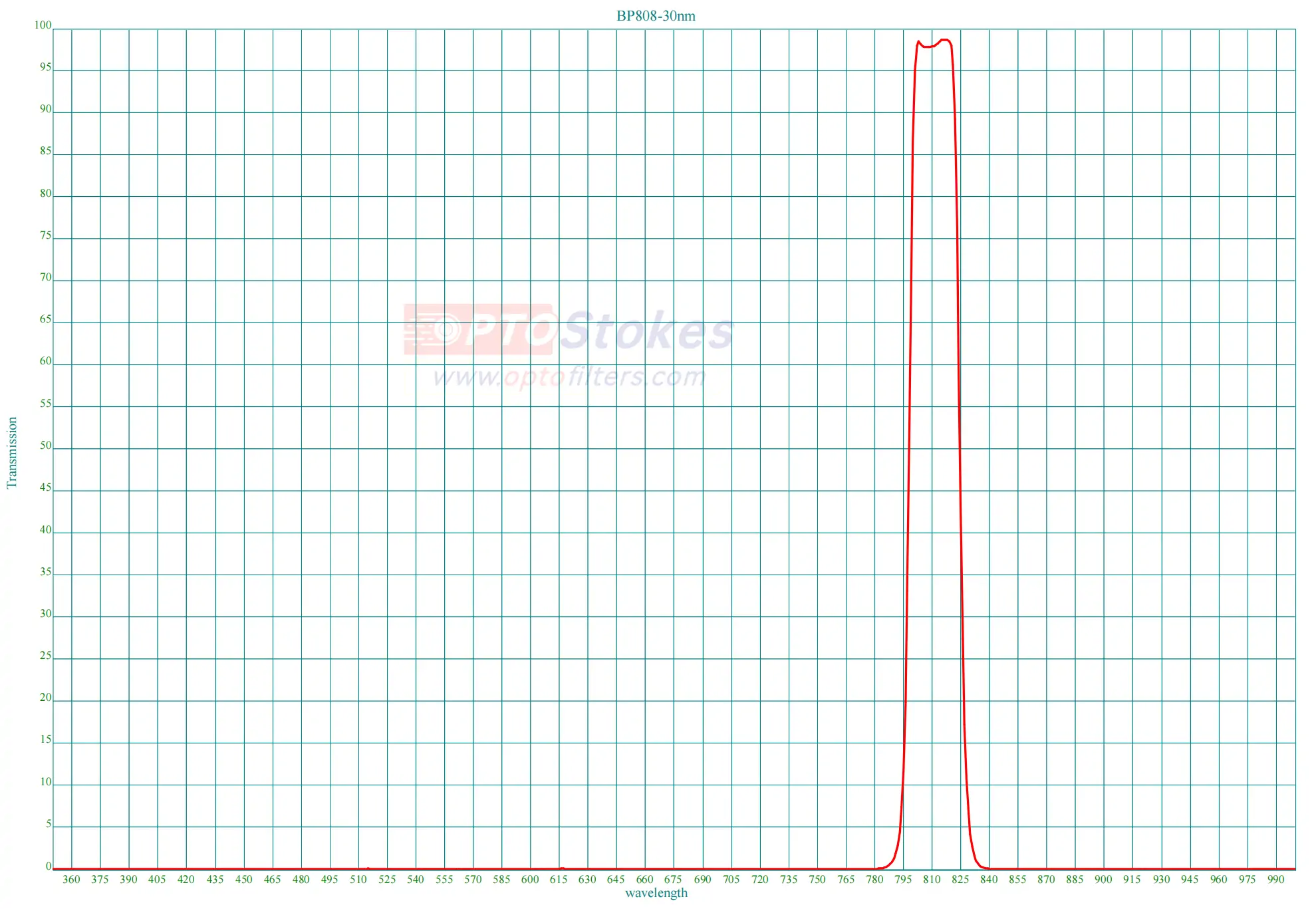
This BP808nm bandpass filter is designed specifically for 808nm near-infrared light source scenes, with a peak transmittance of over 90% in the 805-815nm passband. It also achieves a depth cutoff of OD>2 in the 350-1100nm wide band, effectively blocking environmental noise interference and improving the contrast and detection accuracy of industrial imaging systems.
Technical specifications
| Parameter item | Specification indicators | Remarks |
|---|---|---|
| Center wavelength | 808±3nm | Testing under normal incidence conditions |
| Passband range | 805-815nm | Transmittance within the passband>90% |
| Half width at half maximum (FWHM) | 30±3nm | Actual finished product bandwidth 27-33nm |
| Cut off depth | 350-1100nm OD>2 | Maximum out of band transmittance ≤ 1% |
| Lens thickness | 1.1mm | The thickness tolerance of the substrate can be adjusted as needed |
| Incident angle | Nominal 0 ° normal incidence | Tilting installation will cause the center wavelength to shift towards shorter wavelengths |
Selection example: Industrial surface defect detection scenario
In industrial infrared vision surface defect detection, it is common to use an 808nm near-infrared fill light source to filter visible light and other stray light in the workshop environment, in order to avoid excessive imaging noise caused by background reflection and light interference. This BP808nm filter with a bandwidth of 30nm completely covers the emission spectrum of the 808nm light source, ensuring sufficient light flux for the camera to obtain clear imaging and suppressing environmental noise in the 350-1100nm range to less than 1%, greatly improving the recognition rate of small defects such as scratches and bumps. When selecting, it is necessary to confirm the actual installation angle of the system in advance to avoid large angle oblique incidence causing passband shift and allowing the light source wavelength to fall at the edge of the passband.
Common selection misconceptions
Many engineers only check the center wavelength and peak transmittance when selecting, ignoring the influence of installation tilt angle on narrowband filters: in industrial vision systems, if the filter has an oblique incidence of more than 5 °, the center wavelength of the 808nm filter with a bandwidth of 30nm will shift to shorter wavelengths by several nanometers, and the 808nm light source originally located at the center of the passband may shift to the edge of the passband, resulting in a significant decrease in actual imaging brightness. The correct verification method is to test the imaging brightness at the actual installation angle of the system after obtaining the filter, and confirm that the wavelength of the light source is always within the effective range of the passband. Do not directly install it according to the nominal value of normal incidence.
Customization and supply support
Standard circular and square lenses are available in regular stock, and rectangular and irregular contours can be customized according to drawings. The matching installation ring can adapt to most industrial camera lens fixtures. The center wavelength, bandwidth, cutoff depth, and lens thickness can be adjusted according to project requirements, and customized coating and precision machining services can be provided for non-standard specifications.
Consultation and Inquiry
If your system has problems with imaging dark angles, excessive background noise, and low line to background ratio, you can provide actual light source wavelengths, installation incident angles, and system size drawings, and contact our optical engineers to assist in verifying passband compatibility. Consultation email: sales@optofilters.com
Tags: infrared filter bandpass filter 808nm industrial vision filter