
Product Description
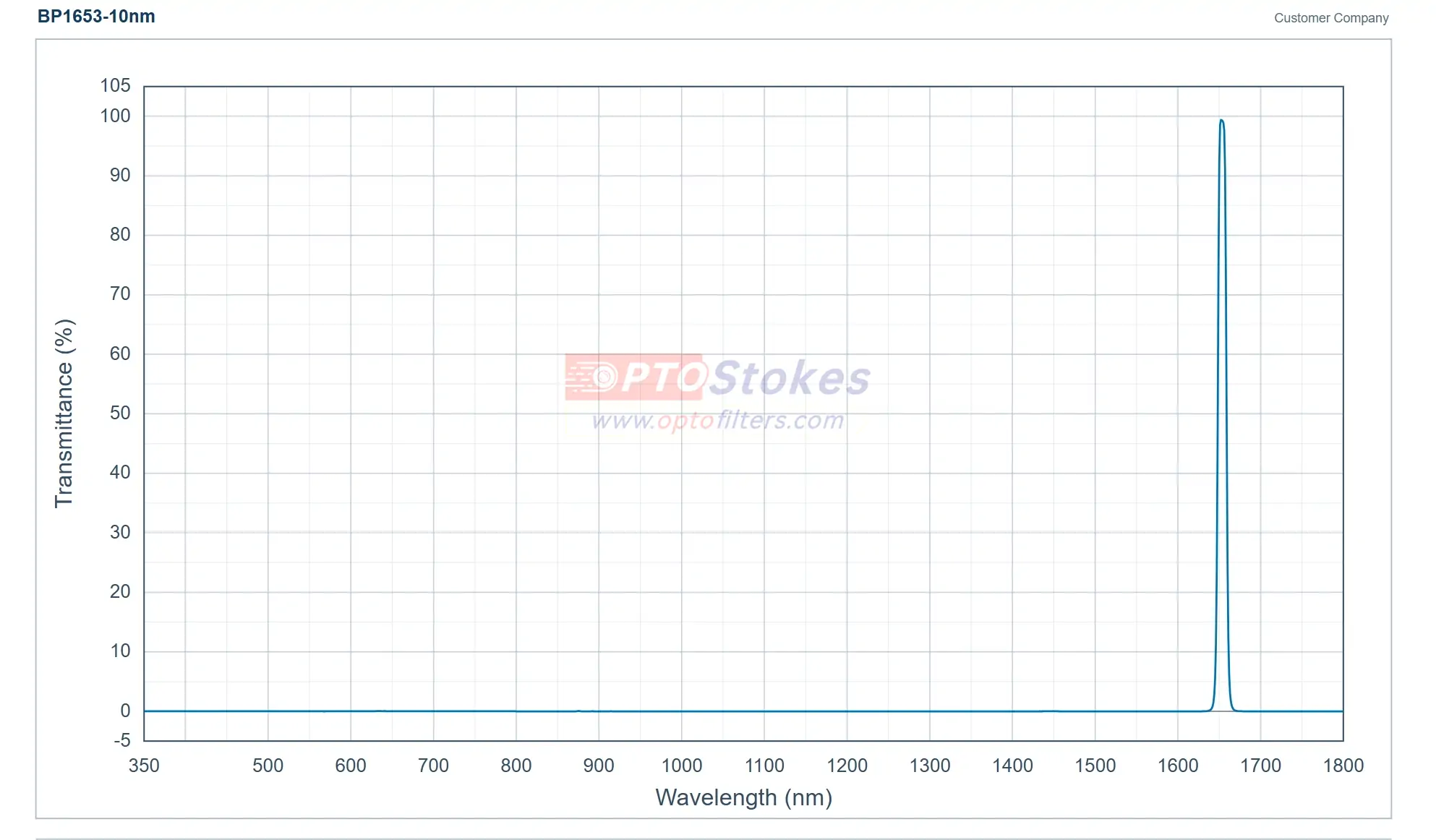
BP1653 narrowband filter: 1653nm ± 2nm, 10nm bandwidth, Block 350-1800nm
BP1653 is a near-infrared narrowband filter with a center wavelength of 1653nm and a half width of 10nm. It is installed in front of the detector in the gas detection optical path to block ambient light and stray light outside the passband, allowing absorption measurements to fall on a clean background. The signal variation of such systems is often only a few thousandths to a few tens of thousands, and whether the blockage is clean or not can determine the stability of the baseline more than the peak transmittance.
Its blocking range is worth a separate look: continuous coverage from 350-1800nm, covering a range from ultraviolet to near-infrared. This span is very practical for gas detection - the edge mode, pump leakage, factory lighting, and sunlight of DFB lasers mostly fall within this range.
Technical specifications
| Parameters | Specifications | Description |
|---|---|---|
| Product model | BP1653 | Bandwidth and blocking are subject to the following table |
| Center wavelength CWL | 1653 ± 2nm | Nominal incident angle 0 ° |
| FWHM | 10 ± 2nm | When the transmittance drops to 50% of the peak, the distance between two points |
| Transmittance | T>1653nm@ 90% | Single point indicator, the width of the high transparency interval is based on the measured curve |
| Blocking range | 350-1800nm (excluding passband), OD> 3 | OD3 corresponds to a transmittance of 0.1% |
| Incident angle | 0 ° | Other working angles need to be confirmed separately |
| Thickness/Shape | Confirm according to inquiry | No fixed specifications specified on this page |
Three details determine whether this piece can be used correctly. The blocking interval is written as' passband excluded '- the area around 1653nm is a highly transparent region, which should not be included in any blocking promises. When reading the specifications, this section should be taken out from 350-1800nm for reference. OD> 3 corresponds to a transmittance of 0.1%, which is the general grade for this level. The specifications do not specify whether it is the minimum or average value of the band. When purchasing, it should be clearly accepted according to the minimum value. Thirdly, at 1653nm, T>; 90% "is a single point indicator, and the actual width of the high transparency zone within the passband is determined by the membrane system. The actual measured curve is more reliable than the nominal value.
Gas detection: a parameter based selection deduction
The following is a deduction example, not a customer case.
Requirement: Online monitoring of methane in pipelines or open optical paths, with DFB laser scanning absorption lines near 1653nm, optical path length of several meters, and InGaAs detector.. Under the illumination or sunlight in the factory area, the ambient light entering the detector will raise the background of the absorbed signal, and even submerge several ppm of changes.
1653nm falls near the methane 2 × 3 frequency band and is one of the commonly used bands for TDLAS detection of methane; The specific position and line strength of the absorption line need to be checked against the HITRAN data according to the target gas, and this page does not guarantee the absorption line. This band also has a practical benefit: 1.65 μ m is located in the near-infrared region that is relatively safe for the human eye, and the risk of open light path debugging is lower than that of visible light and short wave near-infrared. The filter itself does not provide laser safety protection function.
Why 10nm: The wavelength tuning range of DFB is usually only a few nanometers, and the 10nm passband covers both the scanning area and leaves room for junction temperature drift.. Even narrower, a change in temperature may squeeze the absorption line out of the passband; Even wider, the suppression of ambient light deteriorates accordingly. The reasonable value of bandwidth is determined by the tuning range, not the narrower the better.
Why is 0 ° appropriate: TDLAS has a collimated optical path, small beam divergence, and 0 ° incidence is consistent with the design conditions, without the need for additional compensation..
Is OD3 sufficient?: The key depends on the type of light source.. Narrow linewidth lasers already have less energy outside the band, and OD3 (0.1%) is mainly used to block ambient light, which is sufficient for most ppm level detections. If changing to long path length, strong sunlight, or ppb level targets results in an increase in ambient light collection, it is necessary to evaluate whether it has risen above OD4.
Before placing an order, it should be verified that the actual measurement passes through the curve rather than the nominal value.; The lowest transmittance of the laser at the wavelength landing point throughout the entire operating temperature range; Is the upper limit of detector response within 1800nm (InGaAs typically up to 1700nm, just covered); The actual verticality of the filter holder.
Two easily trampled misjudgments
One is the transmittance of only the central wavelength of the nucleus. The specification states T>1653nm@90%, but the actual operating wavelength of DFB is determined by the junction temperature and driving current, rarely stopping at exactly 1653nm. The two sides of the 10nm passband are already moving downwards, and if the laser works stably at 1654nm, the measured transmission may have dropped to just over 70% - the signal is 20% weaker, but according to the specifications, there is no violation. The correct approach is to mark the wavelength range of the laser throughout the entire operating temperature range, and require the supplier to provide the lowest transmittance within this range, rather than the center wavelength.
The second is to install a deviated mirror holder according to a 0 ° curve. The 10nm passband is more sensitive to angles than 13nm and 20nm. According to the estimation of the effective refractive index of typical film systems, a 5 ° oblique incidence causes a blue shift of approximately 1-1.5nm, while a 10 ° angle results in a 3-5 nm shift, accounting for a quarter to half of the passband. The perpendicularity tolerance between the filter holder and the optical axis, whether the pressure ring bends the lens, and the divergence angle of the beam itself will ultimately be converted into equivalent incident angles. After installation, use a known wavelength light source to measure the transmission once, which is more reliable than on the drawing.
Customization and delivery support
In addition to this specification, the shape can be adjusted according to the project (circular, square, irregular), matched with a set of card rings, and the substrate and coating design can be changed, including extending the blocking range beyond 1800nm, increasing the OD level, and redesigning according to the actual working angle. Samples and measured spectral data can be provided by project. Batch applications also require confirmation of batch consistency with a center wavelength of ± 2nm - if multi-channel instruments cannot be calibrated piece by piece, the wavelength distribution between batches must be agreed upon in advance. For the complete category, please refer to<a ref=“ https://www.optofilters.com/product/OpticalFilters.html Classification of Optical Filter Products
Information required for inquiry
Please provide: target center wavelength and bandwidth, laser wavelength range throughout the entire operating temperature range, operating incident angle and beam divergence angle, external dimensions and aperture, annual usage, operating temperature range, detector type and response upper limit. The second point is often overlooked, but it is the key to determining whether this piece is suitable or not. Technical Consultation and Inquiry: sales@optofilters.com , or through<a ref=“ https://www.optofilters.com/single/contact-us.html Contact us on thepage to submit.
Tags: 1653nm narrowband filter 1653nm bandpass filter gas detection filter methane detection filter BP1653 NIR narrowband filter