
Products Description
BP624/40+DM660+BP694/40: cy5channel fluorescent filter set
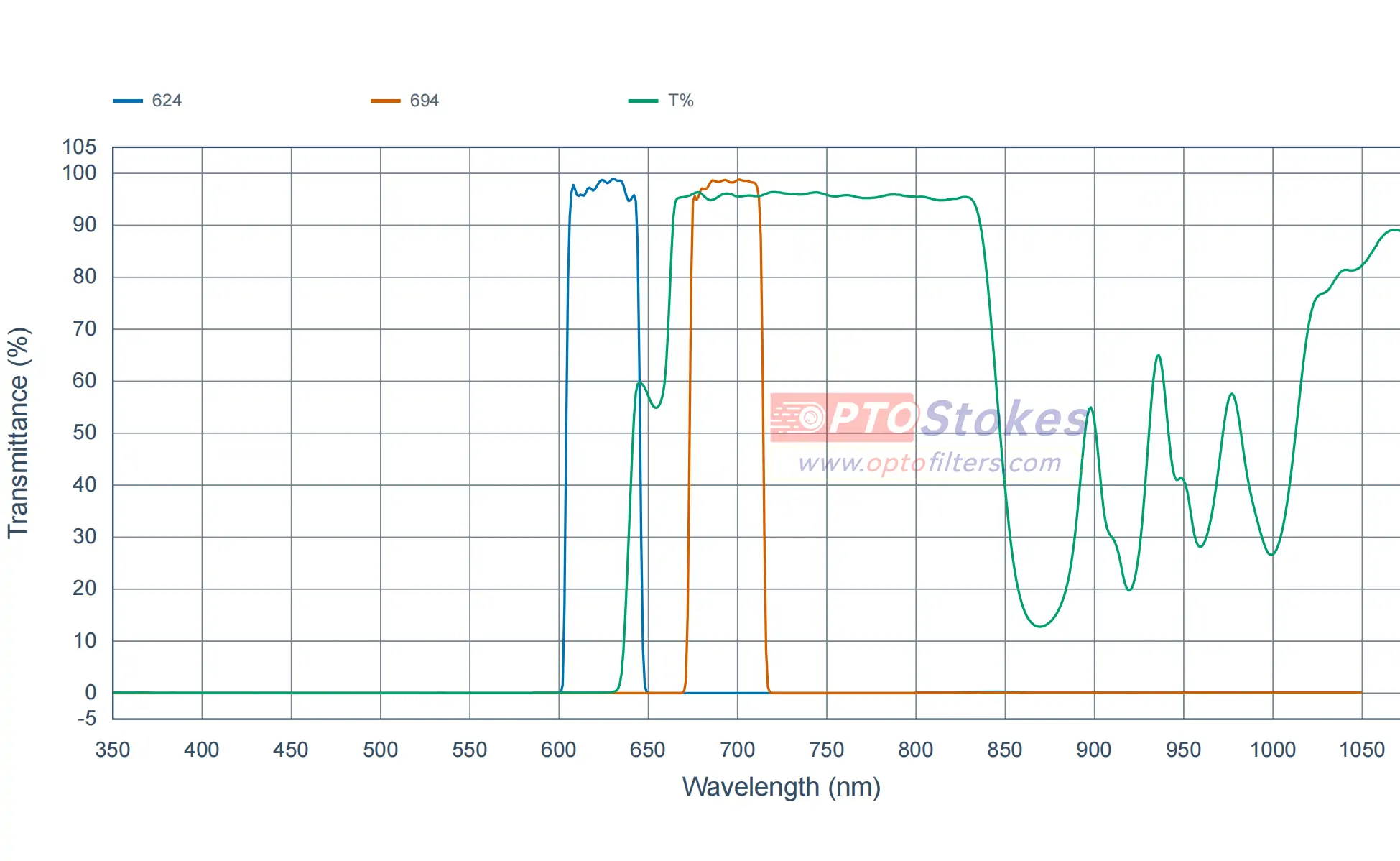
This is a set of three combinations for the far red channel: BP624/40 limits the excitation band, DM660 reflects the excitation light to the sample at 45 ° and allows the emission light to pass through, and BP694/40 intercepts the emission band in front of the detector. The division of labor for the three pieces is fixed, and the frequency bands must be checked together. Looking at any one piece alone will not be accurate.
Technical specifications
BP624/40 (excitation)BP694/40 (emission)
| Parameters | BP624/40(EX) | DM660 (dichroic mirror) | BP694/40(EM) |
|---|---|---|---|
| Passband and transmittance | 609–639nm,Tave> 90% | 670–700nm,T> 95% | 680–708nm,Tave> 90% |
| Center wavelength | 624±2nm | — | 694±2nm |
| Bandwidth FWHM | 40±2nm | — | 40±2nm |
| Blocking and Reflecting Bands | 350-594nm, 655-800nm, 800-1050nm (OD values not provided, confirmation required) | 430–650nm,T< 2% | 350–664nm、730–800nm:ODave> 6(OD>5); 800–1050nm:OD> 3 |
| Incident angle | 0° | 45° | 0° |
What channel is this band suitable for
Its characteristic is that the excitation band (609-639nm) is widely separated from the emission band (680-708nm), and the middle is cut by DM660 near 660nm. Compared to the short wave channel where excitation and emission are only separated by about twenty nanometers, the far red channel has a larger filter margin and lower risk of cross color; The cost is that the fluorescence signal itself is weaker, and the sensitivity and exposure time of the detector need to keep up.
Selection Example: A far red imaging optical path that requires excitation around 620nm and collection and emission around 690nm.. Select BP624/40 for limited excitation, BP694/40 for truncated emission, and DM660 for 45 ° spectroscopy. There are three boundaries: all three are defined as 0 °/45 ° collimated light, and the clearly converging light path is not applicable; The actual installation angle of DM660 deviates by 45 °, and the separation degree around 660nm will change; The blockade of BP624/40 does not have an OD value attached, and the ability to suppress ambient light cannot be evaluated. When verifying, a filter block should be installed to measure the excitation and emission spectra of the entire group, and it should be confirmed that the emission peak of the fluorescent group does indeed fall within 680-708nm - for orange red dyes such as ROX with an emission peak of about 604nm, this emission plate cannot receive a signal.
The most easily overlooked pit: the endpoint of the dichroic mirror transmission band
DM660 indicates that the transmittance between 670-700nm is higher than 95%, and no indicators are given for wavelengths above 700nm; The passband of BP694/40 reaches 708nm. When viewed at the center wavelength of 694, it falls completely within the transmission band, resembling a tight fitting seam; Including the passband width, the longest 8nm is actually in the range without specification guarantee.
The consequence is that a piece of the long wavelength end of the emission band is cut off in advance, the signal integration decreases, the imaging of weak fluorescent samples becomes darker and requires longer exposure, while the curves of the two individual retests are qualified. The verification method is very straightforward: overlay DM660 and BP694/40 to measure the combined transmission curve, focusing on whether there is an early drop near 700nm, rather than looking at two separate specification sheets.
Customization and Service
All three pieces can be processed into circular, square, or irregular shapes, equipped with snap rings, or delivered as a whole filter block assembly; It is recommended to confirm the size, thickness, and collar structure together with the filter block model. In addition, the blocking band of BP624/40 is currently only provided with a range and no OD value. If it is to be used for strong ambient light or long exposure imaging, this item needs to be supplemented during the inquiry.
To verify if this combination matches your fluorophore, you can send the dye name, excitation and emission bands, filter block model and installation size, and estimated quantity to sales@optofilters.com 。 The configuration of other channels can refer to<a ref=“ https://www.optofilters.com/product/FluorescenceFilterSets.html Fluorescent filter group; when replacing one of them separately,<a ref= https://www.optofilters.com/product/BandpassFilters.html Bandpass filters can be classified by center wavelength and bandwidth.
Tags: BP624/40 BP694/40 DM660 far-red filter set fluorescence microscopy dichroic mirror