
Product Description
SP410 UV Short Pass Filter: 320-400nm Transmitting, 200-630nm Blocking OD5
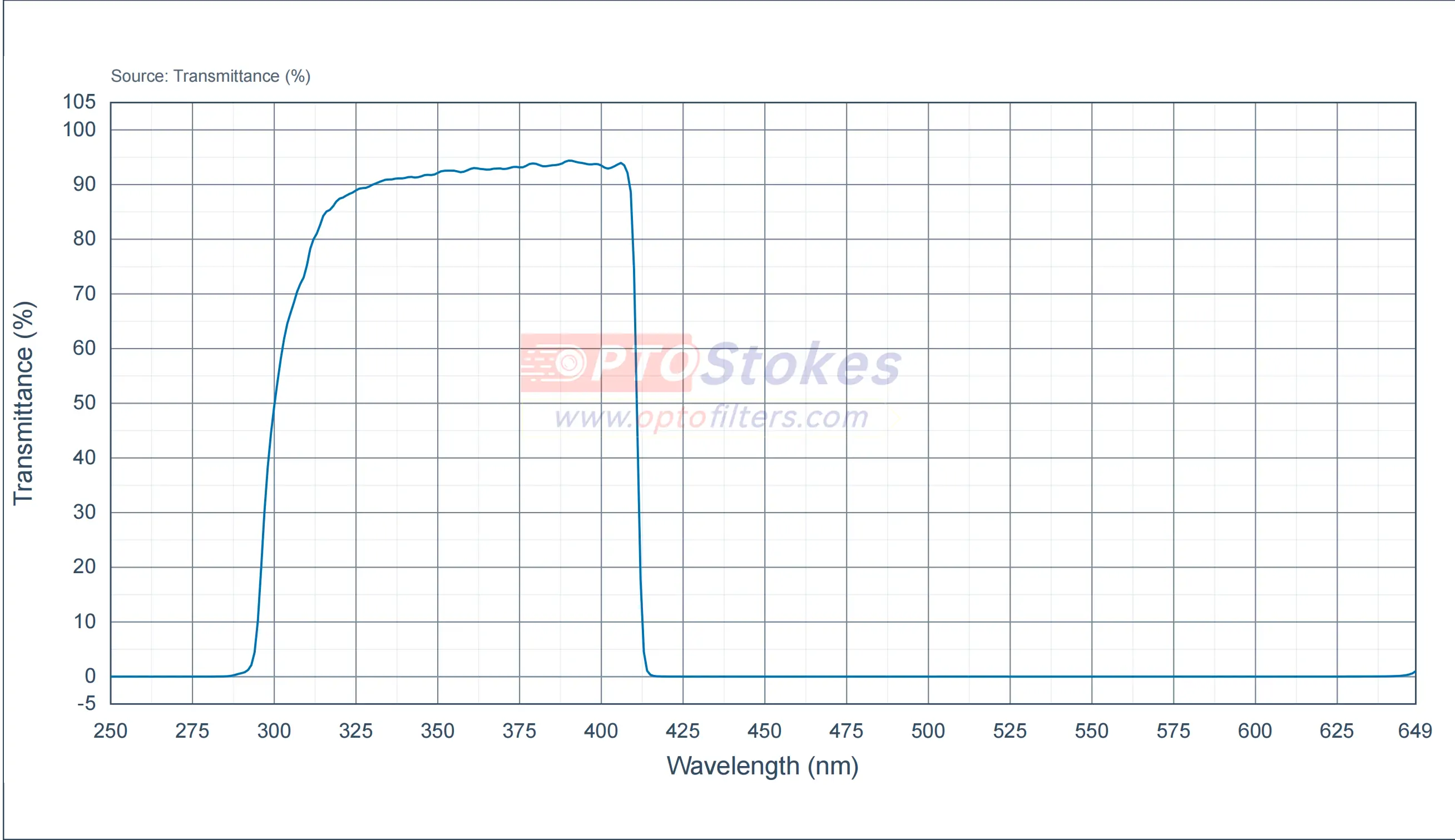
SP410 is a UV short pass filter: 320-400nm is applied, and the remaining part of 200-630nm is pressed below OD5. It solves the same type of problem - the signal is in ultraviolet, while everything else in the room is brighter than it. The surface inspection of solar cells is the most typical occasion. It is not the 90% inside the band that determines its usability, but the 0.001% outside the band.
Technical specifications
| Parameters | Specifications | Description |
|---|---|---|
| Product model | SPF410 | Short circuit, nominal 410nm cutoff |
| passband | 320-400nm, Tave>;90% | band average transmittance, non peak |
| Shortwave side blocking | 200-280nm, ODAVE>5 | OD5 corresponds to a transmittance of 0.001% |
| Long wave side blockade | 420-630nm, OD AVE>5 | Input the labeled range of 200-630nm as the out of band range |
| Incident angle | 0 ° | Other working angles need to be confirmed separately |
| Thickness/Size/Substrate | Confirm by inquiry | No fixed specifications specified on this page |
To block that section, it needs to be split into two parts for reading. The specification states that the wavelength range of 200-630nm is around the open band: 200-320nm on the short wave side and 420-630nm on the long wave side. The curve between 400 and 410nm drops from 90% to OD5, which is why the cutoff mark is at 410nm but the passband stops at 400nm. If the detection wavelength is between 396-400nm, it is actually standing on the shoulder.
Surface inspection of solar cells: a parameter based selection deduction
The following is a deduction example, not a customer case.
Requirement: Surface inspection station for battery cells, illuminated by 365nm or 395nm ultraviolet light sources, with filters installed in front of the camera or light source, aiming to detect scratches, stains, adhesive residue, and microcracks.
Why use ultraviolet: Photons between 365-395nm are scattered within a few micrometers on the surface of silicon wafers and do not travel into the body, thus amplifying the contrast of surface features. Visible light cannot achieve this - it will penetrate into silicon, and surface details will be smoothed out by volume effects.
Why must it be OD5: The ultraviolet signal itself is very weak, and on workstations without shading, indoor visible light is often two to three orders of magnitude stronger than it. OD2 (1%) and OD3 (0.1%) cannot block it, and the leaked visible light will flatten the image, causing the defect to disappear. OD5needs to apply an out of band pressure of one ten thousandth to maintain the ratio of signal to background.
Why wear it on the light source side: first purify the spectrum of the light source, and then naturally reduce stray light, which is more convenient than blocking it in front of the camera. The method of installing on both sides also exists, depending on the shading conditions of the workstation.
Applicable boundary: 0 ° incidence; The camera has actual response to 320-400nm; The workstation has basic shading or sufficient light source power.
Before placing an order, it is necessary to verify the quantum efficiency curve of the camera in ultraviolet light; Measured transmittance around 396-400nm; The substrate absorption at the 280nm end - ordinary glass has already begun to absorb here and requires materials such as fused quartz to hold on.
Two easily trampled misjudgments
One reason is that they thought changing the filter would enable UV imaging. Ordinary CMOS pixels have polycrystalline silicon gates and microlenses in front of them, which have strong absorption of UVA. The quantum efficiency of 320-400nm is often only in the single digits. No matter how clean the filter is, it's useless if the sensor doesn't respond. This is the most common misjudgment in UV detection projects: buying a filter first, the image cannot be adjusted, and then changing the camera later, both the project schedule and budget are lost. The correct sequence is to first confirm the UV response curve of the camera, and then determine the edges of the filter.
The second is to treat 400nm as a wall. 400nm is the upper limit of the passband, 420nm is the cutoff point, and the middle 10nm is the descending segment of the curve, not perpendicular. If the detection wavelength is pressed to 395-400nm, the actual energy obtained is already decreasing, and the exposure time will be longer than estimated at 90%. Move the lighting center to 365-385nm, and the margin will immediately widen without spending a penny. This one is the easiest to adjust during the sampling stage, but it will be more expensive to make changes after the structural components are completed.
Customization and delivery support
The cutoff wavelength and transition band can be adjusted according to the project, the substrate can be changed (whether the 280nm end can be maintained depends on this), the anti reflection within the passband can be optimized, the blocking level can be increased, circular square and irregular shapes can be processed, and a set of card rings can be matched. Samples and measured spectral data can be provided by project. Batch supply requires agreement on whether OD5 is the minimum or average value - the number of membrane layers and price corresponding to the two calibers are different, and the cost of disputes afterwards is much higher than a previous statement. For more specifications of the short circuit series, please refer to<a href=“ https://www.optofilters.com/product/Shortpass_Filter.html Short pass filter, for other models in the ultraviolet band, please refer to<a ref=" https://www.optofilters.com/product/UV_Bandpass_Filter.html UV bandpass filter
Information required for inquiry
Please provide: detection wavelength and light source type, camera model and UV response, filter installation position (light source side or camera side), external dimensions and aperture, workstation shading conditions, and annual usage. The first and third points are the most crucial - the light source determines whether the passband is sufficient, and the camera determines whether this solution is feasible or not. Technical Consultation and Inquiry: sales@optofilters.com , or through<a ref=“ https://www.optofilters.com/single/contact-us.html Contact us on thepage to submit.
Tags: UV short pass filter 320-400nm filter solar cell detection UV imaging OD5 blocking SF410