
Product Description
SP375 UV Short Pass Filter: 320-370nm Transmitting, 200-800nm Blocking Average OD5
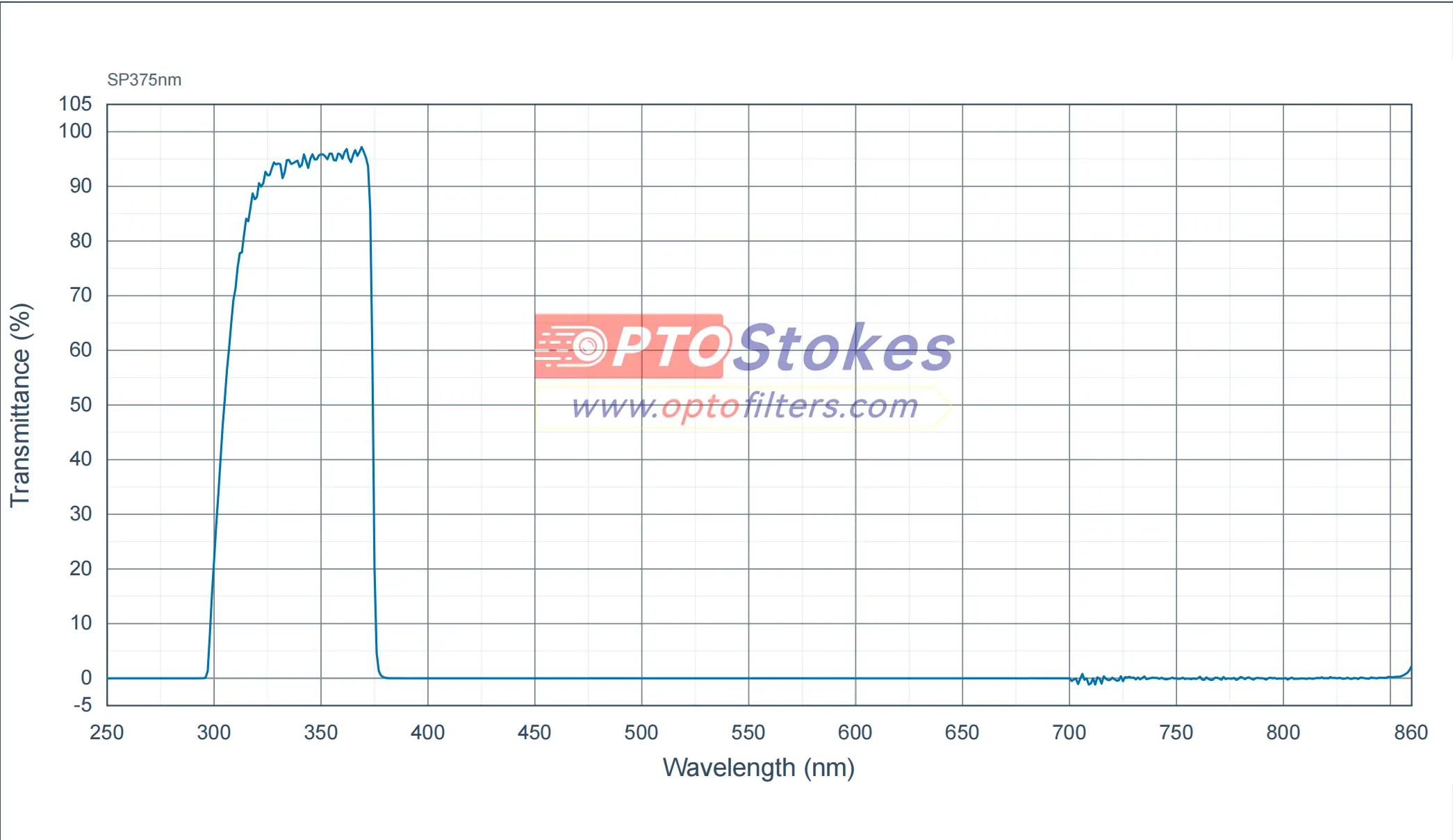
SP375 is a UV short pass filter: 320-370nm is applied, and the entire 200-800nm range outside the passband is compressed to an average OD5. OD5 corresponds to a transmittance of one millionth, which is two orders of magnitude deeper than common OD4 short pass chips. This level is not designed for ordinary UV imaging - it is used in situations where the UV signal itself is weak and the detection is limited to visible leaks rather than detector noise.
Technical specifications
| Parameters | Specifications | Description |
|---|---|---|
| Product model | SP375 | Short circuit, nominal 375nm cutoff |
| passband | 320-370nm, Tave>; 90% | band average transmittance, non peak |
| Shortwave side blocking | 200-320nm, ODave>; 5 | OD5 corresponds to a transmittance of 0.001% |
| Long wave side blockade | 370-800nm, ODave>; 5 | Input the labeled range of 200-800nm as the out of band range |
| Incident angle | 0 ° | Other working angles need to be confirmed separately |
| Thickness | 1.0mm | Single substrate thickness |
| Appearance/Dimensions/Substrate | Confirm by inquiry | No fixed specifications specified on this page |
Block needs to be read in two parts. The term '200-800nm' refers to the wavelength range of 200-320nm on the short wave side and 370-800nm on the long wave side. Between 370nm and 375nm, the curve falls from 90% to OD5, which is the most difficult part to achieve in the entire film system - the narrower the transition band, the deeper the blockage, the more layers there are, and the greater the stress. A thickness of 1.0mm is not only considered for mechanical strength, but also provides a more stable substrate for multilayer films.
UV detection: a parameter based selection deduction
The following is a deduction example, not a customer case.
Requirement: UV detection station, illuminated by 365nm mercury lamp or UV LED, with filter installed on the light source side or camera side, detecting surface thin layer residues, low contrast defects, or weak UV fluorescence.
Why cut at 370nm: 365nm is the main peak of mainstream ultraviolet light sources, and the upper limit of 370nm just allows it to pass completely, while cutting off the visible range from the source. The lower limit of 320nm avoids shorter wavelength bands, where material absorption increases sharply and the actual flux of the optical system drops quickly.
Why it must be OD5: If the detection limit is determined by the background rather than noise, the 0.01% leakage of OD4 is the ceiling. Signals such as weak fluorescence and thin layer residue are often four to six orders of magnitude weaker than indoor visible light. Only when the out of band pressure is reduced to one millionth can the signal-to-noise ratio be determined by the detector itself. This is also the reason why it is more expensive than the OD4 models in the same series - the extra layers are real.
Applicable boundary: 0 ° incidence; The main peak of the light source falls within 320-370nm; The substrate does not absorb at the 320nm end.
Before placing an order, verify the measured position of the 370-375nm transition band; Is OD5 the average or minimum value; Substrate material (ordinary glass at 320nm end has obvious absorption and needs to be fused with quartz); And the fluorescence level of the filter itself under 365nm irradiation.
Two easily trampled misjudgments
One is to use ODave>; 5 is pronounced as' every point is greater than 5 '. The average value allows individual wavelengths to drop, and there will be low points near the transition zone and material absorption edge of the membrane. If the interference source is right at the low point, even if the average value is beautiful, it will not solve the problem. The safe approach is to request the complete scan curve, identify the worst point, and then compare it with your own light source spectrum, rather than signing just by checking a number.
Secondly, only transmission is considered, not spontaneous fluorescence. OD5 can handle the light passing through, but cannot handle the light emitted by the film layer and substrate themselves. When applied at 365nm, some coating materials and ordinary glass substrates will emit visible fluorescence. This part of the light does not pass through the blocking logic of the film system and is directly superimposed on the signal - you think the background has been pressed to one millionth, but in reality it is limited by a piece of "self illuminating" glass. When performing UV fluorescence or low light UV imaging, whether the substrate has low fluorescence and whether the film material is clean are more effective than OD that is one order of magnitude deeper, which is usually not seen in the specification book and must be separately mentioned.
Customization and delivery support
The cutoff wavelength and transition band can be adjusted according to the project, the substrate can be changed, the transparency within the passband can be optimized, the thickness can be changed, circular square and irregular shapes can be processed, and a set of snap rings can be matched. Samples and measured spectral data can be provided by project. Batch supply must agree on whether to take the average or minimum OD5 value - there is a significant difference in the number of layers and price between the two calibers, and the cost of disputes afterwards is much higher than a single sentence beforehand. For other specifications of the short circuit series, please refer to<a ref=“ https://www.optofilters.com/product/Shortpass_Filter.html Short pass filter, for other models in the ultraviolet band, please refer to<a ref=" https://www.optofilters.com/product/UV_Bandpass_Filter.html UV bandpass filter
Information required for inquiry
Please provide: detection wavelength and light source type (mercury lamp or UV LED), response range of camera or detector, installation position of filter, external dimensions and aperture, substrate material requirements, whether low fluorescence version is required, and annual usage. The first and sixth points are the most crucial - the light source determines whether the passband boundary is sufficient, and the low fluorescence requirement determines whether this piece can be used in weak signal situations. Technical Consultation and Inquiry: sales@optofilters.com , or through<a ref=“ https://www.optofilters.com/single/contact-us.html Contact us on thepage to submit.
Tags: UV short pass filter OD5 filter 375nm short pass plate UV detection filter SP375