
Product Description
LP9000 Long Pass Filter: Germanium substrate, 9 μ m Blocking, 9.5-12.5 μ m average transmittance of over 90%
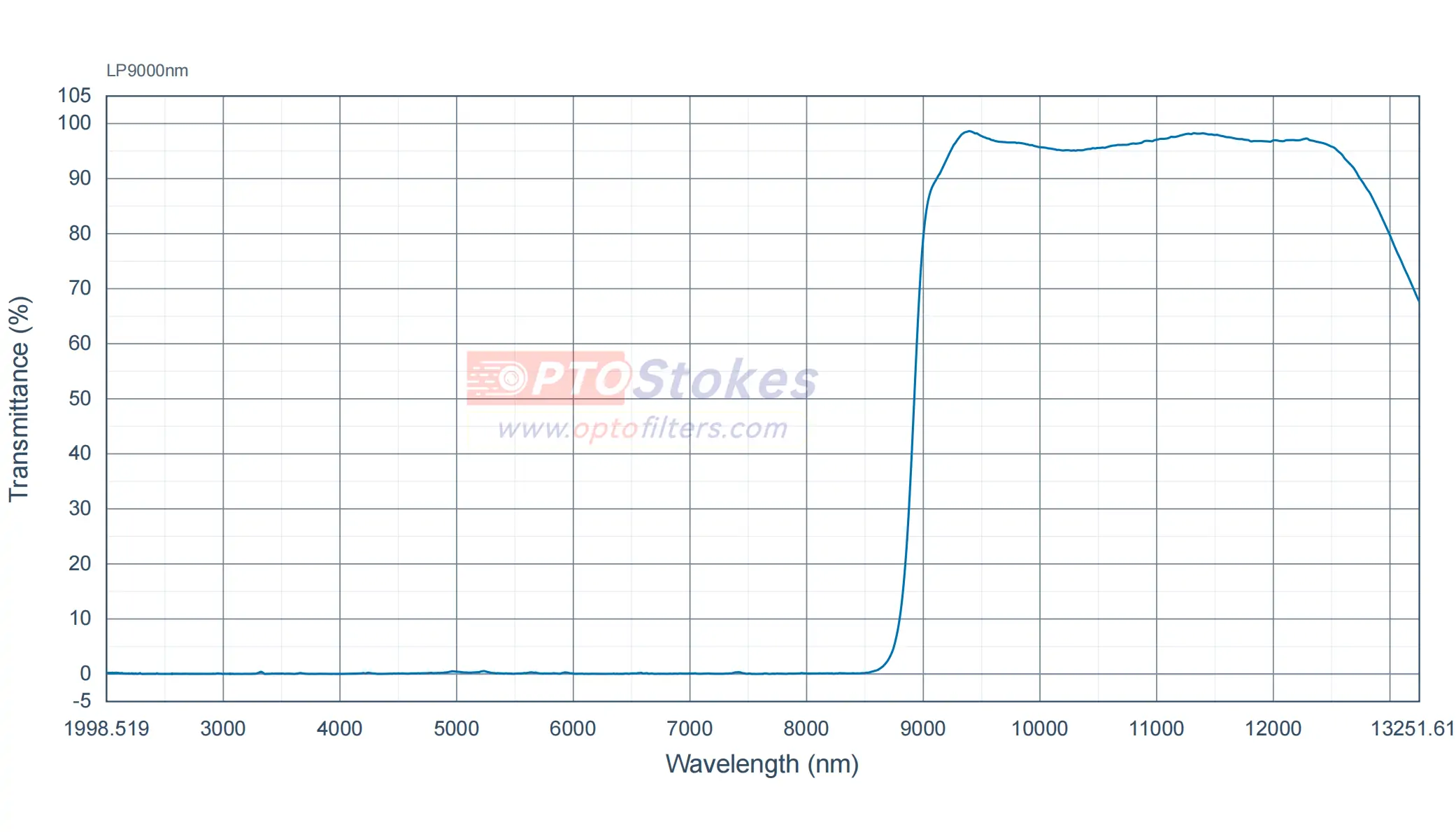
LP9000 is a 9 μm long pass filter made of germanium substrate, used in the window position of infrared detectors: when thermal radiation of 9.5-12.5 μ m is emitted, it is pressed below 8.5 μ m to OD2 or above. It is prone to misreading in two places - through and blocking targets are the average values (Tave, ODave), neither the peak nor the worst. This difference will be magnified during the acceptance stage, let's clarify it first.
Technical specifications
| Parameters | Specifications | Description |
|---|---|---|
| Product model | LP9000 | Model nominal cutoff wavelength 9000nm |
| Through the interval | 9500-12500nm, Tave>; 90% | band average transmittance, non peak |
| Cut off interval | 400-8500nm, ODave>; 2 | band average optical density, non full band minimum |
| Transition zone | Approximately 8500-9500nm | Defined by the above two boundary segments, the edge shape is based on the measured curve |
| Substrate material | Germanium (Ge) | Transmitting range of about 2-14 μ m |
| Incident angle | 0 ° | Other working angles need to be confirmed separately |
| Thickness/Dimensions | Confirm according to inquiry | No fixed specifications specified on this page |
Accurately reading two 'averages' is more important than memorizing numbers. Tave is referring to the average transmittance over a width of 3000nm between 9500-12500nm, and a few percentage points drop near the edge does not affect this indicator; Similarly, ODave allows individual wavelengths below OD2 as long as the average value of the entire segment crosses the line. On the other hand, if there is a strong interference source in your system that happens to be pressing at a certain low point, even if the average value looks good, it is useless - this will be discussed in the section on misconceptions in the following text.
Why can only materials like germanium be used in this band
At 9.5-12.5 μ m in the long wave infrared range, there are only a few materials that can transmit: germanium (about 2-14 μ m), zinc selenide (about 0.6-21 μ m), zinc sulfide (about 0.4-12 μ m), and barium fluoride (about 0.15-12 μ m). The upper limit of silicon transmission is around 7 μ m, and by 9.5 μ m, it has completely fallen outside the window, which is why products in this wavelength range can hardly bypass germanium.
Germanium is close to the default selection here, not just because of its range. Its refractive index is about 4.0, and its single-sided reflectivity is close to 36% - only a little over 40% of the energy on both sides of the bare chip can pass through. So Tave>; The 90% indicator is actually earned through the use of anti reflective membranes, not inherent in the material itself. Placing an order only seeing that germanium can penetrate 2-14 μ m may result in receiving a semi-finished product with high reflectivity.
Another advantage lies in encapsulation. The thermal expansion coefficient of germanium is similar to that of Kovar alloy, making it suitable for sealing with the shell after metallization; This determines the feasibility of the solution earlier than the transmittance on the detector window. The first threshold of a window panel is whether it can be sealed, and the second threshold is how much it can penetrate.
Infrared detector window: a parameter based selection deduction
The following is an example of selection, not a customer case.
Requirement: Window plate at the front end of the infrared detector, also used for band selection. The device needs to be vacuum sealed, with windows and tube shells sealed tightly. There are temperature cycles during assembly and use.
Why cut at 9 μ m: The radiation of the detection object (normal temperature object, human body, normal temperature workpiece) is concentrated above 9 μ m, and most of the short wave energy coming in below 9 μ m is from lamps, sun, and heaters, which only has a negative impact on the signal-to-noise ratio. Placing the cutting point at 9 μ m is the shortest path for the detector to only respond to hot objects.
Why use the average index to describe it: the window area is the energy integral of the entire band, not a single point. Defining using average transmittance is closer to practical use and fairer than using peak values - but conversely, accepting based on average means allowing individual wavelengths to fall, and both buyers and sellers must first write this consensus clearly.
Applicable boundary: 0 ° incidence; The upper limit of detector response shall not exceed 12.5 μ m (if exceeded, the long wave side shall be renegotiated); The baking temperature of the packaging process needs to match the temperature characteristics of germanium.
Before placing an order, it is necessary to verify the actual position and width of the transition band between 8500-9500nm; The calculation method of ODave (band range, weighting method, sampling interval); Compatibility between metallization layer and sealing process; Is the transmittance consistent before and after baking.
Two easily trampled misjudgments
One is to use ODave>; Read 2 as' every point is greater than 2 '. The average value refers to the weighted or arithmetic average of the entire range of 400-8500nm, allowing individual wavelengths to fall below 2- it is not uncommon for them to fall into the OD1 head near the material absorption band or at the junction of membrane segments. If there is a strong interference source in the system that happens to be located at that position, even if the average value is qualified, it cannot be stopped. A prudent approach is to specify both the average and minimum values in the contract, or to directly request continuous scanning curves and find the segment with the worst point.
The second is to treat the window panel as a pure optical component. The detector window is also a package: it needs to be sealed airtight, withstand vacuum, and undergo temperature cycling during assembly and baking. The transmittance of germanium decreases with increasing temperature (enhanced absorption of free charge carriers). If the packaging process includes a baking and degassing step above 100 ℃, the transmittance before and after baking may not be the same. These cannot be seen in the optical parameter table, but directly determine whether this piece can be installed. Explaining the packaging form, sealing material, and baking temperature together when inquiring is much more useful than only quoting one cutoff wavelength.
Customization and delivery support
The cutoff wavelength and transition band width can be adjusted according to the project, the grade and thickness of germanium can be specified, metallization treatment can be carried out to match the sealing, long wave side anti reflection can be optimized, the shape and diameter can be changed, and the matching card structure can be installed. Samples and measured spectral data can be provided by project. Batch supply requires agreement on the calculation methods for Tave and ODave - band range, weighting method, and sampling interval - which are not clearly stated. The same piece of film can be calculated for two results in the hands of both parties, which is the most common source of dispute in long wave infrared orders. The selection ideas for filters belonging to the same category of long wave infrared can refer to<a href=“ https://www.optofilters.com/article/case/LWIR-Filter-Selection-for-NH3-Sensors.html Long wave infrared filter selection case; for more categories, see<a ref=" https://www.optofilters.com/product/OpticalFilters.html Classification of Optical Filter Products
Information required for inquiry
Please provide: cutoff wavelength and transition band requirements, detector model and response upper limit, packaging form and sealing material, process baking temperature, external dimensions and thickness, whether there are other requirements for the minimum blocking value, and annual usage. The third and fourth clauses determine whether this area can be sealed, and the sixth clause determines whether there will be any disputes during acceptance - the average and minimum values are two different prices, so it is convenient for both parties to clarify first. Technical Consultation and Inquiry: sales@optofilters.com , or through<a ref=“ https://www.optofilters.com/single/contact-us.html Contact us on thepage to submit.
Tags: 9 μ m long pass filter germanium window plate infrared detector window LWIR long pass plate LP9000