
Products Description
BP440 blue bandpass filter: 440nm ± 5nm, 60nm bandwidth, OD3 full band cutoff
BP440 is a blue bandpass filter with a center wavelength of 440nm and a half width of 60nm, used in the blue channel of industrial machine vision. Its function is not to "make the image blue", but to separate the blue light in the lighting, block the yellow green spectral lines and infrared background in the factory - after monochromatization, the contrast is stable, and the threshold for binarization will not drift with ambient light.
Technical specifications
| Parameters | Specifications | Description |
|---|---|---|
| Product model | BP440 | The wavelength and bandwidth are subject to the following table |
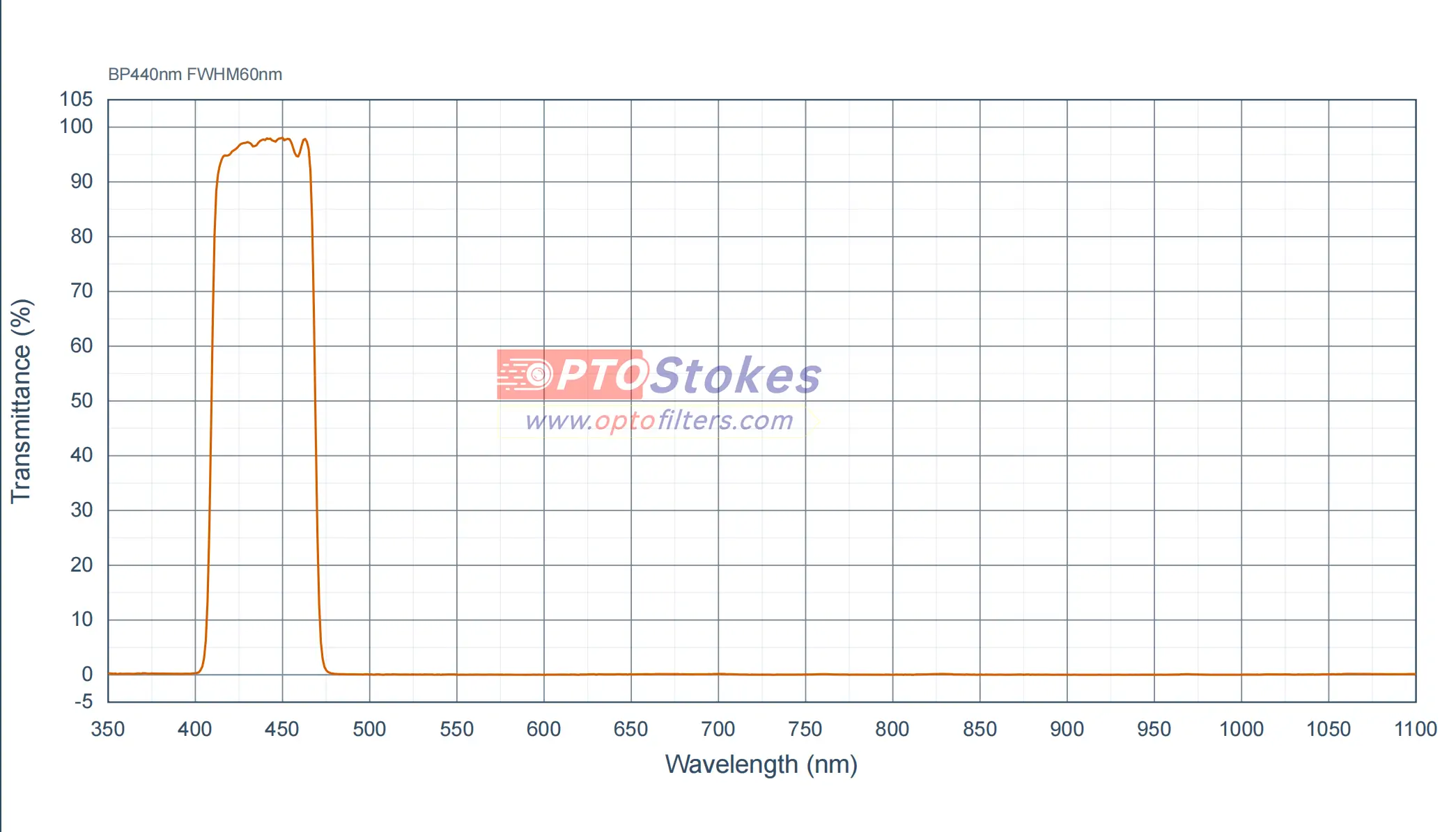
| Center wavelength CWL | 440 ± 5nm | Transmittance at this wavelength T>; 90% |
| FWHM | 60 ± 5nm | When the transmittance drops to 50% of the peak, the distance between two points |
| High transparency band | 415-460nm, T>; 90% | High transmittance interval within the passband, with edge shape based on the measured curve |
| Blocking range | 350-1100nm (excluding passband), OD> 3 | OD3 corresponds to a transmittance of 0.1% |
| Incident angle | 0 ° | The installation of the rear lens must be explained separately |
| Thickness/Shape/Substrate | Confirm according to inquiry | No fixed specifications specified on this page |
The high transmittance region of 415-460nm is 45nm wide, with a half width of 60nm, and the ratio of the two is close to three-quarters, indicating that the edge of this curve is quite steep - dropping from 90% to 50% only occurs at around 5nm. This shape is good for machine vision: it is clean outside the passband and does not require resetting the threshold when switching light sources. But the requirements for film layer control are high, and the actual shoulder of the curve should be based on the manufacturer's measured data, rather than calculating the exposure time based on an ideal rectangle. In addition, the blocking interval is written as "passband excluded", and 440nm itself falls within the range of 350-1100nm.
Machine vision blue light channel: a parameter based selection deduction
The following is a deduction example, not a customer case.
Requirement: Use blue LED ring light illumination on the production line for detection, and the camera is a black and white CMOS. It is necessary to stably extract blue ink marks or coating defects. The composition of on-site lighting is very diverse: fluorescent lamps have strong spectral lines at 546nm and 611nm, and skylights and factory lights also bring a large amount of near-infrared.
Why 440nm: It falls within the emission range of blue LED and is separated from the green line of fluorescent lamp (about 546nm) by more than 100nm, which is sufficient for the blocking effect of OD3. After the ambient light is suppressed, the grayscale distribution of the image is only determined by the blue light reflectance, and the threshold can be fixed.
Why is the bandwidth 60nm instead of 10nm: Machine vision requires short exposure. With a wider bandwidth and sufficient light input, the exposure time can be reduced to minimize motion blur. Narrowband chips here have negative benefits - the signal-to-noise ratio does not improve due to bandwidth narrowing, as the limiting factor is the ratio to ambient light, not absolute luminous flux.
Why block to OD3: The response of silicon-based cameras spans 350-1100nm, and near-infrared in the environment will directly image, resulting in overall graying and decreased contrast. OD2 (1%) is sufficient for general testing, but in the determination of high contrast and low contrast defects, the difference between 0.1% and 1% is a noticeable difference.
Applicable boundary: 0 ° incidence; The light source and filter are of the same color (blue with blue); When installing behind the mirror, it is necessary to evaluate the cone angle of the light.
Before placing an order, it should be verified that the actual peak wavelength of the light source - the common peak of blue LED is between 450-470nm, and the high transmittance upper limit of this passband is up to 460nm. If the light source is 470nm and the peak has already exited the passband, the actual transmittance will be significantly lower than 90%; The beam divergence angle at the installation position of the filter; The measured transmittance at both ends of 415nm and 460nm.
Two easily trampled misjudgments
One is to install the filter behind the lens without considering the cone angle of the light. Machine vision pursues the amount of incoming light, with a large aperture and short working distance. The beam behind the lens is a clearly diverging cone, and the incident angle of the edge field of view can reach over 20 degrees. The passband of a bandpass filter shifts towards shorter wavelengths as the incident angle increases. The 60nm passband shifts overall and slightly widens under oblique incidence, resulting in misalignment of the effective wavelengths at the center and corners of the image. In situations where high detection uniformity is required, this difference is enough to invalidate the edge region, and operators often first suspect the algorithm. There are two solutions: install the filter in the collimation section in front of the lens, or customize it according to the actual angle, the former is simpler.
The second is to use white light illumination with this blue light filter. The blue bandpass only covers a small area of 415-460nm, and more than 90% of the energy in white light is blocked outside the door, resulting in a noticeable darkening of the image. The instinctive reaction on site is to increase the gain or extend the exposure, followed by noise and motion blur, ultimately leading to the conclusion that the filter is useless. The correct combination is that the light source and filter are of the same color: blue LED with blue bandpass will improve both energy utilization and ambient light suppression. Bandpass filters are essentially used to purify monochromatic light paths, not to select colors from white light.
Customization and delivery support
The center wavelength and bandwidth can be adjusted according to the project, the substrate can be changed, the transparency within the passband can be optimized, the blocking interval can be expanded or narrowed, the shape can be changed (circular, square, irregular), and a set of card rings and mirror holders can be matched. Samples and measured spectral data can be provided by project. Batch applications require agreement on batch consistency apertures with a center wavelength of ± 5nm and a bandwidth of ± 5nm, as well as channel pairing rules for multi station equipment - when multiple cameras on the same device share a set of judgment parameters, the batch distribution directly determines whether calibration is required for each device. The filter configuration ideas for machine vision can refer to<a href=“ https://www.optofilters.com/article/case/85.html Application Cases of Optical Filters for Machine Vision; For more categories, please refer to<a ref= https://www.optofilters.com/product/OpticalFilters.html Classification of Optical Filter Products
Information required for inquiry
Please provide: the type of light source and actual peak wavelength, the spectral response range of the camera, the installation position of the filter (in front of or behind the lens), the cone angle of the light at that position, the external dimensions and aperture, the reflection characteristics of the detection object, and the annual usage. The first and fourth points are the most crucial - the peak value of the light source determines whether the bandwidth is sufficient, and the cone angle of the light determines whether the passband will shift. Technical Consultation and Inquiry: sales@optofilters.com , or through<a ref=“ https://www.optofilters.com/single/contact-us.html Contact us on thepage to submit.
Tags: 440nm bandpass filter blue light filter machine vision filter narrowband filter BP440