What is the Working Principle of a Color Sorter?
Concept & Definition
A color sorter, also known as an optical sorter, is an automated device that uses photoelectric principles to detect and separate discolored items, pest-infected particles (spherical, blocky, or granular), and foreign impurities from bulk materials. While color sorters in China are primarily used in precision rice milling, they are widely applied globally across industries requiring color-based separation of solid particulate matter, including food processing, agriculture, chemicals, and minerals.
Color sorters provide irreplaceable value when defective and conforming products cannot be separated by screening equipment due to nearly identical particle sizes, or by gravity separators due to equivalent densities. The two primary detection technologies used in modern color sorters are photoelectric sensing and digital image processing.
Technical Principles of Operation
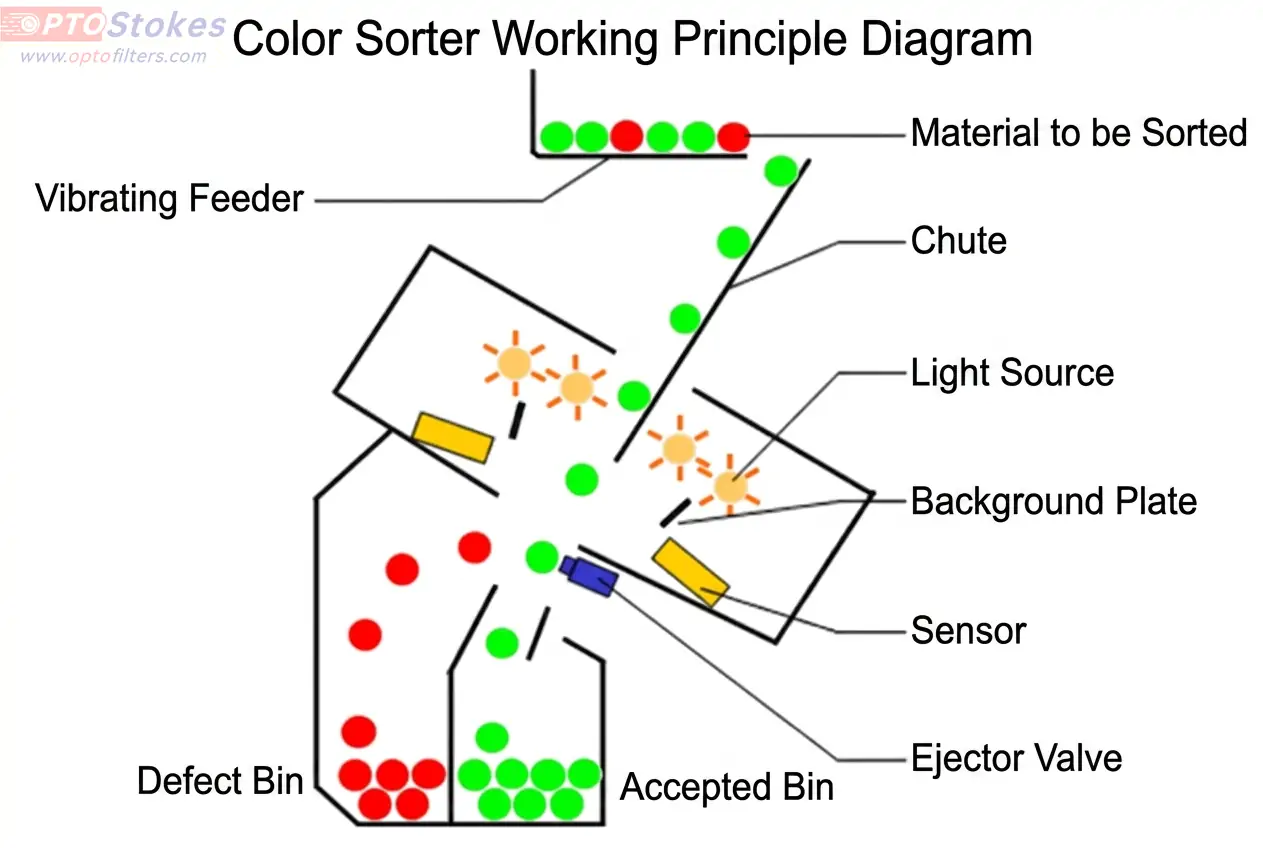
Color sorters operate based on pre-calibrated sorting criteria that define acceptable material quality thresholds. The complete sorting process follows four sequential stages:
Feeding & Transport: Material passes through a vibration-controlled feeding system, entering the chutes in a uniform, single-layer stream at a consistent speed.
Imaging & Detection: As material enters the optical inspection zone, high-speed monochromatic or color cameras capture the fast-moving product stream, converting it into 256-level grayscale or full-color digital images. High-quality machine vision filters are critical components in this stage, eliminating stray light interference and ensuring accurate color detection.
Analysis & Recognition: Defective products exhibit distinct grayscale or color variations compared to conforming products. Fully digital processors and advanced pattern recognition algorithms analyze these variations in real time to make precise sorting decisions.
Ejection: Upon identifying a defective particle, the controller signals the drivers to activate pneumatic ejectors. These ejectors release high-speed, precise, short-pulsed air blasts to deflect defective particles from the main stream, optimizing overall material purity.
Core System Composition
A color sorter integrates four interconnected functional subsystems, each critical to overall performance:
| Subsystem | Key Components | Primary Function |
|---|---|---|
| Feeding System | Vibratory feeders, chutes, acceleration mechanisms | Delivers material in a uniform, single-layer stream at controlled speed |
| Detection System | Light sources, optical assemblies, background plates, photoelectric detectors, dust extraction, cooling systems | Inspects material optical properties (reflection, absorption, transmission) to acquire quality data |
| Signal Processing & Control | Digital processors, pattern recognition algorithms, control circuitry | Executes real-time image analysis and generates sorting commands |
| Rejection System | High-frequency pneumatic valves, air compressors, ejection nozzles | Performs physical separation of defective particles |
Optical System Configurations
The optical system is the heart of any color sorter, and its configuration directly determines sorting accuracy. Two primary optical configurations are commonly used:
Single-wavelength (monochromatic) systems: Distinguish only light intensity and brightness differences. These systems are suitable for simple sorting applications where defects differ significantly in brightness from good product.
Dual-wavelength (bichromatic) systems: Differentiate true color variations by comparing material response at two distinct wavelengths. These systems use precision bandpass filters to isolate and transmit target wavelengths with high accuracy, enabling detection of subtle color differences that monochromatic systems cannot identify.
Environmental control is also critical for optical system performance. Continuous low-pressure air curtains and periodic high-pressure air blasts prevent dust accumulation on optical components, while automatic wipers provide real-time dust clearance. Light sources (infrared, visible, or ultraviolet) must maintain highly constant power output to ensure consistent detection results.
Target Applications
Color sorters are extensively utilized across multiple industries for precision material separation. They are particularly effective for sorting:
Agriculture & Food: Rice, tea, sesame, beans, melon seeds, raisins, millet, buckwheat, peanuts, cottonseed, wolfberries, and Sichuan peppercorns
Industrial & Recycling: Glass, plastics, slag, mineral ores, and electronic waste
Pharmaceuticals & Chemicals: Pills, capsules, and chemical granules
Core Advantages Over Manual Sorting
High Efficiency: Processes significantly higher volumes than manual sorting, with consistent throughput 24/7
Superior Accuracy: Detects subtle defects and color variations that human inspectors cannot identify
Cost Reduction: Eliminates labor costs associated with manual sorting and reduces material waste
Value Optimization: Maximizes product grade and quality, driving superior economic returns
OPTOStokes Optical Solutions for Color Sorters
OPTOStokes provides high-performance optical components designed specifically for color sorter applications. Our neutral density filters help control light intensity and prevent sensor saturation, while our custom bandpass filters ensure precise wavelength isolation for maximum sorting accuracy.
We maintain an extensive in-stock selection of standard optical filters for common color sorter configurations, enabling fast delivery for urgent projects. For applications with unique requirements, we offer fully customized optical solutions tailored to your specific wavelength, transmission, and blocking specifications. Our robust production lines ensure predictable lead times and consistent quality for both prototype and volume production orders.
Get Expert Optical Support
Are you designing a new color sorter system or looking to improve the performance of existing equipment? Do you require custom optical filters with precise spectral characteristics to address challenging sorting applications? Our team of optical engineering experts is ready to assist you.
Contact us at sales@optofilters.com to discuss your specific requirements, request technical consultation, or obtain a detailed quotation. We can help you select the optimal optical components to achieve the highest possible sorting accuracy and reliability for your color sorter system.