How Does the Angle of Incidence Affect Optical Filter Performance?
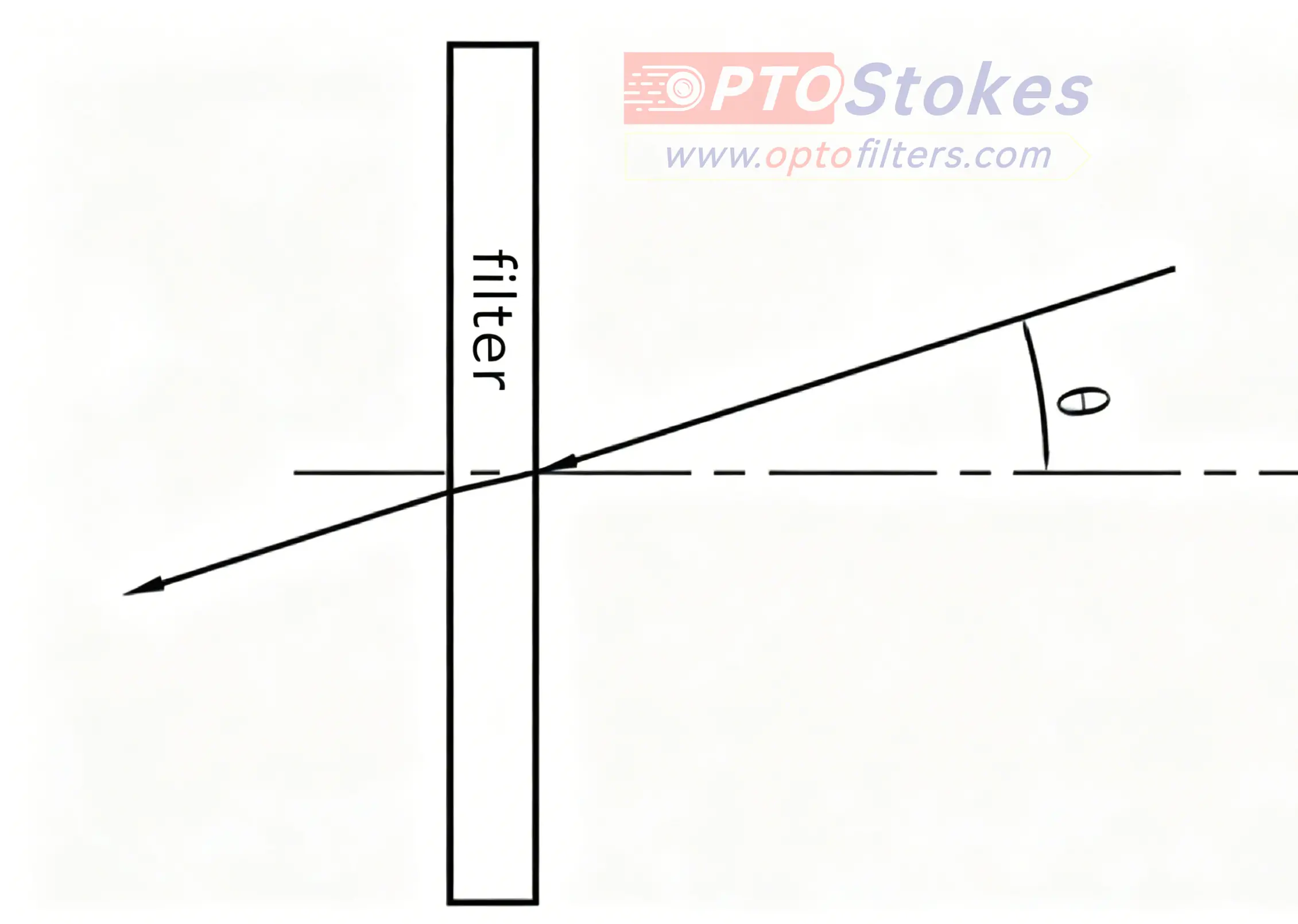
The angle of incidence (AOI) is one of the most critical parameters influencing the spectral performance of optical filters. A common and costly misconception is defining AOI solely as the angle between the filter normal and the line connecting the light source to the filter center. In non-collimated optical systems, light remains divergent even when the source is perfectly aligned with the filter's central normal, resulting in a range of incident angles rather than a single 0° AOI.
For accurate system design and performance prediction, it is essential to specify the full angular range of light striking the filter surface. Interference filters are inherently highly sensitive to changes in angle of incidence, and performance deviations can be substantial even with small angular variations.
Center Wavelength Blue Shift Phenomenon
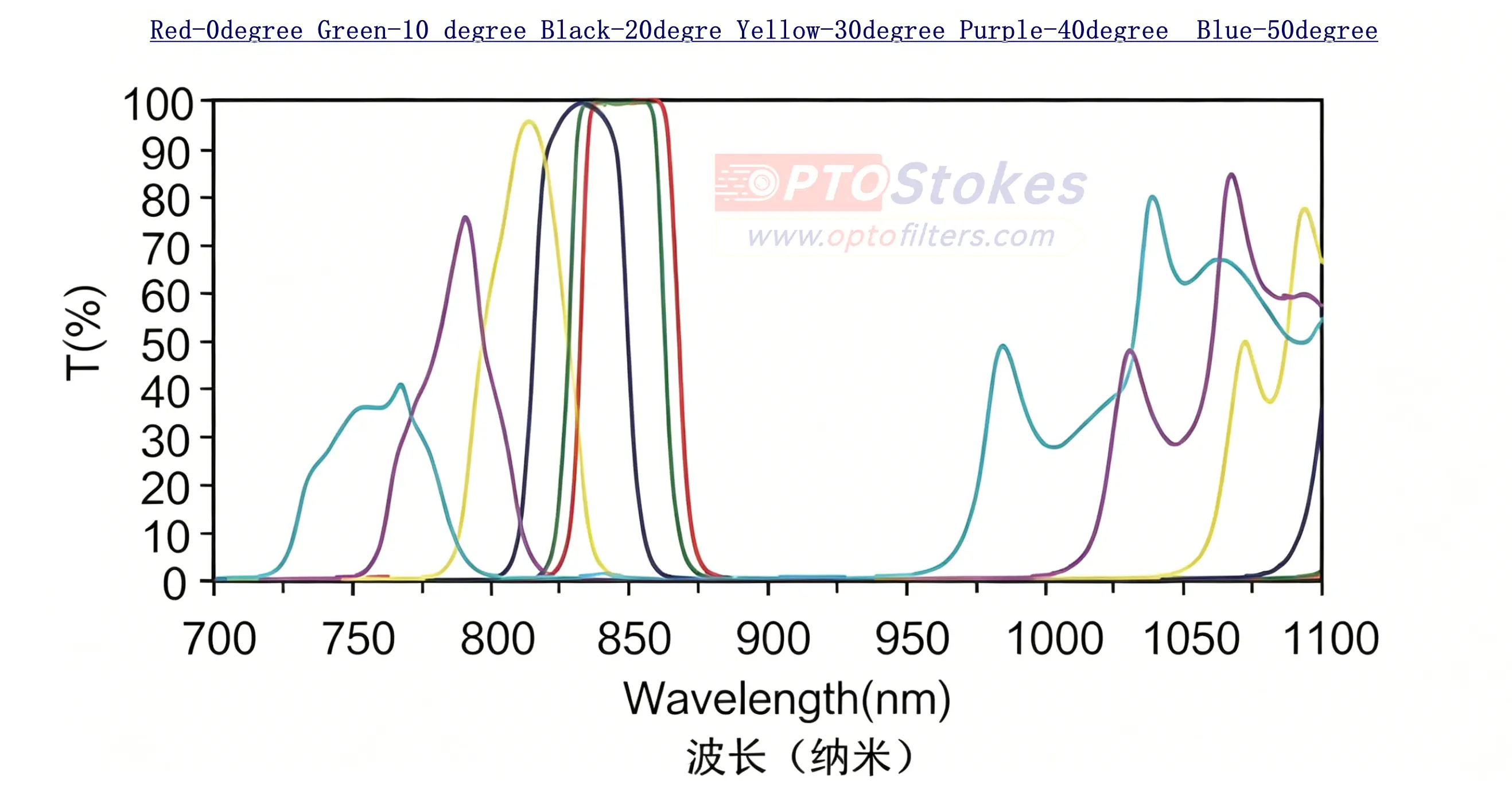
As the angle of incidence increases, the center wavelength (CWL) of all interference filters shifts toward shorter wavelengths—a fundamental characteristic known as blue shift. This effect arises from the change in optical path difference through the thin-film coating stack at non-normal angles, and it cannot be completely eliminated from interference-based filter designs.
For example, an 850 nm narrowband filter designed for 0° AOI will exhibit a progressive blue shift as the incident angle increases. At 50° AOI, this filter will no longer function as an 850 nm filter; its center wavelength will have shifted to approximately 760 nm, completely altering its intended spectral performance.
The magnitude of the blue shift depends on the effective refractive index of the coating stack and the angle of incidence. Narrower bandwidth filters exhibit significantly more pronounced angular sensitivity compared to broadband filters, making precise AOI control absolutely critical for narrowband applications.
Angle Sensitivity by Filter Type
Different filter types exhibit varying degrees of angular sensitivity. The following table summarizes typical performance characteristics for common filter categories, providing practical guidance for system designers:
| Filter Type | Relative Angular Sensitivity | Typical CWL Shift at 30° AOI | Maximum Recommended AOI |
|---|---|---|---|
| Ultra-narrowband Filters (FWHM < 10nm) | Very High | 8-12% of CWL | ≤ 15° |
| Narrowband Filters (10-50nm FWHM) | High | 6-9% of CWL | ≤ 20° |
| Broadband Filters (> 50nm FWHM) | Moderate | 4-6% of CWL | ≤ 30° |
| Longpass/Shortpass Filters | Moderate-Low | 3-5% of edge wavelength | ≤ 40° |
| Neutral Density Filters | Low | Minimal | ≤ 60° |
Optimal Filter Placement in Optical Systems
To minimize the effects of angular variation, the industry-standard best practice is to position optical filters between the imaging lens and the detector (such as a CCD or CMOS sensor). In this position, the light has already been focused by the lens, resulting in a relatively small divergence angle—typically below 12° for most imaging systems.
Conversely, placing the filter in front of the lens (facing the target object) exposes it to a wide range of incident angles. In this configuration, the filter cannot effectively suppress stray light across all angles, leading to reduced contrast, increased noise, and degraded system performance.
This placement guideline is particularly critical for machine vision systems, fluorescence microscopy, and other high-precision imaging applications. Proper filter positioning ensures consistent spectral performance across the entire field of view and maximizes the signal-to-noise ratio of the system.
Solutions for High AOI Applications
In applications where a wide range of incident angles is unavoidable, OPTOStokes offers specialized filter designs optimized for angular tolerance. Our engineering team can develop custom coating stacks that minimize blue shift and maintain consistent performance across specified angular ranges.
We also provide angle-compensated filters that are intentionally designed to operate at non-normal angles. These filters are calibrated to deliver the specified center wavelength at the intended operating angle, eliminating the need for system redesign or performance compromises.
OPTOStokes Technical Expertise
OPTOStokes maintains an extensive in-stock selection of standard optical filters designed for common operating angles and applications. For projects with unique requirements, our advanced coating technologies and robust production lines enable us to deliver custom filters with precise angular performance characteristics.
All our filters undergo rigorous spectral testing at multiple angles of incidence to ensure they meet or exceed specified performance parameters. We guarantee predictable lead times and consistent quality for both prototype and volume production orders.
Get Expert Optical Design Support
Are you designing an optical system with challenging angular requirements? Do you need assistance selecting the right filter or optimizing filter placement to minimize AOI effects? Our team of optical coating experts is ready to assist you.
Contact us at [email protected] to discuss your specific requirements, request technical consultation, or obtain a detailed quotation. We can help you select or design the optimal filter solution to achieve reliable performance across your system's operating angular range.