
Product Description
XYZ tristimulus value chromaticity filter set: 600nm/555nm/445nm three piece set
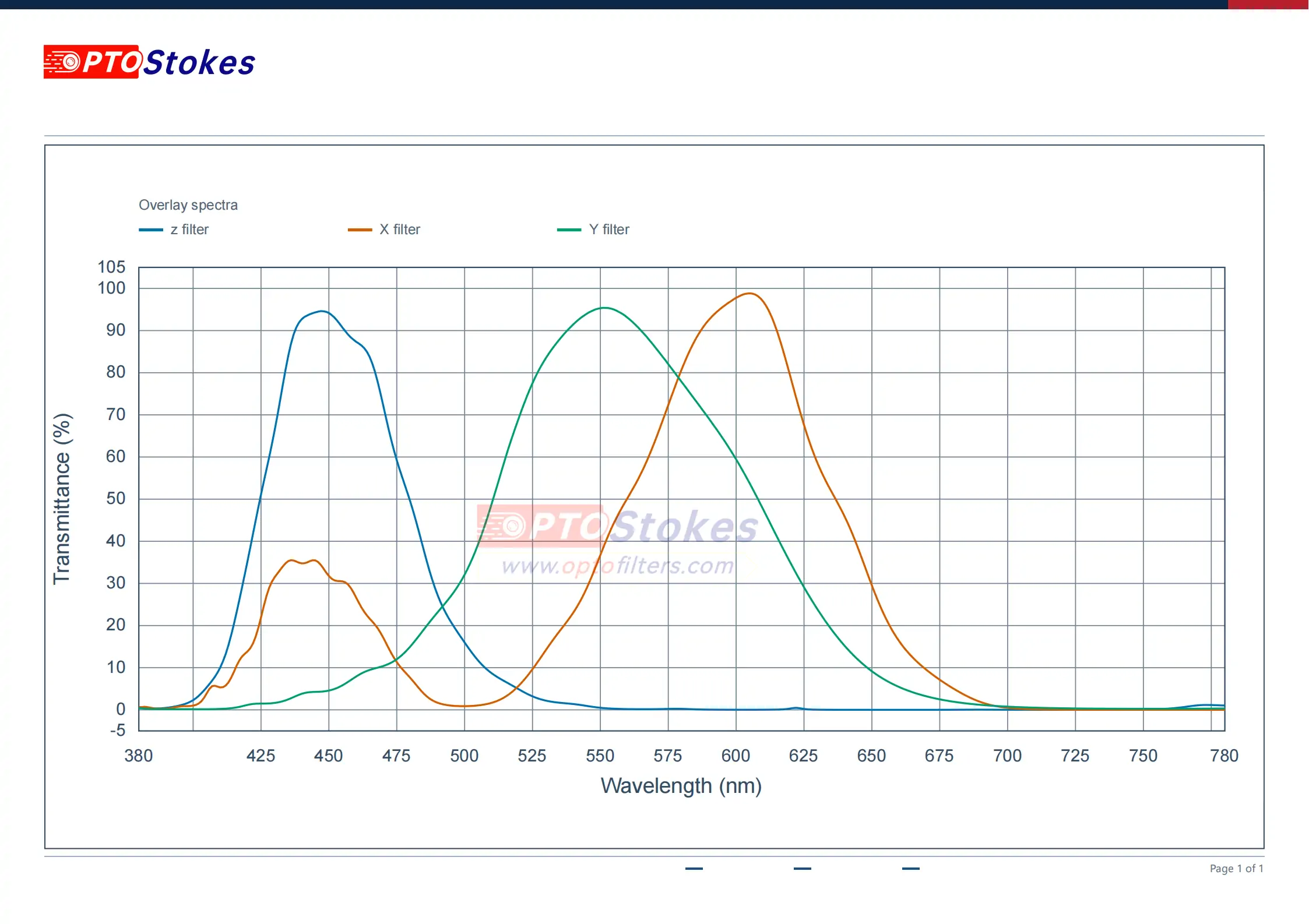
This is a set of three color filters, installed in front of three detection channels: 600nm for the X, 555nm for the Y, and 445nm for the Z, all with a transmittance higher than 95%, and blocking above OD2 at 380-780nm outside the passband. It does not directly replicate the CIE tristimulus curve, but instead samples from three channels and restores the chromaticity coordinates through a correction matrix. Only by understanding this can we know how to use a 6% matching deviation.
Technical specifications
| Parameters | X slice | Y slice | Z slice | |
|---|---|---|---|---|
| Transmitting wavelength (T>95%) | 600nm | 555nm | 445nm | |
| Blocking range (excluding passband) | 380-780nm, OD>; 2 | 380–780nm,OD> 2 | 380–780nm,OD> 2 | |
| Incident angle | 0 ° | 0 ° | 0 ° | |
| Comprehensive matching deviation | <; 6.5% | < 6% | < 6% | |
| FWHM | This page does not provide | This page does not provide | This page does not provide | |
| Size/thickness/substrate | Confirm according to inquiry | Confirm according to inquiry | Confirm according to inquiry |
Three points need to be explained. Firstly, the blocking range is written as "excluding the passband" -380-780nm itself covers three wavelengths of 600, 555, and 445, and the blocking commitment refers to the part outside the passband. Secondly, the three pieces must be installed separately on three channels and cannot be stacked in series: the three pieces have the same blocking interval, and stacking them together is equivalent to blocking the entire visible light segment. Thirdly, this page does not provide the half width of each piece, and the bandwidth width directly determines the sampling width of the three channels, which needs to be confirmed according to the inquiry.
The indicator of 'comprehensive matching deviation less than 6%' is easily misread. It refers to the overall deviation of the restored chromaticity coordinates relative to the standard value after the three channel calibration matrix is used, regardless of the degree of agreement between the single spectrum and the CIE curve. In other words, the spectral shape of the film itself can be far from the standard curve, as long as the combination of the three can be mathematically corrected. This also explains a common question: 600nm, 555nm, and 445nm do not equal the peak positions of X ̄, Ȳ, and Z ̄ in CIE, but this does not prevent it from being established as a chromaticity sampling scheme.
Online color detection: a parameter based selection deduction
The following is a deduction example, not a customer case.
Requirement: Low resolution colorimeter or online color detector, white light illumination, three photodetectors each equipped with a filter, output relative chromaticity coordinates for color difference grading or sorting, without pursuing spectral reconstruction.
Why choose this set: The device cost of the three channel scheme is significantly lower than that of the beam splitter, and it can work by calibrating the matrix once. A matching deviation of 6% is usually sufficient for applications such as color selection and Δ E grading, but it is insufficient for metrological situations that require strict comparison with standard samples - this should be clarified during the selection stage, otherwise the instrument will only discover insufficient accuracy when it is produced.
Why should we pay attention to OD2: the 1% leakage outside the passband is broadband in nature. When measuring dark samples or low reflection surfaces, the target signal itself may only be a few thousandths of the illumination light, and the proportion of light leakage will increase accordingly, causing the color coordinates to shift towards the direction of the illumination light source.
Applicable boundary: 0 ° collimated illumination and reception; The brightness of the tested sample is not too low; Pair three pieces as a group for channel pairing.
Before placing an order, it is necessary to verify the consistency between the measured curves of each piece and the pairing of the three channels; Repeatability under low reflectivity samples; The calibration conditions and recalibration period of the calibration matrix.
Two easily trampled misjudgments
One is to replace only the damaged part when replacing spare parts. The three pieces are calibrated under the same calibration matrix, and the relative relationship between X, Y, and Z has been written into the calibration parameters. Even if a single piece is completely qualified on the specification sheet, the differences in curves between batches will still render the original matrix invalid, resulting in an overall shift in color coordinates and the inability to identify the cause on site. The correct approach is to replace the entire set and recalibrate it, or to order spare parts according to the "same batch, paired delivery" policy during the procurement phase.
The second is to use OD2 blockade to test dark samples. The leakage of light outside the passband does not decrease as the sample darkens, but the signal attenuates, and the ratio of the two deteriorates with decreasing brightness. This is not a problem with the filter, but rather a mismatch between the parameters and the operating conditions - it is suitable for surface color measurement above medium brightness. If the working conditions include dark, low reflection, or weak lighting conditions, the blocking level should be increased or a spectral scheme should be used instead of compensating in software.
Customization and delivery support
The shape can be adjusted according to the project (circular, square, irregular), matched with a set of card rings, and the substrate and coating design can be changed, including adjusting the transmission wavelength to match the response of specific detectors, improving the blocking level, and delivering in three channel pairing. Samples and measured spectral data of each piece can be provided according to the project. When using the entire set, wavelength tolerances and pairing rules need to be agreed upon, which determines whether re labeling is required after replacement. For the complete category, please refer to<a ref=“ https://www.optofilters.com/product/OpticalFilters.html Classification of Optical Filter Products
Information required for inquiry
Please provide: the center wavelength and required bandwidth of each of the three channels, the response range of the detector, the type and color temperature of the illumination source, the brightness range of the tested sample, the external dimensions and aperture, whether the three pieces need to be paired for delivery, and the annual usage. The second and fourth decisions determine whether the blocking level is sufficient, and the sixth decision determines the cost of replacement parts. Technical Consultation and Inquiry: sales@optofilters.com , or through<a ref=“ https://www.optofilters.com/single/contact-us.html Contact us on thepage to submit.
Tags: XYZ chromaticity filter colorimeter filter set CIE tristimulus value filter color measurement filter RGB color separation filter X filter Y filter Z filter