
Products Description
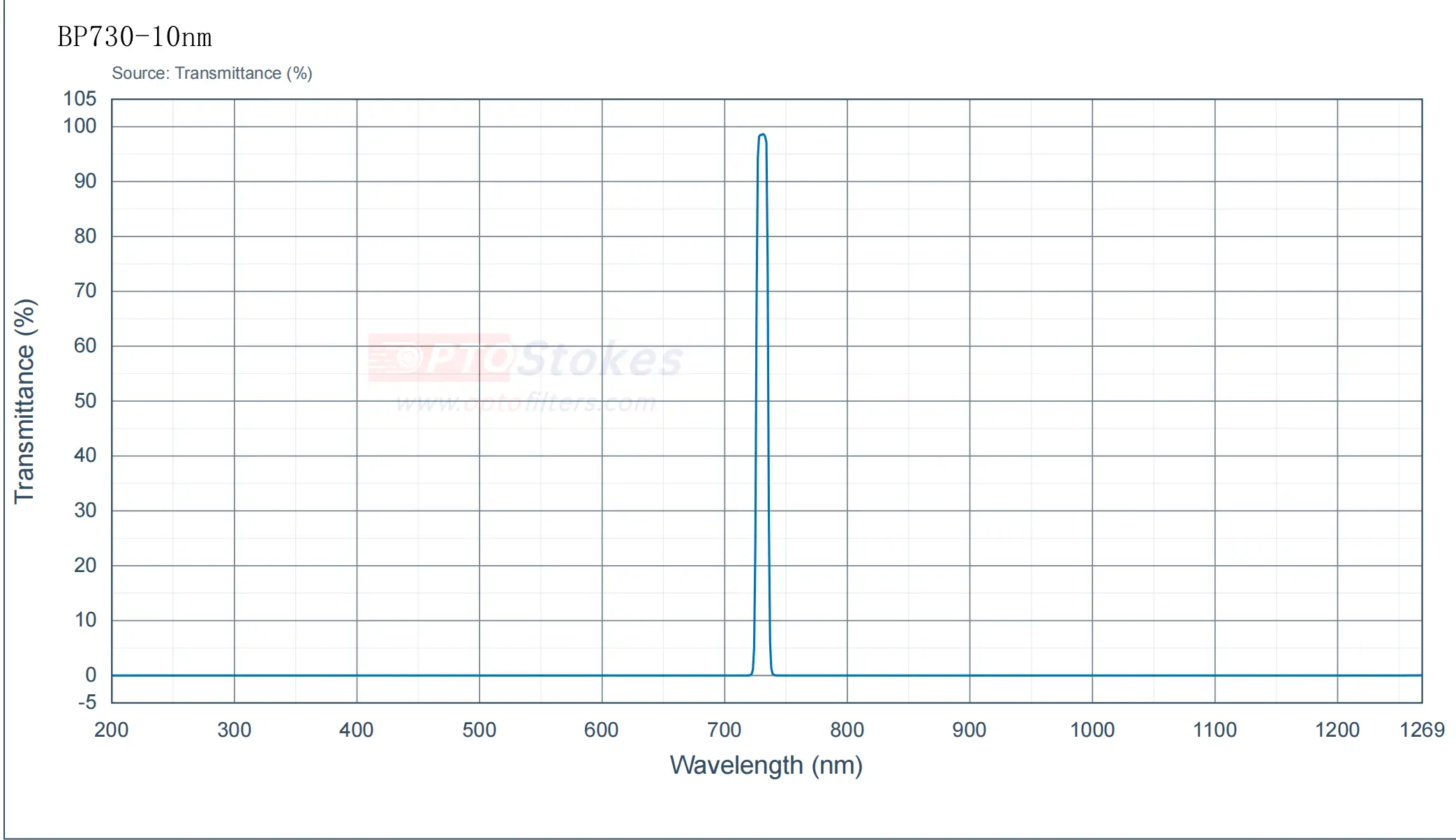
BP730-10nm narrowband filter: 730nm ± 2nm, 10nm FWHM, 200-1200nm Block to OD5
BP730-10nm is a near-infrared narrowband filter with a center wavelength of 730nm and a half width of 10nm, used in the chlorophyll fluorescence detection channel to separate the fluorescence near 730nm from the excitation light and strong fluorescence near 685nm. Its hardest indicator is not transmittance, but the cut-off of OD>5 in the entire range of 200-1200nm - the fluorescence signal has been cut-off.
Technical specifications
| Parameters | Specifications | Description |
|---|---|---|
| Product model | BP730-10nm | The model already includes bandwidth identification |
| Center wavelength CWL | 730 ± 2nm | Transmittance at this wavelength T>90% |
| FWHM | 10 ± 2nm | When the transmittance drops to 50% of the peak, the distance between two points |
| Transmittance | T>90% at 730nm | Single point indicator, the width of the high transmittance interval is based on the measured curve |
| Blocking range | 200-1200nm (excluding passband), OD>5 | OD5 corresponds to a transmittance of 0.001% |
| Incident angle | Not specified, quoted and tested at 0 ° | Installation in the light cone or converging light path must be separately specified |
| Thickness/Shape/Substrate | Confirm according to inquiry | No fixed specifications specified on this page |
There are three places in the specifications that need to be read accurately. 'Excluding passband' means that the 200-1200nm range near 730nm is not continuously blocked, and the blocking commitment should be understood around the passband. The column for incident angle is blank and is quoted and tested at 0 ° by default - fluorescence systems often install filters behind the objective lens or in the light cone, but the actual incident angle is not 0 °, which must be stated during the inquiry. The substrate is also not specified, and ordinary glass will emit light under short wave excitation, which is a disadvantage for fluorescence detection.
Chlorophyll fluorescence: a parameter based selection deduction
The following is a deduction example, not a customer case.
Requirement: Chlorophyll status assessment of leaves or canopy, excited by 630nm or 660nm LED, with two channels in front of the detector set at 685nm and 730nm respectively, using the ratio of the two to reflect the photosynthetic status and pigment content.. 730nm is the fluorescence emission peak of photosystem I, with a significantly lower intensity than the PSII peak at 685nm, indicating that this channel is inherently disadvantaged.
Why must it be OD5: Excitation light is four to six orders of magnitude stronger than fluorescence.. As long as one ten thousandth (OD4) of the excitation light leaks into the 730nm channel, the reading is completely contaminated, and the contamination is additive - it does not change with the blade state, but directly flattens the ratio. OD5 compresses the residual to one hundred thousandth, which is equivalent to the level of fluorescence itself; If the excitation power is higher or more precise dynamic measurements need to be made, we should move towards OD6.
Why 10nm: The emission band of 730nm itself is about 20-30 nm wide, and receiving 10nm has better selectivity, but at the cost of reducing the number of photons.. The ratio method also has a practical constraint: if the bandwidths of two channels are not consistent, system differences rather than physiological changes will be mixed into the ratio, so the bandwidths of the two channels usually need to be symmetrically selected.
Applicable boundary: The excitation wavelength falls within the blocking range (both 630nm and 660nm meet the requirements); The ambient light does not directly illuminate the detection surface; The fluorescence intensity of the 730nm channel is sufficient to be resolved by the detector.
Before placing an order, it is necessary to verify the OD curve measured throughout the entire section, with a focus on the band boundary; Actual transmittance at 730nm and 685nm; Whether the substrate is a low spontaneous fluorescence material - this specification is not included and must be separately agreed upon.
If the system also needs to configure excitation, emission, and color separation chips simultaneously, please refer to<a href=“ https://www.optofilters.com/article/industry-Insights/Fluorescence-Filter-Sets.html The combination idea of fluorescent filter group. When multiple pieces are stacked, the blocking of each piece must cover the wavelengths of the other channels, and meeting the standard for a single piece does not mean that the entire group is usable.
Two easily trampled misjudgments
One is to treat 'OD>5' as meeting the standard for every nanometer. 200-1200nm spans one thousand nanometers, and most implementation methods are segmented plating or multi plate combination. The transition between bands and the edge of the absorbing material are often the closest points. According to the average value of sampling, it appears that the entire section is above OD5, but in reality, there may only be OD4 in a narrow range. The fluorescence channel is most sensitive to the weakest point - if there is light leakage, don't look at the average, look at the weakest window. The correct approach is to specify the minimum value of the entire section in the contract and require the provision of a complete wavelength scanning curve, rather than a few sampling points.
Secondly, the default filter always receives light vertically. The 10nm passband is sensitive to the incident angle. According to the estimation of the effective refractive index of typical film systems, a 5 ° oblique incidence causes a blue shift of approximately 1-1.5nm, while a 10 ° angle results in a 3-5nm shift. In fluorescence imaging, the cone angle behind the objective lens can reach plus or minus twenty degrees, and the passband of the edge field of view will shift and widen as a whole, resulting in low corner signals and normal center of the image. When installed in converging or diverging light paths, it should be customized according to the actual cone angle, and do not use 0 ° components for hard installation.
Customization and delivery support
The shape can be adjusted according to the project (circular, square, irregular), matched with a set of card rings, and the substrate and coating design can be changed, including extending the blocking range beyond 1200nm, increasing the OD level, redesigning according to the actual cone angle, and specifying low spontaneous fluorescence substrates. Samples and measured spectral data can be provided by project. Batch applications require prior agreement on the consistency aperture between the center wavelength ± 2nm and the minimum OD value of the entire section - if multiple instruments cannot be calibrated piece by piece, the batch distribution must be written into the protocol. For the complete category, please refer to<a ref=“ https://www.optofilters.com/product/OpticalFilters.html Classification of Optical Filter Products
Information required for inquiry
Please provide: target wavelength and bandwidth, excitation light wavelength and power, cone angle at installation location, external dimensions and aperture, annual usage, operating temperature range, and whether low spontaneous fluorescence substrate is required. The third and last items are most often missed, but they directly determine whether the reading of this piece is correct after installation. Technical Consultation and Inquiry: sales@optofilters.com , or through<a ref=“ https://www.optofilters.com/single/contact-us.html Contact us on thepage to submit.
Tags: NIR narrowband filter 730nm narrowband filter 730nm bandpass filter chlorophyll fluorescence filter plant physiology detection filter BP730