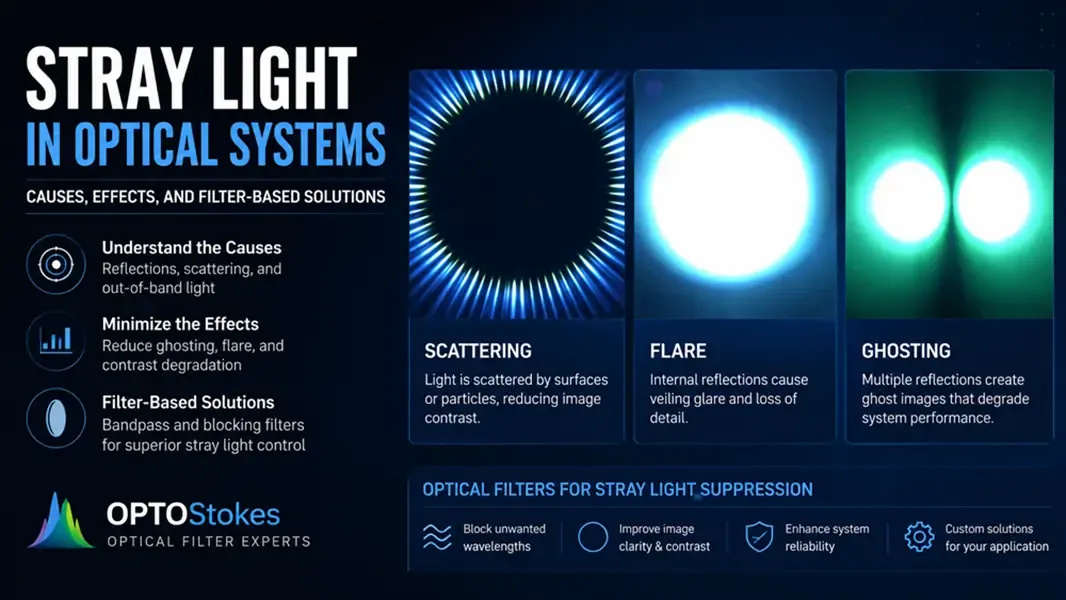
Stray light is unwanted optical radiation that reaches the detector, image plane, or measurement path outside the intended optical design. It may come from scattering, internal reflections, diffraction, environmental light, thermal radiation, or out-of-band spectral leakage.
In precision imaging, spectroscopy, microscopy, machine vision, and astronomical instruments, stray light does not usually damage the hardware. The real problem is more severe: it reduces contrast, distorts measurement data, masks weak signals, and can lead to wrong engineering decisions.
The practical conclusion is simple: stray light should not be treated as a cosmetic image defect. It is a system-level noise source that must be controlled by optical design, mechanical baffling, coating strategy, and wavelength-selective optical filters.
What Is Stray Light?
In an optical system, useful light follows the designed optical path and carries the signal required for imaging, detection, or spectral analysis. Stray light is any light that enters the system, reflects inside the system, scatters from surfaces, leaks through unwanted spectral bands, or reaches the detector through an unintended path.
Common forms of stray light include ghost images, flare, veiling glare, abnormal bright spots, background haze, and false spectral signals. In high-sensitivity systems, even low-level stray light can reduce signal-to-noise ratio and compromise measurement repeatability.
Main Causes of Stray Light
1. Surface and Bulk Scattering
Scattering is one of the most common sources of stray light. Surface scattering occurs when light interacts with dust, scratches, polishing marks, coating defects, or rough optical surfaces. Instead of following the designed path, part of the light is redistributed into unwanted directions.
Bulk scattering occurs inside the optical material. Bubbles, inclusions, local refractive index variations, or material inhomogeneity can scatter transmitted light. This is especially critical in systems that require low background noise, high contrast, or weak-signal detection.
2. Unwanted Internal Reflections
Every uncoated or poorly coated optical surface reflects part of the incident light. In multi-element lenses, filters, windows, prisms, and detector assemblies, these reflections may bounce between surfaces and finally reach the image plane or sensor as ghosting or flare.
Mechanical parts can also contribute. Lens barrels, aperture blades, retaining rings, mounts, sensor packages, and inner walls may reflect light even after blackening treatment. If these reflections are not blocked or absorbed, they become a persistent stray light source.
3. Diffraction from Apertures and Edges
When light passes through aperture stops, blade edges, slits, gratings, or sharp mechanical boundaries, diffraction can create weak unwanted light distributions. In ordinary imaging systems, this may appear as low-level artifacts. In precision metrology, spectroscopy, or microscopy, it can become a measurable error source.
4. Optical Aberrations and Design Limitations
Coma, astigmatism, spherical aberration, field curvature, and imperfect focusing can spread light away from the intended image point. When the energy distribution is not properly controlled, part of the light may form background noise or abnormal image artifacts.
5. Out-of-Band Spectral Leakage
In spectroscopy, fluorescence imaging, laser detection, and machine vision, unwanted wavelengths can be as damaging as unwanted optical paths. If a detector receives light outside the target band, the system may show false signals, reduced contrast, or incorrect intensity readings.
This is where optical filters become essential. A well-specified bandpass, longpass, shortpass, notch, dichroic, or blocking filter can suppress non-working wavelengths before they reach the detector.
How Stray Light Appears in Real Optical Systems
| Observed Problem | Typical Appearance | Likely Cause | System Impact |
|---|---|---|---|
| Ghosting | Secondary bright spots, often symmetrical or aperture-shaped | Multiple reflections between lenses, filters, windows, or detector surfaces | False image features and reduced image reliability |
| Flare | Bright haze around strong light sources | Scattering, internal reflections, or inadequate anti-reflection coating | Lower contrast and weaker edge definition |
| Veiling Glare | Gray or milky image background | Broad stray light distribution inside the optical path | Reduced black level, lower dynamic range, and poor image clarity |
| False Spectral Signal | Unexpected peaks or elevated baseline in spectral data | Out-of-band light, grating scatter, or insufficient blocking | Measurement error and incorrect material or sample interpretation |
| Abnormal Bright Spots | Random bright dots, streaks, or patterns unrelated to the object | Dust, scratches, edge reflection, or mechanical reflection | Image artifacts and inspection failure |
Why Stray Light Matters in Different Applications
Imaging and Photography
In imaging lenses, stray light often appears as ghosting, flare, or a loss of contrast when strong light sources enter or approach the field of view. Backlit scenes, night lighting, and high-intensity illumination make the problem more visible.
The result is not only an aesthetic issue. Important image details may be hidden by haze, glare, or reflection artifacts.
Astronomical Observation
Astronomical systems are designed to detect weak signals from distant objects. If stray light from a bright star, moonlight, internal reflection, or nearby illumination enters the system, weak astronomical signals can be masked or lost.
For telescopes and observation instruments, stray light control must combine baffling, surface treatment, coating design, and spectral filtering.
Microscopy and Industrial Inspection
In microscopy, especially with transparent, low-contrast, fluorescent, or reflective samples, stray light reduces the visibility of fine structures. In industrial inspection, it may cause false edges, missed defects, or inconsistent measurement results.
Fluorescence microscopy is particularly sensitive because excitation light must be strongly blocked while emission light must pass with high efficiency. Incorrect filter selection can directly reduce image contrast.
Spectroscopy and Optical Measurement
Spectrometers require clean spectral separation. Stray light can raise the baseline, create false peaks, and distort intensity measurements. In applications such as chemical analysis, material identification, environmental testing, or optical coating inspection, this can lead to incorrect conclusions.
For this reason, many optical systems use precision filters to block non-target wavelengths before light enters the detector or spectrometer.
How to Reduce Stray Light in Optical Systems
1. Use Anti-Reflection Coatings
Anti-reflection coatings reduce reflection losses at optical surfaces. They are commonly applied to lenses, windows, prisms, and filters to lower surface reflection and suppress ghost images.
The coating should match the working wavelength range, angle of incidence, polarization condition, and environmental requirements. A coating optimized for visible light may not perform correctly in UV, NIR, SWIR, MWIR, or LWIR systems.
2. Add Aperture Stops and Field Stops
Aperture stops and field stops limit the allowed light path. They block rays that do not contribute to the designed image or measurement signal. Multi-stage stops are often used in precision instruments to suppress off-axis and scattered light.
This method is effective, but it must be designed carefully. Poorly placed stops may reduce throughput, introduce vignetting, or clip useful signal.
3. Improve Mechanical Blackening and Internal Geometry
Lens barrels, mounts, retaining rings, and internal mechanical surfaces should be designed to reduce reflection. Threaded structures, stepped inner walls, matte black coatings, and high-absorption surface treatments are commonly used.
The goal is not only to make the surface black. The geometry must prevent reflected light from reaching the detector.
4. Use Baffles for Strong Off-Axis Light
Baffles are used to block direct or reflected light from strong off-axis sources. They are common in telescopes, outdoor imaging systems, laser instruments, and high-sensitivity detection modules.
Baffle design should be based on ray tracing or stray light simulation. Randomly adding baffles may block useful light or fail to suppress the actual stray path.
5. Optimize Optical Design at the Early Stage
Stray light is easier to prevent during design than to fix after assembly. Early-stage optical simulation can identify ghost paths, edge reflections, detector reflections, grating scatter, and mechanical reflection risks.
Design teams should review lens spacing, surface curvature, coating selection, aperture placement, detector tilt, mechanical edge treatment, and filter position before the system enters production.
6. Select the Right Optical Filters
Optical filters are one of the most practical tools for suppressing wavelength-based stray light. They do not replace good optical and mechanical design, but they can significantly improve spectral purity and signal-to-noise ratio when the main problem comes from unwanted wavelengths.
OPTOStokes supplies optical filters for imaging, fluorescence, spectroscopy, machine vision, laser systems, and scientific instruments. Standard filter options are available for common wavelengths, and custom filters can be specified for target center wavelength, bandwidth, blocking range, transmission, size, and coating requirements.
Which Optical Filter Helps Control Stray Light?
| Filter Type | Main Function | Typical Stray Light Problem Solved | Common Applications |
|---|---|---|---|
| Bandpass Filter | Passes a defined wavelength band and blocks outside wavelengths | Out-of-band background light | Fluorescence imaging, machine vision, laser detection, spectroscopy |
| Longpass Filter | Transmits longer wavelengths and blocks shorter wavelengths | Unwanted short-wavelength illumination or excitation light | Fluorescence emission, Raman systems, NIR imaging |
| Shortpass Filter | Transmits shorter wavelengths and blocks longer wavelengths | Thermal background or unwanted long-wavelength leakage | Machine vision, detector protection, multispectral systems |
| Notch Filter | Blocks a narrow wavelength band while transmitting surrounding wavelengths | Laser line interference | Raman spectroscopy, laser rejection, fluorescence systems |
| Dichroic Mirror | Reflects one spectral band and transmits another | Incorrect beam separation or spectral mixing | Fluorescence microscopy, beam combining, multispectral imaging |
| Neutral Density Filter | Reduces light intensity without changing spectral shape significantly | Detector saturation from excessive light intensity | Camera calibration, laser attenuation, imaging systems |
OPTOStokes Approach to Filter-Based Stray Light Control
OPTOStokes focuses on practical filter selection for optical systems that require clean spectral separation, stable transmission, and controlled blocking performance. For engineers and procurement teams, the key is not simply buying a filter with the right name. The filter must match the real optical path and detector response.
For stray light suppression, OPTOStokes helps customers define the required filter parameters based on the working wavelength, unwanted wavelength range, optical geometry, angle of incidence, detector sensitivity, and target signal level.
Key Parameters to Confirm Before Selecting a Filter
| Parameter | Why It Matters |
|---|---|
| Center Wavelength / Cut-on / Cut-off | Defines the useful spectral region that must be transmitted or blocked. |
| Bandwidth | Controls how narrow or broad the useful signal band should be. |
| Peak Transmission | Affects signal strength and system throughput. |
| Blocking Range | Determines which unwanted wavelengths are suppressed. |
| Optical Density | Indicates blocking strength. Higher OD means lower leakage in the blocked region. |
| Angle of Incidence | Filter spectral performance shifts when the incident angle changes. |
| Substrate and Size | Must match mechanical mounting, aperture, thermal condition, and optical quality needs. |
| Application Environment | Temperature, humidity, laser power, cleaning method, and vibration may affect filter choice. |
Common Mistakes When Using Filters for Stray Light Suppression
Choosing Only by Center Wavelength
A center wavelength alone is not enough. Engineers must also define bandwidth, blocking range, optical density, transmission requirement, and angle of incidence. A filter with the correct center wavelength may still allow unwanted leakage outside the passband.
Ignoring Detector Sensitivity
Some detectors remain sensitive outside the visible range or target working band. If the filter does not block the detector-sensitive region, the system may still show background noise even when the visible image appears acceptable.
Using a General Filter in a High-Contrast System
Machine vision, fluorescence, spectroscopy, and laser systems often require stronger blocking than general imaging applications. A standard filter may not provide enough suppression for weak-signal detection.
Placing the Filter in the Wrong Optical Position
Filter position affects angle, beam size, reflection path, thermal load, and ghosting behavior. In some systems, moving the filter slightly can reduce reflection artifacts or improve suppression performance.
Recommended Workflow for Stray Light Optimization
| Step | Action | Purpose |
|---|---|---|
| 1 | Identify whether the issue is ghosting, flare, veiling glare, false spectral signal, or abnormal bright spots. | Separate optical path problems from wavelength leakage problems. |
| 2 | Check optical surfaces, coatings, mechanical reflections, aperture stops, and detector reflections. | Locate physical stray light paths. |
| 3 | Measure or estimate the unwanted wavelength range reaching the detector. | Define the required filter blocking range. |
| 4 | Select or customize the correct bandpass, longpass, shortpass, notch, dichroic, or blocking filter. | Suppress non-working wavelengths before detection. |
| 5 | Verify performance under real illumination, angle, temperature, and detector conditions. | Confirm that the solution works in the final system, not only on paper. |
When Should You Use a Custom Optical Filter?
A custom optical filter should be considered when standard filters cannot meet the required wavelength, bandwidth, blocking range, optical density, size, angle, or environmental condition.
Custom filters are especially useful when the system must detect a weak signal near a strong light source, isolate fluorescence emission from excitation light, suppress laser interference, reduce spectral crosstalk, or improve signal-to-noise ratio in industrial measurement.
For a custom filter request, engineers should provide the target wavelength range, required transmission, blocking range, optical density, incident angle, substrate size, thickness limit, quantity, and application background. This information allows OPTOStokes to recommend a more accurate filter structure.
Conclusion
Stray light is not caused by one single defect. It is usually the result of scattering, reflection, diffraction, optical aberration, mechanical geometry, coating performance, and spectral leakage working together inside the system.
The most effective strategy is also system-level: improve optical design, reduce internal reflection, use proper baffles and stops, apply suitable coatings, and select optical filters that block unwanted wavelengths before they reach the detector.
For imaging, spectroscopy, microscopy, machine vision, laser systems, and scientific instruments, OPTOStokes provides standard and custom optical filters to help engineers improve contrast, reduce background noise, and achieve more stable optical performance.
To discuss a stray light suppression requirement or request a custom filter recommendation, contact OPTOStokes at sales@optofilters.com or visit https://www.optofilters.com/.