Products Description
BP12000nm infrared bandpass filter | Center wavelength 12000nm
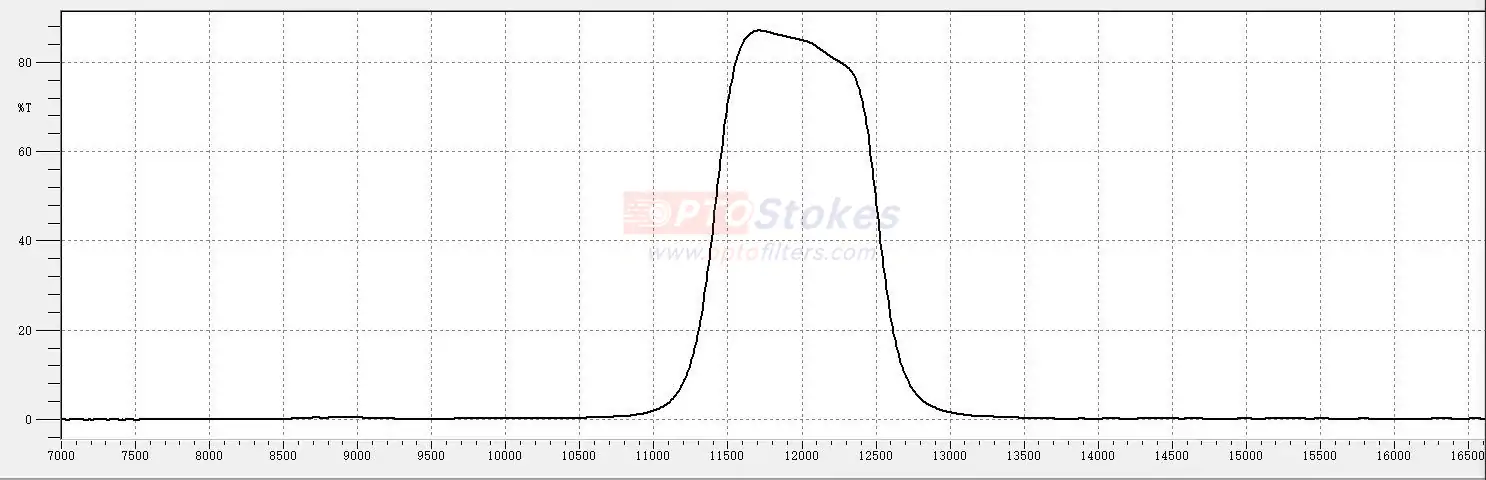
Our OPTOStokes BP12000nm bandpass filter is specifically designed for long wave infrared high-precision temperature measurement scenarios. The center wavelength of 12000nm maintains high transmittance in the target band, while effectively blocking stray signals within the range of 7000-16500nm. In order to reduce the interference of non target infrared radiation on temperature sensors and help devices obtain more stable and accurate temperature readings.
Core technical specifications
| Parameter item | Indicator Description |
|---|---|
| Center wavelength (CWL) | 12000nm ± 50nm, transmittance T>80% |
| Half width at half maximum (FWHM) | 1000nm ±100nm |
| Blocking range | 7000nm-16500nm,OD>2 |
Main application scenarios: high-precision industrial temperature measurement scenarios
Previously encountered scenario case: A non-contact temperature measurement device at an industrial site needs to avoid background infrared interference of 7-11 μ m in the environment and accurately collect target radiation signals near 12 μ m. The conventional wideband long wave infrared window cannot distinguish between target and background radiation, and the temperature measurement results fluctuate greatly. When using this BP12000nm bandpass filter, it can limit the effective response to the core range of 11500nm-12500nm, significantly reducing the impact of stray light. Before use, it is recommended to verify the maximum temperature rise of the actual working environment of the equipment and confirm the spectral stability of the filter substrate at the corresponding temperature.
What are the common selection misconceptions for infrared filters?
Many engineers only focus on the central wavelength index when selecting, ignoring the actual incident angle AOI of the filter. When the filter is installed from 0 ° normal incidence to oblique incidence, the center wavelength will undergo a blue shift, and the originally nominal transmission peak of 12000nm may shift to 11700nm or even lower, resulting in insufficient transmittance of the target band and a significant decrease in temperature sensitivity. The correct verification method is to clarify the actual installation angle of the optical path before selection, confirm the measured spectral curve at this angle with the supplier, and avoid placing an order directly based on the 0 ° incident parameter.
Customization and Service Support
In addition to standard circular specifications, we can provide precision machining of irregular sizes such as square and rectangle, and also support the option of matching with a set of snap rings for easy integration into existing temperature measurement equipment optical paths. As a=“ https://www.optofilters.com/tags/ Band Pass Filter ">Band Pass Filteris a member of the product line. This product relies on mature coating technology to ensure batch spectral consistency, and can also be used with otherInfrared optical componentsare selected for matching to reduce the communication cost of optical path matching. If there are special spectral index requirements, they can also be submitted through customized coating channels.
If you are confirming the installation dimensions, incident angle adaptation, batch delivery cycle, and other details of this filter, you can organize the target wavelength, actual optical path incident angle, aperture requirements, and purchase quantity, and send them to sales@optofilters.com Obtain technical evaluation and quotation.
Tags: infrared filter Infrared bandpass filter 12000Nm filter